What a turning wheel actually does
Drive straight across paving and the load rolls: the contact patch moves forward and the surface takes a vertical push. Turn the wheel while the vehicle is barely moving and the load scrubs instead. The tire twists on the spot and the paving takes a horizontal shear the open drive never sees, on every entry and every exit, concentrated into the same few square yards.
It is the scrubbing, not the axle weight, that opens joints and works units loose. The whole apron detail follows from that: the bed must resist sideways movement, the joint must stay filled, and the edge must be held against creep toward the road.
Where the apron sits on an Aruban plot
The apron is the piece between the public road and the gate or property line, and it does more than mark a boundary. It is where a road built for traffic meets a drive built for a household, and where the vehicle changes direction. The range of entrances is wide: villa plots at Noord and along Malmok, service entries behind the Palm Beach and Eagle Beach hotel corridor, commercial forecourts in Oranjestad. Different buildings, same few square yards doing the hardest work on site.
Bound or unbound, and why it decides everything
The first decision is whether the setts sit on a flexible construction or a bound one, and on an apron the answer is not always the one used behind the gate.
- Flexible construction on a sand bed suits pedestrian areas and light, straight-line vehicle movement, but it moves under repeated turning.
- Bound construction, with setts bedded and jointed in mortar over a concrete slab, resists shear and is the safer answer where wheels turn on the spot.
- Ready-mix and crushed aggregate from the island supply that base course; the imported stone is only the layer that takes the wear.
- Keep the build-up consistent across the whole apron, because a bound-to-unbound change under a turning wheel becomes a crack line.
Depth, joint width and course direction
Once the base is settled, the units have to suit the duty rather than the terrace they match.
- Go thicker than the terrace specification, because vehicle areas want more stone in the unit rather than a bigger face.
- Keep the face size modest, since smaller units spread the shear across more joints and interlock better than large ones.
- Course across the direction of travel, so wheels cross joints instead of running along them.
- Keep the joint narrow and consistent, because a wide joint under a turning tire is a joint waiting to empty.
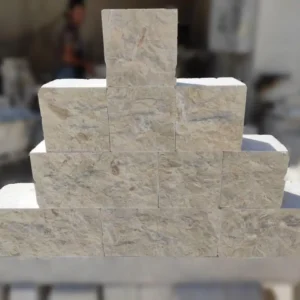
Depths and face sizes are worth fixing before quantities are ordered, and apron-duty cobblestone in stock depths is the practical starting point when an entrance has to take real vehicles rather than occasional ones.
Holding the edge at the road line
An apron has a free edge at the road, and a free edge under turning traffic will creep. Restraint there is not optional.
- A concrete haunch, a curbstone line or a cast edge beam gives the courses something solid to close against.
- Get the restraint in place and cured before the field of setts is laid, because restraint added afterward rarely holds.
- Restrain the gate line too, and any point where the apron meets a softer construction.
- Treat a drainage channel crossing the entrance as part of the restraint, detailed to the same standard as the road line.
Salt film and blown grit on a working apron
Aruba’s exposure is unusual, and it works in the buyer’s favor as often as against it. The island sits below the main Atlantic hurricane track, so there is no storm season to build around. What replaces it is constant: trade winds carrying salt off the sea and fine abrasive dust off dry ground, all year.
- Salt film settles and dries, so regular rinsing keeps it from building up in the joint and at the unit edge.
- Blown grit acts as a mild abrasive under tires, which dulls an apron faster than it dulls a terrace.
- Pick a face texture that keeps its grip as it wears rather than one relying on a shallow surface treatment.
- Expect to top up jointing at the road edge; that is maintenance, not failure.
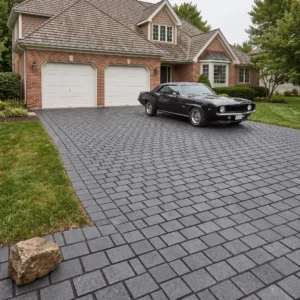
Where the wear is genuinely heavy, dark basalt for Aruban driveways gives a denser unit that carries dust film less visibly than a pale stone, and it can take the apron alone while lighter paving carries the terrace behind the gate.
Ordering, Barcadera and the border line
Aruba’s cargo port is Barcadera, which took the role when it opened on 12 April 2016; Oranjestad now works cruise and passenger traffic. Put Barcadera on the bill of lading. At the border, turnover tax has been collected since 1 August 2023 at a combined 7 percent, made up of BBO at 2.5, BAVP at 1.5 and BAZV at 3, while customs duty runs roughly 2 to 22 percent depending on the product line, so confirm the classification with your broker. Value is worked out on a CIF basis, and where freight and insurance are not itemized separately Aruba Customs applies a 16.5 percent uplift to invoice value on shipments from the Americas. Splitting them out is a small piece of paperwork with a real number attached.
An apron that stays put
An apron is a small area with an outsized failure rate, for one reason: it takes a load nothing else on the site takes. Specify it as a structure, restrain it properly, and choose a unit with enough stone to resist a twisting wheel. Get the apron right and the rest of the drive looks after itself.