Where the Apron Earns Its Keep
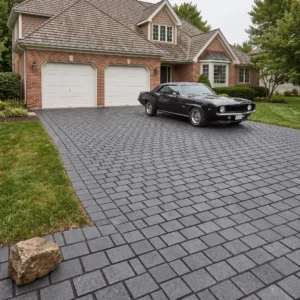
Every villa on this island meets the road somewhere, and that meeting point is usually a few square yards of paving doing several jobs at once. It carries the turn in and the turn out. It takes the delivery truck, the concrete truck during construction, and the loaded van that reverses in because there is nowhere else to go. It also has to look composed enough to be the first thing a guest sees. On a property at Rendezvous Bay or Barnes Bay that is a lot of expectation for a small area.
What a Turning Wheel Actually Does
A wheel rolling forward loads paving vertically, which most surfaces handle. A wheel turning while nearly stationary does something else: it applies torque at the contact patch and tries to twist the units out of the plane. Large-format paving resists that with its own weight and then fails at an edge. Small units resist it as a field, because each one is braced by its neighbors on all sides and the load spreads through the joints instead of concentrating at a corner.
- Point loads from a jack or a laden axle sit on one or two units, not a whole slab
- Torque is shared across a bonded pattern rather than levered at a long edge
- A damaged unit is lifted and swapped without disturbing the surrounding field
- Falls and crossfalls can be worked into the coursing without cutting large pieces
Format and Depth for Vehicle Duty
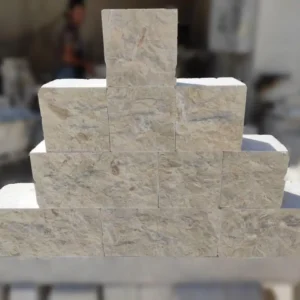
Aprons want a deeper unit than a terrace, and a squarer one. A long, thin sett laid across a turning path presents a weak axis; a chunkier cube-ish format simply has more stone under the wheel. Interlock comes from the ratio of depth to face size, so the practical rule is that as the traffic gets heavier, the face gets smaller and the depth grows.
- Reserve the shallowest formats for foot traffic and courtyard work only
- Step up a depth class where a truck or a service vehicle turns regularly
- Keep face dimensions modest so the pattern does the interlocking work
- Sort units on arrival so depth stays consistent within each laid panel
The Bed Under a Working Apron
This is where aprons are won or lost. An unbound bed is fine for a walked terrace and a poor idea under a turning vehicle, because the bedding layer migrates under repeated torque and the surface can go hollow in the turning arc over time. For vehicle duty, setts under turning vehicles belong on a bound bed over a properly formed concrete base, with full jointing rather than a swept-in filler. It costs more on day one and it is the reason the apron keeps reading true under repeated truck traffic.
Edges Are Where Aprons Fail First
Watch any failed apron and the story starts at the perimeter. A wheel clips the outer course, the restraint moves a fraction, and from then on every vehicle widens the gap. A continuous restraint element resists that in a way a haunch of mortar behind the last course never will, which is why edgings that frame the apron are worth specifying at the same time as the field, not after the field is priced.
- Restrain every free edge, including the one that meets loose gravel or planting
- Set the restraint before the field so the coursing is laid to a fixed line
- Bed and haunch the edge units continuously rather than in spot dabs
- Give the road junction the strongest detail on the whole apron
Joints, Heat and Salt
The island is barely three miles wide, so wind-borne salt reaches every property, not only the ones on the sand. Long dry spells let salt concentrate in a surface, then an intense downpour dissolves and moves it. That cycle is the durability stress worth designing against, and joints are where it plays out. Full, well-compacted joints leave nothing for the salt to sit in and nothing for a tire to pluck out.
- Fill joints completely rather than topping up a swept surface later
- Check the jointing after the first heavy rain, while any loss is still local
- Choose a dense, low-absorption unit so salt cycling stays at the surface
- Wash the apron down after a long dry spell rather than waiting for the storm to do it
Building Back With Resilience in Mind
Building conversations on this island are still shaped by September 2017. Irma changed how people specify, and rightly so. Nobody here pretends a surface can be made immune to a storm, but an apron detailed for resilience behaves well in a bad season: it does not float, it does not become debris, and where wind-driven water scours a margin the repair stays local. Work to the Anguilla Building Code and to your engineer’s details, and treat the apron as part of the storm-water route rather than a decorative afterthought.
Ordering and Clearing a Consignment
Apron stone is a small quantity with a long lead, which is an awkward combination. Cargo reaches Road Bay at Sandy Ground, often after a hub port call and a short feeder crossing, so the crates are handled twice and should be built for it. Clearance runs through Anguilla Customs on ASYCUDA World, usually via a registered broker, with duty charged on CIF value; a nine percent Import Goods Tax has applied to CIF at the port since the first of August 2025, and your broker will confirm the duty line for the specific classification. Get the apron specified early, because it is the one piece of paving every visitor drives over.