The Tariff Anguilla Actually Uses
Anguilla is a British Overseas Territory with internal self-government, and an associate member of both CARICOM and the OECS. That associate status carries one consequence which matters more than any other to an importer: the CARICOM Common External Tariff does not govern Anguilla. The island runs its own HS-based schedule, assessed ad valorem on the CIF value of the goods under the Integrated Customs Tariff Regulations 2007. If a supplier quotes you a CET rate for a stone product, they are quoting a different country’s schedule and the figure in your budget is wrong before you start.
What Changed at the Port in 2025
Goods and services tax arrived in Anguilla on 1 July 2022 at 13%, charged on the value of imports. From 1 August 2025 the Government repealed that charge at the port and replaced it with a 9% Import Goods Tax on the CIF value of imported goods, while a 13% General Services Tax now applies to services. Essential non-confectionery food items remain exempt.
So any quote, spreadsheet or web page still carrying “13% GST on imports” is out of date. For goods crossing the quay today the position is a 9% Import Goods Tax on CIF, sitting on top of customs duty.
CIF Is the Base, Not Your Invoice
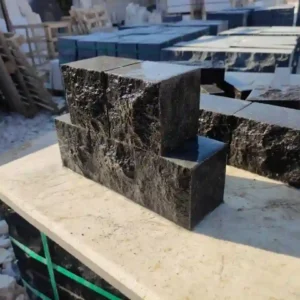
Duty and the Import Goods Tax are both calculated on CIF value, and that catches out more budgets than the rates themselves ever do. CIF is the cost of the goods plus insurance plus freight to the port of import, so every dollar of freight is also a dollar that gets taxed. The same arithmetic applies to every format in the paving range we ship, whatever the invoice line happens to say.
- The value of the stone itself, as invoiced by the supplier.
- Freight to the port of import, including the leg that carries the load across to Road Bay.
- Insurance covering the consignment for that whole journey.
- Any charge the declaration properly attributes to landing the goods rather than to work performed afterward.
- Nothing that happens after clearance: haulage to the plot, site handling and laying all sit outside the CIF base.
The Numbers We Will Not Print
There is a specific duty line for cut and dressed stone in Anguilla’s schedule and we are not going to publish it here. The rate applied depends on how your goods actually classify, and classification is the broker’s job with the real invoice in front of them. The Customs Service Charge has likewise been cited at different levels depending on the measure in force, so confirm the current rate with your broker rather than trusting a percentage on any supplier’s website, ours included. A wrong number in a client budget is worse than a blank you have to go and fill.
Clearing Through ASYCUDA World
Commercial consignments clear through Anguilla Customs’ ASYCUDA World system, normally via a registered broker. Brokers create and submit declarations for importers and must register with the Comptroller before they can act. A simplified declaration route exists for small non-commercial imports with only a handful of classification lines; a villa paving order is far above it and needs a full declaration.
- Appoint the broker before the goods sail, not once they are standing on the quay.
- Hand over commercial invoice, packing list, weights and bill of lading as one package.
- Make sure the invoice description matches the goods closely enough to classify without guesswork.
- Ask in writing which charges beyond duty and the Import Goods Tax will apply to this consignment.
- Agree who carries quay charges and storage if the load waits, because that clock starts quickly.
Currency, Quotes and the Peg
The Eastern Caribbean dollar is Anguilla’s official currency, pegged at EC$2.70 to US$1, and US dollars are widely accepted. Luxury villa work on the island is generally priced and discussed in US dollars, which removes a variable that complicates budgeting in floating-rate markets elsewhere. A US-sourced stone package therefore lands in the currency the rest of the build is already speaking, and the conversion, where it appears at all, is arithmetic rather than exposure.
Putting the Tax Line Into a Villa Budget
Landed cost is a stack, not a price. Building it in the right order is what lets a landscape architect defend the specification when the quantity surveyor asks why the stone line moved. If you want a sense of where our supply sits before the stack is applied, where our price ranges sit is the honest starting point, and everything below is added to it.
- Ex-works value of the stone, by format and finish, at the quantity you are actually buying.
- Ocean freight and insurance to the port of import, which together complete the CIF figure.
- Customs duty at the classified rate, applied to CIF.
- The 9% Import Goods Tax, also applied to CIF.
- Brokerage, quay handling, haulage to the plot and the site handling nobody remembers to price.
Where the Costing Usually Goes Wrong
The places an Anguilla paving budget can come apart are predictable, and none of them are the stone.
- Carrying the repealed 13% import figure instead of the current 9% Import Goods Tax.
- Applying a CARICOM CET rate that does not govern this island at all.
- Taxing the invoice value only, and forgetting that freight and insurance sit inside CIF.
- Leaving the feeder leg, brokerage and quay handling out of the sheet entirely.
Get the mechanism right and the landed number becomes something you can defend line by line.