The Barefoot Test at Midday
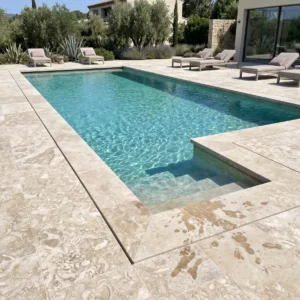
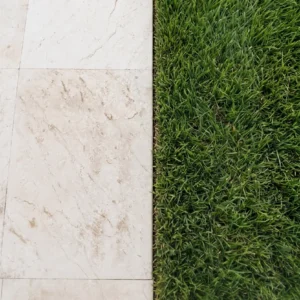
Nobody reads a datasheet on the way out of a pool. They step onto the deck, and within two paces the material has either passed or failed. Around Cap Estate, Rodney Bay and the villa market that keeps them busy, that single moment decides more repeat orders than any technical claim on paper. Pale stone helps, because a lighter surface reflects more of the sun rather than storing it and handing it back through the afternoon. But tone on its own is a partial answer, and treating it as the whole answer is how a beautiful terrace ends up unusable between eleven and three, with everyone crowded onto the one shaded strip at the edge.
Tone Is Only Half the Story
Several things push surface temperature around, and material color is only one of them.
- Finish depth, because a textured face holds thin shadow and reads cooler than a flat, closed surface.
- Thickness and mass, since a heavier unit takes longer to warm and longer to give the heat back.
- What sits underneath, as a slab bedded over dark, sealed material behaves differently from one over open aggregate.
- Air movement, which on the leeward coast can be far gentler than people expect in a sheltered courtyard.
- Hours of direct exposure, which a pergola or a well-placed tree changes more cheaply than any material swap.
Glare Is the Other Complaint
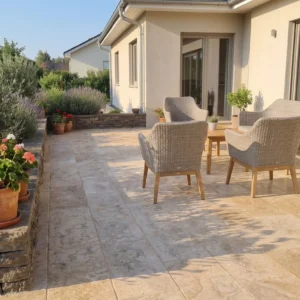
Heat gets discussed; glare gets endured. A very pale terrace under a high Caribbean sun can be genuinely hard to look at, and the fix is texture rather than a darker stone. Bush-hammered, sandblasted and tumbled faces break the light into small scattered points instead of throwing a flat sheet of it back at the eye. That is why texture choices that scatter glare deserve as much attention as tone when you are choosing paving for an open deck with no shade above it.
Texture pays twice, which is what makes it the easiest decision on the list. The same broken surface that softens reflected light also gives wet feet something to hold on to, so a single choice improves both comfort and safety. A closed, flat face does the reverse on both counts, looking sharp in a showroom and disappointing on an exposed Caribbean terrace in July.
Where Heat Actually Bites
Not every part of a project needs the same treatment, and spreading the budget evenly across a scheme usually wastes it.
- Pool copings and the first two rows of deck, where wet feet meet the hottest strip of the day.
- Open roof terraces with no planting and no shade structure at all above them.
- West-facing frontage that takes the long afternoon sun off the Caribbean side.
- Steps and thresholds, where people pause and stand rather than walking straight through.
Shade and Water Beat Material Every Time
A cool material in full sun still gets warm. A moderately cool material in dappled shade stays comfortable all day. Specify the shade strategy alongside the paving and you can be far less anxious about the material itself, which usually frees up budget for a better finish or a thicker unit where traffic is heaviest. These moves cost less than a material upgrade and work harder.
- Planting that throws dappled shade across the busiest stretch of deck by late morning.
- A pergola or deep overhang above the route people take between water and seating.
- A rinse shower at the deck edge, which cools both the feet and the stone around it.
- Open jointing that lets a hose wash straight through instead of pooling on the surface.
- A shaded landing halfway along any long flight of exposed steps.
Quiet Choices Near the Pitons
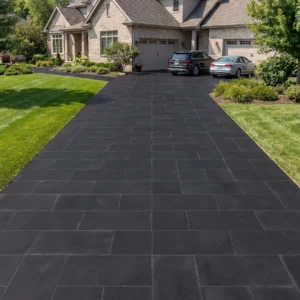
The Pitons Management Area near Soufriere covers roughly 2,909 hectares and carries World Heritage status, with a green buffer zone and an active monitoring file that has repeatedly flagged intrusive building. Any hardscape in that part of the island is looked at closely, and nothing gets built there without going through the Development Control Authority. In practice that argues for restrained, low-reflectance, naturalistic surfaces that settle into the landscape rather than bright expanses that announce themselves from a distance. It is a design constraint worth respecting on its own terms, not a box to be ticked late in the process.
The same instinct serves projects elsewhere on the island. Anse Chastanet, Jade Mountain and Ladera are all built around Piton and hillside views rather than around what sits underfoot, and clients arriving with those references in mind will not thank you for a deck that glows white from the road below. Muted tone, textured face and generous planting usually deliver both the cooler surface and the quieter view.
Formats, Finishes and Ordering
Once tone and texture are settled, the practical decisions are format and supply. Larger units mean fewer joints and a calmer visual field, though they need a flatter bed and more careful handling on a steep site. Smaller units follow curves and falls more forgivingly, which matters on hillside terraces above the west coast road. Ask for calibration tolerance in writing, and get a hand sample onto the actual deck before the order is placed, because paler paving that stays cooler still has to be judged in the light it will live in. Stock arrives by sea into Castries or Vieux Fort, and landed cost should include VAT at 12.5 percent, the 6 percent service charge and the 2.5 percent Health and Citizen Security Levy. Test the stone in full sun on the site itself, and the barefoot argument settles itself.