The Storm Everyone Remembers Was a Water Event
Hurricane Tomas crossed Saint Lucia on 30 October 2010 as a Category 2 system, the latest-in-the-year Atlantic hurricane on record to strike the Windward Islands. It brought as much as 668 mm of rain, roughly twenty-six inches, in about twenty-three hours. Eight people died here, and total damage and loss reached US$336.2 million, equivalent to 43.4% of that year’s gross domestic product.
The detail that matters for anyone specifying hardscape is what actually did the damage. Most of the destruction came not from wind or from flooding on the flat, but from landslides that cut roads, destroyed bridges and washed away river banks. Rainfall intensity, not gust speed, is the design driver here.
The Windward East Coast
The Atlantic side, through Dennery and Micoud and the coast between them, takes the weather first. Rain arrives driven rather than falling, swell works the shoreline continuously, and salt is carried inland on the wind rather than only splashed on the frontage.
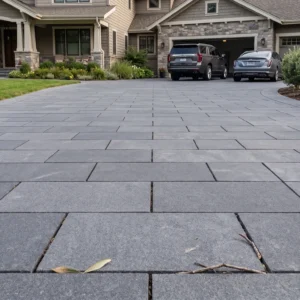
Paving here should be dense and low in absorption, textured rather than smooth, and detailed so water leaves the surface quickly instead of standing in joints. Fixings, restraints and any metalwork associated with the paving deserve the same scrutiny as the stone itself.
- Favor dense, low-absorption stone over open, porous material
- Texture every walking surface rather than only the pool surround
- Keep joints tight and shed water fast instead of holding it
- Specify corrosion-resistant fixings for anything mechanically held
- Plan for rinsing salt off exposed frontage after heavy weather
The Leeward West and the Developed North
The west coast, through Castries, Marigot Bay and down toward Soufriere, is calmer water and gentler wind, but it is not a soft exposure. The developed north around Gros Islet, Rodney Bay, Reduit, Pigeon Island and Cap Estate sits close to open water with steady salt-laden air across terraces and pool decks.
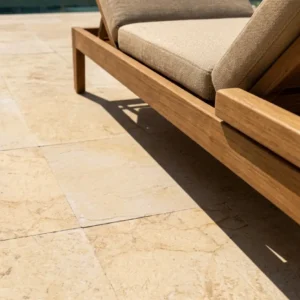
Density and low porosity still matter in these zones because salt works into an open-textured stone and stays there. Pale stone is the usual choice for terraces and pool surrounds because it runs cooler underfoot in strong sun, and it shows salt bloom less readily than a dark unit.
Slopes, Substrate and the Ground Below
Saint Lucia is steep volcanic country, and most attractive building plots sit on or above a slope. Saturated ground on a gradient is where the real risk lives, and paving contributes to that risk whenever it concentrates water and discharges it somewhere careless.
- Intercept surface water above the paving, not only at its lower edge
- Discharge into something engineered rather than onto the slope below
- Compact and drain the sub-base, using locally supplied crushed aggregate
- Restrain edges so sheet flow cannot undermine the outer course
- Have slope stability assessed by an engineer where the fall is significant
Drainage Detailing That Earns Its Keep
Design the surface for the worst hour rather than the average month. That means positive falls everywhere, generous outlets, and jointing that either sheds water quickly or lets it through deliberately.
- Positive falls set out on the drawing, not left to the laying crew
- Open-graded bedding where the design intends water to pass through
- Channels and gullies sized for intense rain rather than light showers
- Access points that can actually be cleared of leaf litter and grit
- A checked route for water from the highest point to a safe discharge
Getting paving chosen for rainfall loads right at drawing stage costs nothing; correcting it after a wet season costs a terrace.
Finish Choice for Driving Rain
In a warm, wet climate a polished exterior surface is the wrong answer. Water sits on it, biological growth colonizes it, and it becomes slick exactly when someone is hurrying in from the rain. Bush-hammered, sandblasted, flamed and tumbled surfaces all give the foot something to work with.
- Bush-hammered for open terraces that take strong sun and hard rain
- Sandblasted where an even, quiet texture suits the architecture
- Flamed for a coarser grip on ramps and sloping approaches
- Tumbled where softened edges suit older or rustic buildings
Texture also disguises the fine grit that washes across paving during heavy rain, so surfaces stay presentable between cleans. Compare textured finishes for driving rain before you commit a large exterior area to one surface treatment.
Working Near the Pitons
The Pitons Management Area near Soufriere covers 2,909 hectares and is an inscribed World Heritage Site with a green buffer zone, and development within and around it is closely watched. UNESCO has repeatedly raised concerns about intrusive building and about enforcement.
If you are working anywhere in that landscape, plan for scrutiny. Secure consent through the Development Control Authority, keep material choices quiet, low in reflectance and naturalistic, and treat the setting as something to sit within rather than something to build over.
Before the Season Arrives
Hardscape work is easiest to get right in the dry months and hardest to correct in the wet ones. Order early enough that crates are on site and the base is complete before intense rain arrives, and sequence the work so no area is left part-bedded through a storm.
Design under the OECS Building Code with your engineer, keep the drainage drawing as detailed as the paving layout, and remember that the base course beneath your stone matters as much as the stone. Water is the design case in Saint Lucia, and paving that respects it survives everything else.