Costa Rica’s surf towns are a national institution: Jacó an hour from the capital, Santa Teresa at the Nicoya tip where the sand road is the main street, Playa Hermosa’s serious waves, Pavones’ legendary left in the far south. Each runs the same barefoot economy – dawn patrol, board racks, smoothie counters, beach bars at sunset – and each builds to a register the surf itself wrote: sandy, salty, casual on the surface and surprisingly demanding underneath. This is the sand-street brief, from the beach path to the bar floor.
The Sand-Street Register
The surf town’s streets are part of its product – unpaved by economics or by choice, walked barefoot, shared by quads, scooters and the town dog – and premises meet them with the gentle-threshold craft: stone aprons where gates and storefronts meet the sand, textures kind to bare soles, edges low and rounded, and rinse points wherever the beach walks in. The register runs deliberately informal; the engineering under it does not. sand-street logistics at village scale maps the same balance on an island that made it a philosophy.
Board Traffic
Surfboards shape the town’s circulation the way tanks shape a dive island’s:
- Paths and gateways run board-width – three meters swings a longboard without casualties.
- Rack areas floor in textured stone with drainage; boards drip and wax drops, daily.
- Outdoor showers at every surf lodge run family-edition generous: boards and bodies rinse in sequence.
- Wax residue is the register’s special enemy – textured surfaces hide it, and a hot-water wash lifts it on schedule.
The Beach Bar Floor
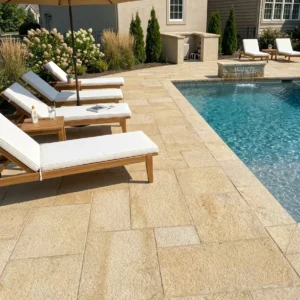
The surf town’s social peak is the sunset bar – sandy feet, board shorts, the day’s stories – and its floor runs the beach-club canon in flip-flops: dense pale stone textured for wet sandy traffic, falls that carry the nightly hose-down, thresholds that release sand to the broom, and lighting that turns the same surface from smoothie counter to evening venue. The economics are serious under the informality: the bar is often the town’s highest-earning floor per meter, and its stone is specified like it.
Surf Lodges and Camps
The accommodation register runs from hostel to boutique surf lodge, and the stone brief scales with it: camps need indestructible working surfaces – board yards, communal kitchens’ spill-proof floors, shower courts at volume; boutique lodges add the wellness layer – yoga decks at platform standard, pool terraces at the family grade, massage pavilions in spa textures. Both ends share the turnover reality of surf-week bookings and the barefoot standard throughout, which conveniently is the same pale textured specification from one batch.
The Tide Clock
Surf towns run on the tide chart, not the office clock – dawn sessions, midday rest, evening gatherings – and their surfaces serve the rhythm: paths legible at first light, shade generous for the midday off-hours, bar and terrace floors ready for the evening peak, and everything hosed and reset before tomorrow’s dawn patrol. The maintenance rhythm rides the same chart; the quiet mid-morning is the washdown’s hour, and the specification that dries fast keeps the town’s schedule.
Growth on the Sand
The surf towns are growing fast – Santa Teresa most famously – and the growth strains exactly what made them: roads, water, the casual scale. Building well amid the boom means the small-town manners at surf pace: consolidated deliveries that spare the one road, dust control on the dry-season streets, water discipline in the districts where supply runs tight, and projects scaled to the town rather than imported over it. The towns keep score the way surf line-ups do – reputation travels instantly, and locals remember who dropped in on whom.
The Jacó Corridor
Jacó runs the register at urban intensity – the closest surf town to the capital, condo towers behind the beach, a genuine commercial strip – and its stone brief blends surf-town informality with city standards: storefront thresholds at commercial grade, pool decks serving tower populations, boardwalk-scale public surfaces, and the corridor’s rental economy enforcing the turnover disciplines building-wide. The corridor proves the register scales; the specification simply gains the commercial clauses as the buildings gain floors.
The Dawn Patrol Threshold
The surf town’s day begins in the dark: dawn patrol moves through gates and gear rooms before five, boards shouldered, wax pocketed, nobody fully awake. Properties that host surfers specify for the hour – gear staging by the gate so the departure is silent, path lighting at the low warm setting that spares sleeping housemates, textured stone underfoot because dew makes everything treacherous at that hour, and the gate hardware chosen to close quietly behind the last board out. The same threshold works the day’s other end: boards racked, feet rinsed, the sunset session’s sand released at the apron before the house begins. The dawn threshold is four square meters of specification that surf guests notice within a day – and mention in every review that follows.
The Line-Up’s Standard
The surf town asks its surfaces for what it asks its regulars: show up daily, handle the salt and the sand, stay casual under pressure. Pale textured stone answers on all counts, from the board yard to the sunset floor – and the corridor-scale version of the same beach-strip economics is mapped in a beach-strip corridor’s playbook one country north. Build to the tide clock and the barefoot standard, and the surf town’s ground works like its best line-up: everyone gets their wave, every day, without drama.
The Flat-Day Economy
Every surf town runs a second economy for the days the ocean declines to perform: the flat spell’s roster of skate bowls, gyms, yoga classes, pool sessions and the café hours where forecasts are argued.
- Pool terraces absorb the flat day’s displaced energy – the surf lodge’s pool works hardest when the waves do not.
- Skate and workout zones floor at working grade beside the board yards, sharing the drainage and the hose.
- Café and juice-bar floors take the all-day occupation the good swell never allows.
- Shade becomes the flat day’s premium; the towns’ midday sun does not flatten with the sea.
Properties that program the flat day keep their guests – and their reviews – through the forecast’s disappointments, and the stone that serves the second economy is the same pale textured family working its usual shifts. The ocean sets the schedule everywhere in a surf town; the flat-day design simply refuses to let the schedule ruin the week.
Sand is the material everyone forgets to specify for
In a surf town the sand does not stay on the beach. It arrives on feet, on boards, in bags and on the wind, it works into every joint, and it behaves like a mild abrasive underfoot. Surfaces that rely on a delicate texture for grip lose it as they polish, and joints that are too open collect grit and never look clean again. The practical answer is a robust, cleanable texture and a joint detail chosen with a broom in mind, right through from the road frontage to the bathroom threshold.
- Textures that keep grip with sand on them, not only when swept
- Joints tight enough to sweep and open enough to drain
- Thresholds detailed level so grit does not collect at a step
- A designated rinse and board-wash point away from walking lines
- Entrance transition zones designed in rather than laid over later
Wet feet, all day, every day
The circulation pattern in these towns is relentless: beach, shower, terrace, kitchen, back to the beach, from first light until after dark. Grip is therefore the governing criterion rather than a box to tick. The work behind frictional testing of natural stone walking surfaces describes the ANSI A326.3 wet method and a benchmark dynamic coefficient of friction of at least 0.42 for level interior floors expected to be walked on wet. A surf house threshold crossed wet and sandy sits well past that reference, and the sensible response is to test the delivered finish and specify above the minimum. The same logic runs through pool decks on both coasts, where the wet condition is the design condition rather than an exception.
- Wet values requested on the exact finish supplied
- Extra margin at every step, ramp and shower surround
- One texture from street frontage through to interior floor
- Outdoor shower drainage taken clear of the route back inside
The wet season decides the works calendar
Most of these towns sit on unpaved or partly paved roads, which turn quickly once the rain arrives. The climatology published by the National Hurricane Center runs the Atlantic season from June through November with a peak on September 10, and although this coast sits outside the main track density, the same months bring the rain that closes access and softens every delivery route.
- Bulk deliveries landed before the roads deteriorate
- Groundworks and external hard landscaping front-loaded into the dry months
- Pallet weights matched to the smallest vehicle that can reach the plot
- A dry, secure lay-down point established before the first load
Choosing surf town stone that suits a house with no front door
These buildings are open by design, so inside and outside share one climate and should share one specification. A single material carried through, laid on a build-up that tolerates sand and can be lifted for repair, is worth more than any change of finish at a threshold.
- One material family carried across inside and outside
- Granular bedding that tolerates sand migration
- Continuous edge restraint where paving meets loose ground
- Spare stock held on site, since the road may be closed when you need it
Our Costa Rica stone supply guide sets out the formats, finishes and lead times that suit this country. Assume the sand gets everywhere, because it does.