Placencia is a ribbon: sixteen miles of peninsula with the Caribbean on one side, a lagoon on the other, and in places only a few hundred meters between them. The road down the spine was paved within living memory, and the build wave that followed it – boutique resorts at Maya Beach, village guesthouses in Placencia proper, homes in between – is still running. Stone work on the peninsula answers to that geography: every site is a beach site and a lagoon site at once.
Two Shores, One Lot
A peninsula lot often runs water to water. The sea side takes wave energy, salt spray and the view; the lagoon side takes still water, mangrove margins and the mosquito hour. Hard landscaping splits accordingly: durable, salt-dense paving and steps on the sea face, and calmer terraces, docks and outdoor rooms on the lagoon face where the evening is actually spent. Specifying both faces from one material family keeps the lot coherent.
Sidewalk Manners in the Village
Placencia village is organized around its famous pedestrian sidewalk, and building beside it comes with unwritten rules:
- Construction traffic works from the road side, never along the sidewalk itself.
- Deliveries stage in yards and cross the pedestrian line quickly – the sidewalk is the village living room.
- Entrances that meet the sidewalk get the best stone in the job: this is the facade the whole village reads.
- Dust and cut-water are controlled; wet-cutting beside the walkway on a breezy day makes enemies fast.
The Maya Beach Standard
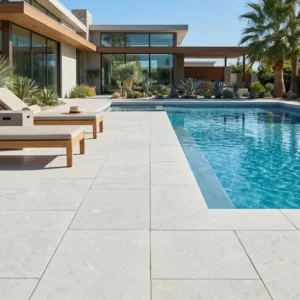
North of the village, the resort strip has settled into a recognisable standard: pale stone terraces to the pool line, timber over water, planting in between. Guests arrive from cold countries expecting barefoot comfort, so the pool-deck logic – light tones, textured finish, rounded edges – governs. What separates the good operators is maintenance: the strip’s best terraces are rinsed, swept and re-sanded on a calendar, and they read years younger than their neighbors. building beach paths that last covers the sand-edge detailing that every seafront lot here eventually needs.
The Big Creek Advantage
Placencia holds a quiet freight card: Big Creek, the country’s southern port, sits directly across the lagoon. Cargo that clears there crosses to the peninsula in a short hop rather than riding the highway from Belize City. For heavy materials that changes the arithmetic – less road time, less handling, and a delivery window the builder controls more tightly. Confirm with the freight agent which port the consignment routes through; for southern jobs the answer shapes the whole schedule.
Storm Honesty on a Ribbon
A peninsula this narrow does not pretend about storms. Hard landscaping is the part of the property that shrugs off a hurricane: stone terraces and walls do not blow away, and after the 2001 storm that struck this coast, masonry and paving were what remained to rebuild around. Detail for it – paving bedded to drain fast, walls engineered to code, nothing loose that the wind can lift – and the stone becomes the durable spine of the lot.
Ordering for the Strip
The peninsula build cadence rewards one discipline above all: complete consignments.
- Combine terrace, pool, path and entrance stone into a single order and clearance.
- Confirm the routing – Belize City or Big Creek – before the sailing, not after.
- Stage pallets off the sand on dunnage; a wet-season lagoon lot swallows anything laid flat.
- Hold five percent attic stock; the strip’s salt and traffic will eventually claim a piece or two.
The Long Game on a Narrow Strip
Placencia rewards builders who respect its scale – village manners at the sidewalk, resort polish at the pool line, storm honesty everywhere. The freight chapter behind every peninsula job is walked step by step in the Belize freight walkthrough, from sailing to barge to site. Build the strip as a ribbon between two waters and the stone work will still look deliberate when the next paving cycle reaches it.
The Lagoon Room: The Peninsula’s Quiet Side
The sea face gets the brochure, but peninsula residents live on the lagoon side – flat water, mangrove birdlife, sunsets over the Maya Mountains. The outdoor room that faces it is the property’s most-used space: a stone terrace at dock level, shaded by late afternoon, close enough to the water that the pelicans become furniture. Detailing is gentler than the sea side but not casual.
- Falls still shed the wet season, even on the calm shore – pooling water breeds the evening’s mosquitoes.
- The dock junction, where timber meets stone, needs a threshold piece that takes traffic without rocking.
- Set the terrace level a hand above the lagoon’s wet-season line; the water keeps its own calendar.
- Shade structure goes on the west edge – the sunset that sells the room also heats it.
Owners who budget the lagoon room as generously as the beachfront find it repays them nightly – it is the side of the lot where the peninsula’s slow evenings actually happen, and the stone that floors it works more hours than any surface on the sea face. Build both shores properly and the narrow lot lives twice as large.
A spit is not a coastline
Sixteen miles of sand between a lagoon and the open sea behaves differently from a mainland shore. There is no high ground to drain to, the water table sits close beneath, and the same storm can push water in from either side. Everything built here is therefore built on a landform that is still being shaped, which argues for surfaces that can be lifted, relaid and, if necessary, moved back rather than rebuilt from scratch.
- Modular formats a two-person crew can lift and reset by hand
- Granular bedding that can be reworked instead of broken out
- Continuous edge restraint, because loose sand unravels an edge quickly
- Services looped with slack so a terrace can move without a rebuild
- Falls resolved locally rather than carried across a long flat plot
One road in, one road out
The peninsula road is the whole supply chain. Every pallet, every mixer and every crew arrives along the same narrow strip, and when it is wet or busy the delivery window closes. Timing matters more here than on almost any other Belizean site, and the season is well documented: the climatology from the National Hurricane Center puts the Atlantic season from June through November, with most activity between mid-August and mid-October and the peak on September 10. Heavy deliveries belong in the first half of the year.
- Bulk materials landed before the wet months close the road
- Deliveries timed outside peak visitor traffic on a single-lane route
- A secure, dry lay-down point identified before the first pallet arrives
- Pallet weights matched to the smallest vehicle in the chain
Salt on one side, lagoon on the other
Exposure here is two-sided and constant. Sea spray reaches the front, the lagoon keeps the back humid, and nothing dries fully for long. Fixings corrode first, then bedding softens, then units rock underfoot. Guidance on detailing natural stone paving for lasting durability puts installation method alongside material selection for exactly this reason, and on a spit the method that lasts is the one built to be taken apart.
- Non-ferrous fixings throughout, with no mixed metals in contact
- Open joints that can be raked and refilled rather than sealed shut
- Low-absorption units anywhere within reach of spray
- Spare stock held on the peninsula so repairs never wait on a delivery
- An annual check of edges and thresholds written into the property calendar
Choosing placencia peninsula stone for a narrow site
The winning approach on this strip is unglamorous: one material, modest units, flexible bedding, restrained edges and a repair path a local crew can follow between guests. Our Belize stone supply guide sets out the formats, finishes and lead times that suit this country. On a sand spit the best surface is the one that can be picked up and put back a little further inland.