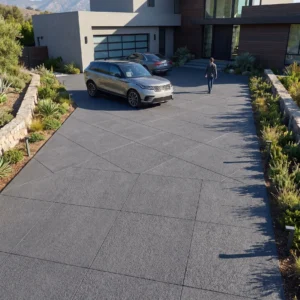
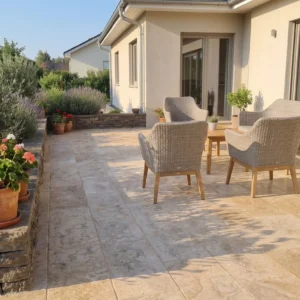
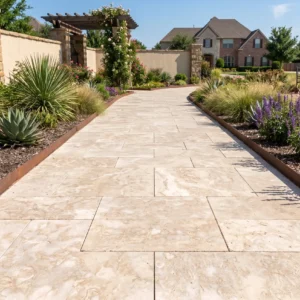
Caye Caulker’s motto is painted on signs and enforced by culture: Go Slow. The island runs at walking pace – sand streets, bicycles, golf carts, no cars – and its build culture has learned to match. Lots are small, budgets are honest, and the best properties are the ones that made a few good decisions early rather than many flashy ones late. Stone work here is modest in area and outsized in effect: an entrance path, a pool surround, a courtyard – small surfaces the whole property leans on.
The Scale of the Island
Caulker is the smaller, quieter sibling in the northern cayes, split in two at the channel everyone calls the Split. Its guesthouses and homes sit on compact lots where a single terrace is the outdoor room, not one of several. That concentrates the specification: one material chosen well, one finish that handles sun and salt, one delivery planned properly. The island rewards restraint the way bigger markets reward spectacle.
Building Without Trucks
Everything solid arrives by water and moves by cart. The practical consequences:
- Pallets land at the front pier or the back-side loading point and travel the sand streets by golf-cart trailer or hand cart.
- Order in island-scale units – smaller pallets, more of them – sized for what a cart can move without churning the street.
- Stage materials inside the lot line immediately; the street is shared space and the village notices.
- Plan lifts for early morning, before pedestrian traffic and heat arrive together.
the neighboring caye’s build playbook describes the same barge-fed rhythm at larger scale, and Caulker builders borrow from it freely.
From Backpacker to Boutique
The island’s hospitality is climbing the same curve Ambergris climbed a decade earlier: hostels adding private rooms, guesthouses adding pools, small hotels adding stone where paint used to do. The upgrade math is friendly because areas are small – a guesthouse courtyard in real limestone costs a fraction of a resort deck and lifts the nightly rate photographs immediately. The operators doing it well upgrade one surface per low season, in order of what guests touch first.
Sun, Salt and Small Surfaces
Caulker’s exposure is classic northern-caye: full sun, steady breeze, salt in the air, rain in fast bursts. Light-toned limestone with a textured finish is the default for the same reasons as everywhere on the reef – cool underfoot, grippy wet, honest in the glare. On small lots the maintenance ask is trivial: a fresh-water rinse and a sweep, minutes a week, and the stone holds its color through the season.
The Services Reality
The island runs on piped water, rain tanks and generators-plus-solar in various mixes, and small lots bury their services shallow. Before any paving goes down, walk the service lines: water runs, power conduit, septic and soak-away positions. A paved courtyard is the lid on that layer – set inspection points flush in the stone and leave spare conduit under any path, because lifting finished paving on an island with no machinery is a hand-tool job nobody enjoys.
Ordering for Caulker
The supply line is Belize City, then barge, then cart – and the order should be shaped for it:
- One consignment for the whole job: field stone, edges, steps and five percent spares.
- Confirm barge frequency to Caulker in advance; slots are fewer than to Ambergris.
- Crate for double handling – pier transfer plus cart transfer – with corner protection throughout.
- Keep spare pieces on the lot, stored flat; replacement freight for two tiles is nobody’s idea of economy.
Go Slow as a Building Standard
Go Slow turns out to be sound construction advice: decide once, order completely, install carefully, maintain lightly. Owners planning small-island premises elsewhere will recognize the pattern in small-island premises done right, where the same discipline runs a commercial operation. On Caye Caulker the properties that age best are the ones that were never in a hurry, and their stone shows it.
Burst Rain on Sand Streets
Caulker’s rain arrives in bursts – twenty loud minutes, then sun – and the island’s sand streets drink it while paved lots must shed it. The small-lot drainage plan is simple and worth doing properly, because a courtyard that ponds after every burst teaches its lesson slowly and expensively.
- Fall the courtyard toward planted or graveled ground inside the lot – never toward the street, where runoff undermines the sand at the gate.
- Size the soak-away for the burst, not the average; the island’s rain does not believe in averages.
- Set path edges slightly proud so the lot’s sand stays off the stone between sweepings.
- Keep a broom-width margin between paving and planting – the maintenance minute that saves an hour.
After the burst, a textured surface dries in minutes and grip returns immediately – one more argument for texture over polish that the island settles within a single wet season. Drainage on a small caye lot is not engineering so much as good manners toward the ground: give the water somewhere better to go than the neighbor’s gate, and the courtyard stays a courtyard through the loudest sky.
Built-In Beats Bought
The island’s best courtyards furnish themselves: a stone bench built into the boundary wall, a low table plinth that doubles as a plant stand, step edges wide enough to sit on when friends outnumber chairs. Built-in stone furniture cannot blow over, cannot be borrowed and never needs replacing – and on a small lot it frees the floor area that loose furniture would eat. One bench in the shade wall, planned at paving time, outlives every plastic chair the island has ever imported.
An island the size of its own supply chain
Caye Caulker is small enough that the delivery plan and the design are the same document. There are no trucks worth the name, the streets are sand, and the last leg of every load runs on a cart or on shoulders. That single fact rules out whole categories of specification before anyone talks about appearance: oversized formats, heavy slabs, anything needing plant to place, and anything that has to be cut on site in quantity. What works instead is a short palette of modest units, cut to list on the mainland, landed in the order it will be laid, with a documented surplus so a single breakage never costs a boat trip.
- Unit sizes and weights matched to a hand cart, not a forklift
- Cut to list before shipping so no saw runs on a sand street
- Deliveries staged in laying order, since there is nowhere to stockpile
- Consumables and fixings shipped with the stone, never ordered later
- Surplus agreed at order stage rather than chased as a part load
The reef is close enough to matter
Everything that leaves a site here reaches the water quickly. The Belize Barrier Reef Reserve System, inscribed by UNESCO in 1996 across about 96,300 hectares and seven protected areas, holds the largest barrier reef in the northern hemisphere together with atolls, several hundred sand cays, mangrove forest and lagoons supporting more than five hundred fish species and sixty-five corals. On an island a few hundred meters wide there is no buffer between a working site and that system, which makes silt control and waste handling a design decision rather than a site instruction.
- Silt screens and containment wherever ground is opened near the shore
- Cutting and washing done off island or on contained hard standing
- Offcuts, packaging and slurry removed by boat, not buried in sand
- Mangrove edges left intact unless a permit expressly allows otherwise
Choosing caye caulker stone for barefoot ground
Most of this island is walked barefoot, often wet, often carrying something. That puts grip ahead of pattern. The work behind frictional testing of natural stone walking surfaces describes the ANSI A326.3 wet method and a benchmark dynamic coefficient of friction of at least 0.42 for level interior floors expected to be walked on wet. A sandy, salty, permanently damp island sits beyond that reference case, so test the delivered finish and specify above the minimum.
- Wet-tested finishes on every route between water, terrace and door
- Textures that hold grip with sand on them rather than only when clean
- Thresholds detailed level so nobody is stepping down onto a wet edge
- Spare units stored on the island so a repair takes an hour, not a week
Our Belize stone supply guide sets out the formats, finishes and lead times that suit this country. Go slow is not only a way of life here; it is also the correct construction sequence.