On the sixth of September 2017 the strongest Atlantic landfall on record crossed Sint Maarten: Irma’s eye traversed the island at full category five, and the Caribbean’s densest tourism economy — hotels, marinas, the hub airport, tens of thousands of livelihoods on fourteen square miles — was stripped in a morning. What followed was the cluster’s hardest rebuild problem: recovering everything, everywhere, at once, with no empty land to stage from. Here is the dense-rebuild chapter.
The density problem
Sparse islands rebuild in sequence; SXM had to rebuild in parallel: the gateway itself wrecked while the region queued behind it, hotels and homes competing for the same crews and berths, debris volumes with nowhere to go on the fourteen-square-mile arithmetic, and triage discipline the resilient-nation parallel ran at national scale compressed here into urban blocks: airport first, port beside it, then the economy’s floors — because the island earns by the visitor day, and every closed month compounded.
The insurance-and-fund engine
The rebuild ran on two financial rails: insured commercial stock cycling through the insurance-backed sprint at portfolio scale, and the Dutch-financed reconstruction program rebuilding public fabric — homes, schools, the hospital, shelters — on documented standards, with the kingdom process culture governing procurement and proof. The dual engine taught the cluster’s finance lesson at record scale: the project with clean documentation rebuilt first, and the binder-to-closing discipline became survival skill rather than nicety.
- Insurance settlements that paid fast but only against what was already insured
- Trust fund and donor money that paid slower but reached public assets
- Owner capital filling the gap between a payout and a better standard
- Sequencing that let materials be ordered before the last approval landed
Build-back-better in practice
The rebuild’s standards hardened visibly: roofs re-engineered to ratings Irma set, the continuous-load-path curriculum written into permits, shelters and public buildings at refuge grade, and ground craft’s quiet chapter throughout — the boardwalk rebuilt stronger, debris-free landscape rules after a storm that weaponized everything loose, stone terraces and plinths standing in the wreckage as the anchors rebuilds started from, and the material lesson the island’s contractors now recite: what the wind cannot lift, the budget does not replace.
The workforce surge
Recovery at density needed hands at density: regional crews arriving on the crossing-trades network at basin scale, the workforce-housing craft improvised then formalized, materials flooding the hub supply line as the port reopened to feed both the island and its queued neighbors, and the sequencing wisdom logistics taught: the rebuild moved at the speed of berths, beds and staging ground — the three scarcities density guards hardest.
- Crew availability treated as a lead-time input, not an afterthought
- Formats a small team can set without cranes or specialist plant
- Prefinished units that cut wet trades on congested sites
- Deliveries staged to the working face because there is nowhere to stockpile
The economy’s comeback arc
The island rebuilt its earning stack in waves: the airport’s terminal returning in phases while the runway worked from day one, cruise calls resuming to a retail mile that reopened shutter by shutter, the yachting economy salvaging a lagoon of wrecks into a refit boom, and the carnival calendar returning as the recovery’s emotional milestone: the island that parties measured its healing by the season it danced again.
Specifying after ground zero
The dense rebuild’s specification survives as the island’s code: engineered permanence in the standing fabric, renewable honesty at the exposed edges, documentation as finance infrastructure, staging discipline as density’s tax, and stone’s standing settled by evidence — the island supply guide serves a market that watched its ground survive its roofs. Irma set the exam at the maximum; the island answered at density; and every specification written since carries the date the wind proved which materials keep their promises.
What the plywood taught: the shutter economy, before and after
Irma’s approach emptied the island’s plywood in hours, and the scramble’s lesson reshaped the protection economy: improvised boarding is the most expensive shutter system sold, purchased in panic, installed badly, and discarded to become the next storm’s debris. The after era runs differently. Engineered protection is now the standard conversation — accordion and roll-down systems on the openings that matter, rated panels stored and numbered for the rest, installation details anchored into sound structure rather than face-fixed optimism — and the build-back permits pushed the upgrade through the housing stock with insurance pricing as enforcement. The seasonal rhythm absorbed the change: the pre-season check now services hardware rather than hunts sheet goods, closing the house runs in hours on the sea-chest principle, and the plywood aisle’s June panic is a memory the hardware trade does not miss.
The density dimension sharpened every point: on fourteen square miles, panic buying empties supply for everyone at once, stored panels compete for the scarcest commodity — space — and the debris equation is collective, because one street’s abandoned boarding is the whole neighborhood’s shrapnel. The solutions answer in kind: buildings’ shared shutter standards through their association governance, panel stores designed into new construction, and the debris-free code treating loose protection materials as the hazard the record proved them.
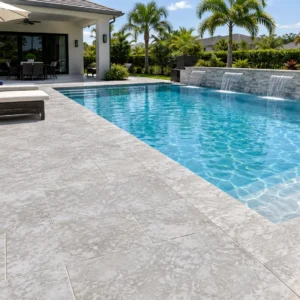
The chapter’s stone footnote is the standing one: the ground layer never joined the shutter economy at all — terraces, walls and aprons needing no protection, no storage and no June queue — and every square meter moved from vulnerable surface to permanent stone before the storm is a square meter absent from the scramble. The island learned its protection economics the hard way; the specification that follows spends once, stores little and shutters fast.
What the recovery numbers actually recorded
Hurricane Irma crossed this island on September 6, 2017 with sustained winds near 185 miles an hour, and the eye passed directly overhead, which meant more than two hours inside the strongest part of the storm rather than a glancing edge. The National Recovery and Resilience Plan puts the total at roughly 2.7 billion dollars: about 1.4 billion in physical damage, close to seventy-three percent of gross domestic product, and about 1.3 billion in economic loss, another sixty-eight percent. The same document sets out a seven-year recovery program worth some 2.3 billion dollars. Those figures are not background detail. They are the reason a rebuild specification here is written around restraint, replacement and repair rather than appearance alone.
- Assume the design event is a direct hit, not a passing edge
- Value what can be reinstated quickly over what merely looks permanent
- Treat the ground plane as part of the building envelope, not decoration
- Record every fixing type so a later repair does not become a redesign
Where the season sits in the calendar
Timing decides how much of a rebuild is exposed at any moment. The Atlantic season runs from June through November, and the climatological peak falls in the second week of September, which is exactly when Irma arrived. The climatology published by the National Hurricane Center is the practical planning tool for that: it tells a site manager which weeks carry the highest odds of an interruption, and therefore which weeks should carry the least unfinished work.
- Heavy external works scheduled for the drier first half of the year
- Terraces closed out and grouted before the September peak
- Loose material, pallets and offcuts cleared from site weekly in season
- A written tie-down routine for anything that cannot be finished in time
Restraint is a detail, not a material
Wind does not usually lift a well-bedded paver. It lifts the thing that was fixed to it, or the coping that was only bedded, or the loose slab that became a projectile. The lesson the island wrote down after 2017 is that failure travels: one unrestrained element damages the next, and the repair bill is rarely limited to the piece that moved first.
- Mechanical restraint on every coping, step nosing and edge unit
- Non-ferrous fixings sized for uplift, not just for weight
- Continuous edge restraint so a single lost unit cannot unzip a field
- Spare stock held on the island so repairs do not wait on a container
What Irma rebuild stone still has to prove
A rebuild is only finished when the next storm passes over it without leaving a list. That is the standard worth specifying to: dense units, mechanical restraint, honest drainage, and a documented repair path that a local crew can follow without waiting for anyone. Our Sint Maarten stone supply guide sets out the formats, finishes and lead times that suit this island. The point of building back better is that nobody has to build back again.