St. Kitts concentrates its nightlife on a few hundred meters of sand-backed pavement: the Strip at Frigate Bay — the beach-bar row where bonfires burn on Friday nights, cruise crowds and university students share the tables, and the island’s social calendar runs from afternoon lime to late-night bass. The Strip is a hospitality micro-district with hard-working ground, and its premises craft is a study in beach-bar economics done at density. Here is the after-dark guide.
The row’s working anatomy
The Strip runs bar-by-bar on shared sand: individual premises on the beach-bar craft pressed into a row, common ground — the walk, the parking edge, the beach approach — carrying everyone’s traffic on the district-duty specification, and the sand-margin transitions multiplied by every doorway: each bar negotiates pavement-to-sand at its own threshold, and the row’s ground reads as a single hospitality floor with a dozen managements.
Friday-night capacity
The Strip’s peak loads arrive on schedule — bonfire Fridays, cruise-ship evenings, university weekends from the vet and medical schools whose students the semester economy houses — and the ground runs event arithmetic: circulation absorbing crowd-surge between bars, the service-tempo operations at open-air pitch, bonfire courts on sacrificial-honest surfaces sited off the main walk, and the morning-after reset: wash-downs, glass sweeps and sand redistribution before the lunch trade — the double-shift discipline with its feet in the sand.
- Specify for a young, dense, late-night crowd rather than a resort terrace.
- Keep circulation generous, since queues form across the frontage.
- Choose material that survives dragged furniture every single night.
- Detail edges robustly, because this is where damage always starts.
Salt, sand and spilled punch
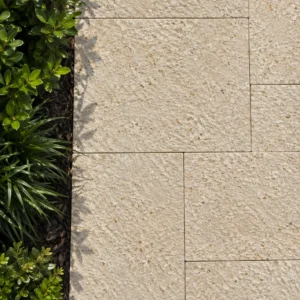
The Strip’s materials face the cluster’s full hospitality chemistry at once: salt off the bay, sand tracked across every surface as permanent abrasive, sunscreen and rum punch as the finish’s daily diet, and barefoot traffic demanding heat-honest, splinter-free, glass-safe ground. The answer is the cluster’s beach-hospitality law: dense stone in forgiving textures, marine-grade fixings on everything structural, drainage that clears both rain and mop-water, and the maintenance rhythm priced into the business plan rather than discovered after it.
The strip-and-resort symbiosis
The row anchors Frigate Bay’s wider economy: resort and condo guests from the peninsula’s approved developments walking down for the authentic evening, the resort-quarter courts sending their guests to the Strip for what no pool deck programs, taxi and shuttle aprons on working-grade ground handling the night’s logistics, and the property-value truth developers price: the Strip’s energy sells the neighborhood, and the neighborhood’s spending sustains the Strip. The ground between them — walks, crossings, lighting on the warm-night register — is the symbiosis’s infrastructure.
- Keep the walking route from the hotels lit and even underfoot.
- Avoid level changes that are invisible at night.
- Use a consistent surface along the whole approach rather than patchwork.
- Design for people arriving in sandals straight off the sand.
Storm season on the sand line
The row lives on the beach’s terms: storm swell reorganizing the sand under the tables, the preparation choreography executed bar-by-bar before named weather, furniture and shade fleets with rehearsed retreat plans, and premises stone specified for burial-and-recovery — the sand-migration honesty at entertainment-district stakes. The bars that reopen first after weather own the season’s best fortnight; their ground is why they can.
Specifying the good night out
The Strip’s kit is beach-bar law at district density: hospitality-duty surfaces, marine fixings, sand-tolerant textures, event-capacity common ground and reopening-grade resilience — landed on the federation supply line and served by the islands’ supply guide in the register the row runs on: honest, robust, wash-down cheerful. The bonfires burn, the bass rolls, the cruise ships glow offshore — and the ground under the party takes it all, night after night, which is exactly the specification.
Daylight on the Strip: the other twelve hours
The Strip’s daytime is a different business wearing the same premises, and the row’s economics increasingly run on both shifts. The day trade has its own registers: beach-chair and umbrella service on the sand the night’s crowd never sees, lunch service at family tempo, the excursion-stop logic as catamaran and booze-cruise itineraries fold the Strip into their circuits, and the vet-and-med-school study crowd colonizing shaded tables with laptops through the quiet afternoons. The premises serve the shift with small adaptations: shade infrastructure earning its keep from ten o’clock, menus and staffing flexing between registers, rinse points and boardwalk transitions handling wet feet all day, and the stone floors’ morning reset — the reset discipline — delivering a lunch venue no one would guess hosted last night’s bass.
The operational rhythm is a relay: morning crew resets and preps, day team runs the family-and-student trade, changeover staggers into the sunset seating, and the night register takes the handoff with the premises already earning fourteen hours deep. Maintenance lives in the seams — the mid-afternoon lull absorbs the small repairs, the supplier deliveries and the row’s shared-ground upkeep — and the surfaces built for the night’s worst behave all the better under the day’s mild use.
For operators the two-shift model is resilience arithmetic: day revenue steadies the season’s cash flow, the family trade builds the reputation the night trade converts, and the premises’ capital — the stone, the shade, the service infrastructure — amortizes across every open hour instead of six loud ones. The Strip’s legend was built after dark; its business is increasingly built all day, on ground specified from the start to work both.
Grip on a surface that is wet by ten o’clock
A bar terrace is a wet floor for most of the hours it is used. Guidance from Use Natural Stone on frictional testing sets ANSI A326.3 as the method with a dynamic coefficient of friction of 0.42 as the benchmark for level interior surfaces expected to be walked on wet, notes that no published exterior threshold exists, and records that polished stone generally fails the wet test. On the Strip that is not a technicality, it is the liability.
- Specify a textured finish across the whole service area, not just the bar line.
- Test the delivered finish rather than trusting a description.
- Keep grip consistent from the sand to the seating to the restrooms.
- Retest annually, since a nightly wash down changes the surface.
- Pay particular attention to steps, which is where night-time falls happen.
What spilled drinks do to the wrong stone
Everything served here is either acidic or sugary and most of it ends up on the floor. The reference from the Natural Stone Institute on limestone is direct about the risk: absorption runs from below one percent to above ten across the family, dolomitic varieties are denser with lower absorption and higher abrasion resistance, and the whole family is vulnerable to alteration by mild acids. Citrus, wine and cola are all mild acids.
- Specify the lowest absorption available anywhere drinks are served.
- Prefer dolomitic material where the crowd is densest.
- Rinse rather than scrub, since grit plus pressure grinds the surface.
- Keep acidic cleaners off the schedule, because the drinks are already doing that.
The other twelve hours
The Strip is photographed at night and inspected by daylight. A frontage specified only for the evening looks tired at eleven in the morning, when the same terrace is a lunch spot and a thoroughfare between hotels and the beach. The surfaces that work do both without looking like a nightclub in daylight.
- Choose a palette that reads well in flat midday light as well as under lamps.
- Design the layout so the venue looks intentional when it is empty.
- Keep service scars out of the daytime sight lines.
- Plan the morning clean into the detailing rather than around it.
Nightlife strip paving built for the Frigate Bay duty cycle
The Strip runs a harder duty cycle than any resort terrace on either island: wet floors, dense crowds, acidic spills and a nightly wash down. Specify real grip, keep absorption low, detail the edges properly and make sure it still reads well at noon. Our St. Kitts and Nevis stone supply guide sets out the formats, finishes and lead times that suit this federation. The venue is judged at midnight and inspected at midday, and the paving has to pass both.