Before the towers, Aruba built cunucus: the island’s vernacular farmhouses — thick-walled, small-windowed, gabled against the trades — scattered across the countryside with their aloe fields, boundary walls and landmark trees. The survivors are heritage treasure and living homes, their renovation a beloved genre, and their design wisdom — refined by centuries of desert wind — reads as a masterclass the newest builds still crib from. Here is the cunucu chapter: renewing the originals, and learning from them everywhere.
Reading the vernacular’s intelligence
The cunucu is climate engineering in folk dress: orientation set against the constant trades, thick masonry banking cool for the day’s heat, small openings on the windward faces and generous shade at the lee, courtyard and arbor spaces making outdoor rooms in the wind’s shelter — the lee-craft manual written before the manual. Renovation starts by reading the intelligence: what the builders knew about this exact wind, this sun path, this seasonal rain — and renewing with it rather than against it.
Renovating the originals
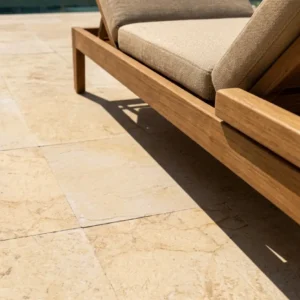
Cunucu renewal runs the cluster’s heritage craft in desert dress: original masonry respected on the old-walls manners — breathing junctions, honest levels, patina as goal — floors renewed in stone that suits the vernacular’s warmth (shellstone’s fossil texture reads beautifully against whitewashed walls), courtyards re-laid as the working hearts they were, and modern services threaded discreetly on the retrofit wisdom. The register stays humble-proud: these were farmhouses, and their luxury is authenticity kept.
- Keep new floor tones warm so they sit comfortably beside lime-washed masonry.
- Avoid a brilliant white floor, which makes an old wall look grubby rather than characterful.
- Use a matte finish so the light in the room stays soft rather than bouncing.
- Let one material run through the whole ground floor so the old plan reads as continuous.
The boundary-wall landscape
Cunucu country’s signature is its dry-stone field walls — generations of cleared coral and volcanic rock stacked into the property lines that still grid the countryside — and their stewardship is landscape heritage: existing runs conserved and rebuilt by the old craft, new boundaries continuing the language on the grazing-country logic the walls always served, and the two-stone instinct honored — rough local stone for the walls’ vernacular mass, finished imports only where floors and copings ask refinement.
Aloe fields and working yards
The cunucu’s economy lives in its grounds: aloe plots that made the island’s first export fortune, working yards where the estate-utility registers ran at family scale, outdoor ovens and wells as heritage features. Renewal treats the working landscape as heritage equal to the house — aloe rows replanted as productive ornament, yard surfaces on honest working grade, wells and ovens conserved as the courtyard’s anchors — and the agritourism turn beckons where owners choose: cunucu visits, aloe-craft demonstrations, the visitor-circuit craft at homestead scale.
Cunucu lessons for new builds
The vernacular’s masterclass transfers wholesale: new villas orienting against the trades cunucu-style, thick-walled thermal instinct informing even the vertical market’s shading strategies, courtyard-first plans making wind shelter the home’s heart, and the landmark-tree wisdom — plant the shade generation early — that the framework-garden philosophy arrives at by analysis where the cunucu got there by living. Contemporary builds crediting the tradition read instantly Aruban; those ignoring it fight the wind forever.
- Keep the original orientation, since these houses were positioned deliberately against the wind.
- Reopen blocked windows on the leeward side before adding mechanical cooling.
- Use the thick walls as thermal mass rather than furring them out and losing the benefit.
- Preserve the shaded outdoor room, because that is where the house was always meant to be lived in.
The tradition’s keepers
Cunucu stewardship is cultural work — heritage bodies, family custodians, craftspeople keeping wall-and-lime skills alive — and projects join respectfully: conservation guidance sought early, old techniques hired where they survive, documentation on the archival habits so renewals inform the next generation’s. The island supply guide serves the genre with matched humility: floors and courtyard stone in the vernacular’s warm register, walls left to the old craft and local rock, and the understanding that the cunucu’s value is exactly what centuries already built — renewal’s job is keeping it standing in the wind it was born to.
Dating the fabric: reading a cunucu’s age before renewing it
Every cunucu renovation should start with detective work, because the house is usually several houses wearing one roof. The reading runs by layers: wall construction shifts — rubble-and-lime cores in the oldest rooms, block extensions from the mid-century, the concrete additions of later prosperity — and the junctions between them, visible as straight joints and thickness changes, map the growth sequence a survey should record before design begins. Roof geometry tells its own dates; floor levels step where eras meet; and the joinery’s hardware, where original, places rooms within decades. The point is practical, not antiquarian: each era’s fabric wants its own treatment — breathing lime regimes for the old walls, conventional methods for the modern additions — and the renovation that treats the whole house as one material damages the oldest part first.
The ground holds the archive’s other half. Original stone thresholds and floor slabs, where they survive, are the house’s birth certificates and worth conserving in place; yard layers — the old work court under later paving, the boundary wall’s earliest coursing — date the homestead’s working life; and the trees complete the chronology, planted generations marking the family’s chapters more reliably than paper. Photograph and note it all before the first intervention: the record steers design, satisfies the heritage-minded, and hands the next generation the file this generation wished it had inherited.
Renewal then proceeds with its eras understood — conserving the oldest fabric’s logic, upgrading the newest without pretense, and letting the house’s growth story stay legible in honest junctions. The cunucu’s value is precisely its accumulated time; reading it first is how renovation adds a chapter instead of erasing the book.
The rock the island is actually made of
An old Aruban house sits on a very specific geology, and knowing it makes the material choices obvious. The account published by Aruba on Arikok National Park describes the island landscape as built from lava, quartz diorite and limestone across a park of 7,907 acres covering close to a fifth of Aruba. Traditional building drew on exactly those materials, which is why a cunucu house looks like it grew out of the ground it stands on rather than like it was delivered to the site.
- Take the palette from local rock rather than from an imported idea of Caribbean style.
- Expect the original masonry to be irregular, and specify new work that accommodates rather than corrects it.
- Use warm mid tones that sit between the pale limestone and the darker volcanic material.
- Keep the exterior palette restrained, since these houses were never colorful buildings.
- Let texture rather than pattern carry the character, which is how the originals worked.
Choosing a floor that suits a two hundred year old wall
New floors are where most cunucu renovations go wrong, usually by being too perfect. The reference from the Natural Stone Institute on limestone sets out what matters technically: absorption running from below one percent to above ten across the family, dolomitic varieties denser with lower absorption and higher abrasion resistance, and universal vulnerability to acid. In an old house with solid walls and rising damp risk, absorption is the property that decides whether the floor works.
- Choose lower absorption where the floor meets solid walls without a modern damp barrier.
- Prefer dolomitic material in circulation areas, since these floors get decades of use.
- Keep acidic cleaners away from the specification, especially near original lime mortar.
- Pick a format with some variation in it, because a perfectly uniform floor fights an irregular room.
Making old and new meet honestly
The most successful cunucu renovations do not pretend the new work is old. They let the original walls be visibly original and let the new floor be visibly new, and they get the relationship right through tone and level rather than through imitation. Fake distressing on a new floor beside genuinely old masonry reads as a mistake within a year.
- Use a clean, simple new floor rather than an artificially aged one.
- Keep the junction between old wall and new floor deliberate, with a shadow gap or a clear line.
- Match the warmth of the new material to the wall rather than trying to match its texture.
- Leave original features exposed where they are sound instead of covering them with new finishes.
Cunucu house renovation that respects both halves
These houses have already lasted longer than anything built beside them. Renovating one well means keeping the orientation, using the wall mass, choosing a warm low-absorption floor that will take another century, and letting old and new sit beside each other without either pretending to be the other. Our Aruba stone supply guide sets out the formats, finishes and lead times that suit this island. The best cunucu renovations look like the house simply carried on rather than like it was rescued.