Aruba does not imitate the lush Caribbean; it perfected a different genre. The island’s native landscape — sculptural cacti, wind-bent divi-divi trees, coral outcrops, aloe fields — is a ready-made design language that the region’s greener islands spend fortunes failing to fake, and the stone-structured desert garden is its natural built form. Where the cluster’s dry-island fundamentals lay the groundwork, Aruba writes the advanced chapter.
The genre, owned
The Aruban garden’s first decision is confidence: commit to the desert genre rather than apologizing toward the tropics. Hardscape carries the composition — gravel fields, generous slab lines, low stone walls drawing rooms on open ground — and planting appears as sculpture: columnar cacti as living pillars, agave rosettes as focal points, aloe drifts as groundcover that earns its keep. The genre rewards restraint the way minimalist architecture does: few species, repeated boldly, against calm stone grounds. Nothing about it reads as compromise; done well it reads as the island itself, composed.
The palette against the light
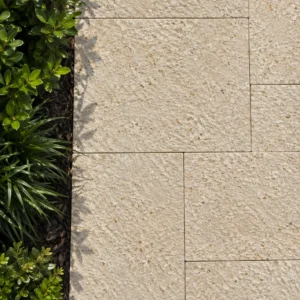
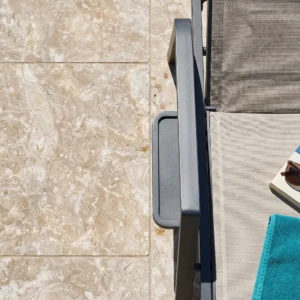
Desert light runs bright and the island’s surfaces reflect, so the garden’s tonal plan manages luminance deliberately: cream and beige gravels over stark white in the open fields, mid-toned slab lines where glare would otherwise accumulate, the palest stone reserved for shaded courts and evening terraces where it glows without dazzling. Against this ground the planting’s greens and the sky’s blue do the color work, with black basalt lines — borders, thresholds, water-bowl surrounds — supplying the graphic punctuation the genre loves.
- Keep the paving lighter than the planting so the greens read as the accent, not the field.
- Avoid high-gloss surfaces, which throw harsh reflected light under a near-vertical sun.
- Use gravel of a related tone rather than a contrasting one, so the ground reads as one plane.
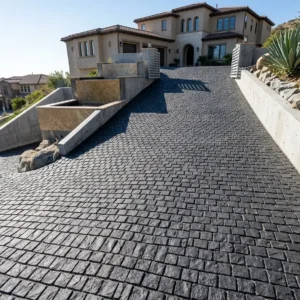
- Reserve the darkest material for shaded areas where it will not become uncomfortable underfoot.
Wind as the garden’s sculptor
The trade wind shapes everything here — the divi-divi’s permanent lean is the island’s logo — and the garden should be designed with the wind rather than against it. Sitting courts find or build their lee with the wind-wall logic; gravel specifies a size the gusts cannot mobilize; loose furnishings are chosen heavy or anchored honestly; and the planting palette leans on species the wind already approved. The wind also gives: constant breeze makes Aruban shade genuinely cool, insect pressure low, and evening terraces comfortable without a fan — assets the design should harvest with well-placed shade and open-sided rooms.
Water, honored by scarcity
A desert garden treats water as ceremony: one modest feature — a basalt bowl, a narrow rill, a wall spout into a stone basin — carries more presence here than a lush island’s cascade, because scarcity is the frame. Practically, features specify for wind (sheltered siting so spray stays in the bowl) and for the island’s water economics (small volumes, recirculation, easy drain-down). The same scarcity logic runs the irrigation question: the mature desert garden barely needs it, which is the genre’s quiet luxury — a landscape composed for an absent owner’s driest month.
Native stone, imported stone, one composition
Aruba’s coral outcrops and boulder fields are the garden’s found sculpture, and the built stonework should converse with them: imported pale limestone in the walked planes and seat walls, local rock left raw as feature and edge, junctions honest rather than blended. The pairing runs the cluster’s two-stone logic in desert dress — calibrated comfort where bodies touch, native drama where eyes rest — and it photographs like the island’s postcards because it is built from the same ingredients.
- Match wall coursing to the scale of the planting rather than to the size of the house.
- Let boulders and specimen cactus sit against masonry rather than in open ground.
- Keep hard edges soft in outline, since a rigid rectangle looks imported in this landscape.
- Use one stone family throughout so the garden holds together across a long dry season.
Keeping a garden that keeps itself
The Aruban desert garden’s maintenance load is the cluster’s lightest: gravel raked and topped annually, sand swept from slab lines on an easy rhythm, the trade wind’s salt rinsed from sitting surfaces, planting pruned for silhouette a few times a year. No mowing, no algae season, no storm strip-down. For absent owners and rental villas the arithmetic is decisive — the garden looks composed on arrival day without a staff in between — and for everyone it frees the island’s reliable weather for its actual purpose. The Aruba stone guide supplies the genre’s entire kit, gravel line to seat wall, in one order.
The desert garden after dark
Aruba’s evenings complete its garden argument: the heat releases, the trade wind turns from challenge to caress, and the island’s clear dry skies open a ceiling the lush islands rarely see. The desert garden is built for this hour — and lighting it follows the genre’s own restraint. Grazing light makes the sculptural planting perform: a columnar cactus lit low from beside becomes garden statuary, an agave’s rosette throws theatrical shadow, and the boulder features hold warmth and light together at the sitting court’s edge. Paths keep the mostly-darkness discipline — pale gravel and slab lines hold ambient light so markers suffice — and the warm-and-graze rules run at desert clarity, where every lumen carries further and restraint reads as sophistication.
The night garden’s furniture is the fire bowl and the sky: cool-season evenings earn a modest flame on the wind-wise rules, its stone surround doubling as the warm seat, while the ceiling above — unpolluted by humidity or towering canopy — supplies entertainment no budget line matches. Design for the astronomy deliberately: one sitting court kept dark-sky honest, loungers positioned for the zenith, and the garden’s lighting scene able to drop to near-black at a switch. The dry air adds its final gift — evenings without the insect pressure that chases lush-island gatherings indoors — so the desert garden’s social hours run as long as the conversation. The genre’s daytime case is water arithmetic and graphic calm; its closing argument is made after sunset, under the clearest sky in the southern Caribbean.
Eighteen inches a year changes everything
The single most important design fact about Aruba is how little rain falls on it. Figures published by Aruba on its own weather and climate put average annual rainfall at just 18 inches, with a dry season from January to April, a rainy season confined to October through December that delivers short intermittent showers, and temperatures running 80 to 90 degrees Fahrenheit year round. That is not a Caribbean garden climate, it is a desert one, and the palette has to admit it.
- Design for the dry season condition, because that is when the garden is seen for most of the year.
- Treat paving and gravel as the permanent structure and planting as the seasonal accent.
- Group the few irrigated plants tightly so water goes where it does visible work.
- Choose species that look intentional when dormant rather than ones that simply look dead.
- Expect wind-blown dust on every surface, and pick colors that carry a light film gracefully.
Which stone survives sun, salt and dust
Material that works in a wet climate can fail quickly in a dry, bright, salt-laden one. The reference from the Natural Stone Institute on limestone sets out the properties that decide it: absorption across the family runs from below one percent to above ten, dolomitic varieties are denser with lower absorption and higher abrasion resistance, and every limestone is vulnerable to acid. On an island where salt arrives on the wind and rain rarely rinses it away, the low-absorption end of the range is the safe end.
- Choose low absorption so wind-borne salt cannot be drawn into the stone and crystallize inside it.
- Prefer dolomitic material on paths, where abrasion from grit is the main wear mechanism.
- Keep acidic cleaners off the maintenance schedule entirely, since one wash can etch a whole terrace.
- Pick a mid tone rather than a brilliant white, which glares under this sun and shows dust immediately.
Gravel, mulch and the ground between plants
In a desert garden most of the visible ground is not planted, which makes the choice of loose material as important as the paving. Stone mulch does three jobs at once here: it suppresses what little weed growth there is, it slows evaporation from the small irrigated pockets, and it gives the garden a continuous surface that reads as deliberate rather than bare.
- Size gravel large enough that the trade wind does not gradually redistribute it across the terrace.
- Use an angular grade rather than a rounded one, since angular material knits together and stays put.
- Lay a generous depth over planted areas so evaporation is genuinely reduced.
- Keep gravel and paving in the same tonal family so the transition reads as one landscape.
Desert garden stone that looks right in April
A garden here is judged in the dry months, not the wet ones. Build it from paving, gravel and masonry with planting used sparingly and deliberately, choose low-absorption material that shrugs off wind-borne salt, and keep the whole palette within one tonal family. Our Aruba stone supply guide sets out the formats, finishes and lead times that suit this island. The island supplies the light and the wind, and a well chosen ground plane is what turns them into a garden.