Grenada’s ground tells its history: volcanic peaks, dark boulders in the rivers, the rich soils that made it the Spice Island. That geology raises the natural question — why import limestone to a stone-rich island? — and the answer is a partnership every well-built Grenadian property already demonstrates.
What the island’s own stone is
Grenada’s native rock is igneous — volcanic material, dark, dense in its finest beds, quarried locally as aggregate and used for the walls, foundations and landscape mass the hillsides demand. In those roles it is excellent and irreplaceable: authentically local, structurally serious, and visually rooted in the island’s drama. What the local industry does not produce is calibrated dimension stone — the finished, flat, surface-controlled flooring units that terraces and pool decks require.
The heat problem dark floors cannot escape
Even if local volcanic stone were milled into perfect tiles, physics would object: dark surfaces bank solar heat, and a Caribbean floor’s first job is shedding it. The cluster’s barefoot arguments apply at full strength — light limestone stays walkable through Grenadian afternoons while dark stone becomes untouchable — which is why the island’s dark beauty belongs in walls and accents, not underfoot in the sun.
The partnership pattern
Walk Grenada’s best properties and the division repeats: volcanic stone in the retaining structures and boundary walls (native strength where strength is the job), imported pale limestone on floors, decks and copings (calibrated comfort where people live), and often factory-finished basalt bridging the two — a volcanic stone with quarry-direct calibration, reading native in borders and steps while behaving like the imported material it technically is.
- Volcanic stone for retaining walls, boundary walls and landscape mass, where weight is the point.
- Imported pale limestone for floors, terraces, treads and copings, where comfort and light matter.
- Local aggregate for bases and bedding, sourced on island through the contractor.
- Cut specials at the junctions, ordered with the floor rather than improvised on site.
Contrast as Grenada’s signature
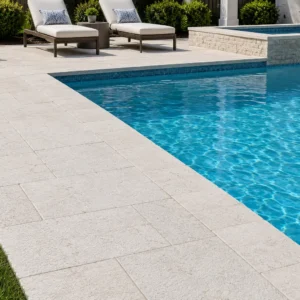
The visual result is the island’s own palette: pale floors luminous against green hillsides and dark stone walls — a contrast stronger and more dramatic than any coral island can stage. Designers lean into it: light terraces floating against volcanic retaining walls, cream pool decks framed by the landscape’s deep tones, the two-tone discipline handed its most theatrical setting.
Specifying the partnership
The practical division writes itself into the order: local aggregate and wall stone sourced on-island through your contractor as always; imported dimension stone — floors, copings, treads, cladding — quoted from the cutting list and shipped through St. George’s; and the interface details (wall caps on volcanic walls, stair treads on volcanic structure) cut as specials so the two industries meet cleanly. Neither replaces the other; the specification simply lets each do what it does best.
- Local aggregate and wall stone bought on island, as they always have been.
- Dimension stone quoted from the cutting list and shipped through St. George.
- Interface pieces such as wall caps, nosings and thresholds cut to drawing.
- Spares from the same batch held for both materials, because both take damage.
The sample pairing worth doing
Grenada offers a doorstep test no coral island can: set a pale limestone sample on the island’s own dark stone, in your site’s light, wet and dry. The contrast that will define the property shows itself in seconds — and the sample box arrives within 3 working days to run it.
Where each stone fails — and how to keep it from happening
An honest comparison names failure modes, and each side of Grenada’s pairing has them. Volcanic rubble walling depends on its mason and its details: a wall without a proper cap sheds water into its own core, joints raked too proud hold moisture against the mortar, and the cure for both is craft plus a capping detail — which is precisely where imported limestone caps earn their place on local stone walls. Pale limestone’s vulnerabilities are different: it is acid-sensitive (citrus, wine, aggressive cleaners etch it, so the care regimen is pH-neutral and stated in writing), and light floors beside dark planting beds show soil splash after rain — a maintenance note in wet-season Grenada, managed with sensible bed edging and rinse-down habits rather than avoided by choosing worse flooring. Dense volcanic stone, for its part, is chemically inert but shows every mortar smear against its dark face, so masons work it clean as they go. Neither list is disqualifying; both belong in the specification conversation, because the property that knows its stones’ weaknesses is the one where neither ever shows.
The junctions: detailing where dark meets light
The two-stone partnership succeeds or fails at its junctions, and four repeat on almost every Grenadian project. The wall cap: an imported limestone cap on a volcanic wall wants an overhang with a drip groove cut beneath, so rainwater falls clear instead of streaking the dark face — a special from the cutting list, not a site improvisation. The stair: volcanic structure with limestone treads needs the tread thickness and nosing decided before the mason builds the stringers, not after. The pool surround meeting a volcanic feature wall wants a shadow gap or a clean mortar joint — never a forced stone-to-stone butt joint between materials that move differently. And every run where the two materials meet in the same plane takes a movement joint, because igneous stone and limestone respond to heat at different rates and a rigid junction eventually tells you so. The supply split follows the details: the contractor sources the volcanic work locally as always, while the caps, treads and surrounds arrive as dimensioned specials on the import order — measured from the mason’s built work where the sequence allows, which is the single best argument for ordering specials after structures stand.
- The wall cap, where an imported limestone cap needs an overhang and a drip groove cut beneath it.
- The terrace-to-wall junction, where a movement joint keeps two very different materials from fighting.
- The step and nosing, where cut limestone meets rubble cheeks and the setting out has to be drawn.
- The planter edge, where soil, water and pale stone meet and staining is decided.
Reading the island in three walls
Anyone can learn the two-stone logic from a page; Grenada teaches it faster in person. Take the coast road and read three walls. First, an old estate boundary: local volcanic rubble, hand-set, capped long ago — note how the capped runs stand proud and square while any uncapped stretch has softened and shed, the whole argument for capping detail written in one wall’s biography. Second, a mid-century town wall in St. George’s: dark stone below, render above, the dark base still crisp where rain and road-splash have worn the render — the island’s instinct for putting its toughest material where water works hardest. Third, a new villa terrace: pale imported stone floating above a volcanic retaining wall, the contrast doing exactly what this guide describes. Then touch both stones at noon — the dark wall face hot enough to argue with, the pale floor merely warm — and the barefoot case closes itself. The exercise takes an hour and changes how clients specify: they stop asking whether to use local or imported stone and start asking where each belongs, which is the right question and one the island itself has been answering, wall by wall, for two centuries.
The numbers behind the comparison
Most of what separates a dense igneous paver from a soft sedimentary tile is measurable, and the measurements are standardized. The Natural Stone Institute publishes the scope of methods used for dimension stone testing, and five of them settle almost every argument about which stone belongs where.
- ASTM C97 for absorption and density, which predicts staining and how a floor behaves after rain.
- ASTM C170 for compressive strength, relevant under vehicles, plant and heavy structures.
- ASTM C880 for flexural strength, which governs treads, copings and unsupported spans.
- ASTM C1353 for abrasion resistance, the honest measure of how a floor wears under traffic.
- ANSI A326.3 for slip resistance, always run on the finish that will actually be laid.
What limestone actually is, and where it varies
Imported limestone is not one material, and the differences inside the family matter more than the difference between limestone and basalt for most decisions. The Natural Stone Institute notes that limestone absorption runs from below one percent to above ten, and that dolomitic varieties generally show higher density, lower absorption, greater strength and better abrasion resistance.
- Dense, low-absorption limestone for terraces, pool surrounds and anywhere rain sits.
- More open, softer stone kept for shaded interior use where its texture is the reason for choosing it.
- Acid sensitivity respected, since carbonate stone reacts to mild acids including many cleaners.
- A stated absorption figure requested for the delivered batch, not quoted from a brochure.
- Finish chosen with the number in mind, because a coarse texture on a thirsty stone holds dirt.
Cost, honestly compared
The price conversation is usually framed as local versus imported, which is the wrong frame. The right frame is which material does which job at the lowest lifetime cost.
- Local volcanic stone wins outright on mass: walls, foundations, gabions and bulk landscape.
- Imported dimension stone wins on anything cut, calibrated or walked on barefoot.
- Freight is a real line but a fixed one, and it falls per square meter as the order grows.
- Craft cost sits with the volcanic side, since rubble walling is only as good as its mason.
- Replacement cost sits with the wrong choice, which is the most expensive line of all.
Volcanic stone and limestone, each doing the job it is best at
Grenada does not present a choice between two materials so much as a division of labor between them. The island supplies mass, strength and a dark visual base at a price no import can match; the import supplies the cut, calibrated, cool-underfoot surfaces the local rock was never going to yield. Properties that respect the division look inevitable; properties that force one material to do both jobs look strained and cost more over time. When you are ready to price the imported half against a real cutting list, our Grenada stone supply guide sets out the order stages. Let the island carry the weight and the import carry the walking, and both stones look better for it.