Grace Bay’s reputation was built on a particular image: white sand, impossible turquoise, and — in every resort photograph — pale stone decks holding the composition together. That image is now the standard TCI properties are measured against, and it teaches a masterclass in deck specification worth reading even if your project sits elsewhere in the islands.
Why the Grace Bay look works
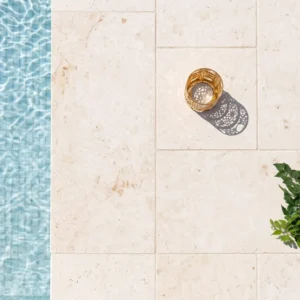
The famous composition is optics with a physics engine: pale stone reflects the same light spectrum the sand does, so deck and beach read as one continuous brightness with the turquoise doubled between them. Dark decks break the composition (and bank heat); busy patterns compete with the water. The lesson generalizes: beside brilliant sea and sand, the deck’s job is to continue them — calm, light, white limestone-toned.
The barefoot economy of a resort island
TCI’s visitor economy is barefoot by design — beach to pool to lunch without shoes — and surface temperature is guest experience measured in steps. The specification consequences run through the cluster’s deck physics: light tones as the non-negotiable, textured finishes in every wet and transit zone, and the one-hour sun test on samples as the cheapest guest-satisfaction research a property will ever run.
- Pale, high-reflectance surfaces in every zone crossed without shoes.
- Texture that grips wet without abrading skin, tested on the finish being laid.
- Shade planned as part of the deck, not added once the first guest complains.
- A cool route from door to water, so no one has to sprint the last ten feet.
Wind, spray and the northern shore
Grace Bay faces the open Atlantic’s trade-wind moods: breezy afternoons carry spray and sand across beachfront decks, and the front-row disciplines apply — dense low-absorption stone, textures sand cannot polish slick, falls that shed a squall fast, and the weekly rinse habit in spray season. The reward for the discipline is the reason the resorts pay for it: decks that photograph brochure-fresh through their second decade.
Infinity edges and the horizon game
TCI’s pools chase the horizon — infinity edges visually pouring into the sea — and the stone package carries the trick: precision weir stones cut flat and level to tight tolerance, stone coping profiled so the near edge disappears from lounger height, and deck falls that keep the foreground mirror-calm. These are specials named early in the quote; the horizon does not forgive improvisation.
- Weir stones cut flat and level to a tolerance stated in the order, not assumed.
- Coping profiled so the near edge disappears when viewed from lounger height.
- Deck falls set to keep the foreground water mirror-calm rather than rippled.
- Specials named at quote stage, because they carry the longest production time in the package.
From resort standard to villa reality
Private villas inherit the standard at villa scale: the same pale palette and textures, 24 x 24 to 36 x 36 in formats laid calm, shellstone where the brief softens toward barefoot-luxury, basalt only as the rare drawn line. The economics inherit too — a villa deck is a fraction of a resort phase, travels as pallets or groupage, and orders through the same quarry-direct channel the big projects use.
The standard, maintained
Grace Bay’s decks look effortless because their maintenance is systematic: rinses on schedule, neutral-only chemistry, textures inspected in traffic lanes, attic stock swapping the rare damaged unit. The care calendar translates directly — and on an island whose brand is the beach, the deck that upholds the standard is not décor but market positioning, maintained ten minutes at a time.
Planning the deck around the furniture, not before it
A Grace Bay deck earns its keep through what stands on it — loungers in rows, daybeds, dining under shade — and the stone plan should start from that furniture plan. Lounger zones want uninterrupted field stone with joints running the viewing direction; dining zones want a level tolerance tight enough that no chair rocks; circulation between them wants clear widths that two passing guests never negotiate. Shade is the detail that reaches into the stone package: pergola posts and sail anchors land on fixings that should be sleeved through the paving into the structure below — cut and drilled units supplied as specials, not field-improvised — and umbrella bases want flush sockets set out on the furniture grid at build time. Wind is the beachfront’s standing note: anything light enough to move in a gust will move, so permanent shade beats loose parasols on the front row, and the fixings that hold it are a stone-package line item, decided while the cutting list is still open.
- Lounger rows over uninterrupted field stone, with joints running the viewing direction.
- Dining zones held to a level tolerance tight enough that no chair rocks.
- Circulation widths that two guests pass without either stepping off the stone.
- Shade structures and their fixings coordinated with the paving layout before setting out.
Renovating an existing deck without closing the resort
Much of Grace Bay’s first condo generation is now decades old, and deck renovation is a live question along the strip. The decision tree runs: if the existing slab is sound and levels allow, a new stone layer over the old surface preserves structure and shortens the program; if bedding has failed or falls are wrong, excavation to base is the honest route — shortcuts over bad falls resurface as ponding within a season. Matching enters where the renovation is partial: an existing coping that stays while the field renews (or the reverse) needs the new stone selected against a cleaned sample of the old, wet and dry, because twenty years of sun and salt have moved the original’s tone. The occupied-resort reality shapes the rest — phasing by building or by deck zone, low-season windows, dust and saw-cutting managed away from open amenities, and crate deliveries scheduled around guest hours. It is slower than a clear site and priced accordingly, but the operators who phase it well renew a deck without ever posting a closure notice; the deck standard at the end is indistinguishable from new-build.
Sunrise service: how the best decks are kept
Walk any flagship Grace Bay property at half past six and the day’s real deck maintenance is already happening: a quiet sweep of the night’s sand, loungers squared to their grid, a freshwater rinse of the splash zone before the first guest appears, cushions out of their dry store. The routine takes one staff member under an hour and it is the entire secret of decks that look new at year ten — nothing dramatic, everything daily. Villa owners can borrow the sunrise service wholesale at domestic scale: a two-minute morning sweep, the rinse habit after salty afternoons, cushions that live indoors overnight, and a monthly slow walk with coffee looking for the loose joint or the ponding patch while both are still small. What the routine prevents is compounding: sand ground underfoot becomes abrasion, salt left to cycle becomes crystallization in any porous spot, a rocking lounger becomes a chipped arris. What it preserves is the photograph — the deck’s booking value lives in its morning light, and morning light is unforgiving of yesterday’s party. The stone asks so little that the routine feels almost ceremonial, which may be why the properties that run it best treat it that way: the day starts when the deck is ready, and the deck is always ready.
Testing the grip you are actually selling
Barefoot decks are a slip conversation whether or not anyone says so out loud. The industry moved on from the old drag-sled method some years ago, and the current test regime is worth understanding before a finish is signed off. A useful account of frictional testing on natural stone walking surfaces sets out what the numbers do and do not promise.
- ANSI A326.3 measures dynamic coefficient of friction and covers testing in place as well as in the laboratory.
- The familiar benchmark of 0.42 applies to level interior surfaces walked on when wet.
- No threshold is specified for exterior or ramped surfaces, so the specifier carries that judgment.
- Polished finishes generally fail to reach the benchmark, while coarser honed finishes perform better.
- Denser stone tends to test lower than softer stone in the same finish, so test the actual specimen.
Absorption, density and why pale is not enough
Color solves the heat problem and nothing else. What decides whether a pale deck still looks pale in year five is how much liquid the stone takes in and how hard its surface is. The Natural Stone Institute records that limestone properties span absorption from under one percent to above ten, and that dolomitic stone generally offers higher density, lower absorption and better abrasion resistance.
- Low absorption for the wet apron, where sunscreen, drinks and pool chemistry land daily.
- Higher abrasion resistance in the traffic lanes that carry every guest from door to sand.
- Acid sensitivity respected around bars and citrus service, since carbonate stone reacts to mild acids.
- One absorption figure quoted per batch, from the delivered material rather than a brochure.
Falls, joints and the water that has to leave
A resort deck sheds squall water, pool splash and hose water several times a day, and the detail that governs all three is invisible from a lounger. Get it wrong and the deck reads dirty within two seasons for reasons that have nothing to do with the stone.
- Falls set away from the building and away from the pool coping, checked with a level before bedding.
- Drainage lines placed where furniture will not sit on them and staff will not sweep sand into them.
- Joint width chosen for the format, then held consistently so the field reads calm.
- Bedding continuous under copings and edges, because hollow beds fail first at the waterline.
- Rinse points positioned so the weekly wash is a ten-minute job rather than a morning.
Choosing Grace Bay deck stone you will still like in ten years
The famous view does most of the work; the deck simply has to stay out of its way and stay comfortable underfoot while it does. That means a pale, dense, honest stone with a texture that grips wet, falls that move water off fast, and a maintenance routine measured in minutes rather than contractors. It is a short list, and every item on it is decided before anything is ordered. Where the pool edge meets the deck, the detail deserves its own conversation, which is why we set it out separately in our notes on pool coping for Turks and Caicos. Specify for bare feet and moving water first, and the photograph takes care of itself.