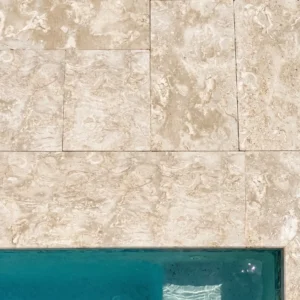
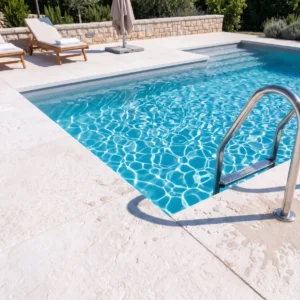
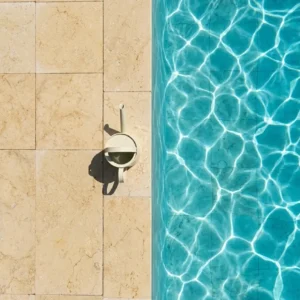
Antigua entertains at the long table — villa dinners that start at sunset and finish under stars — and the dining terrace is that ritual’s architecture. Its stone brief differs subtly from the lounging deck’s: chairs instead of loungers, service instead of sunbathing, evening instead of noon. Design for the dinner and the terrace earns its place nightly.
Sizing for the table that matters
Dining terraces size from the furniture outward, and the arithmetic is unforgiving:
- The ten-seat table Antigua villas actually use runs about 3 meters
- It wants 1.2 meters of chair-and-circulation clearance on each side
- That commands roughly 5.5 x 3.5 meters before a service path or console joins
The furniture-first sizing rule applies with dinner-party numbers, and generosity here is the difference between hosting and apologizing.
The level floor, non-negotiable
Nothing undermines a dinner like a rocking chair leg, so dining zones demand the flattest stone on the property:
- Large formats
- Tight joints
- Calibrated thickness
- Lippage near zero
Lay the table zone dead level while the surrounding field carries the drainage falls, and absorb the transition in a border course. Chairs slide, glasses stand, and nobody notices the engineering.
Surfaces for service and spills
Dinner traffic is service traffic: trays, carts, dropped forks, spilled wine. The spec responds — dense sealed stone that releases food and wine with a morning wipe (the kitchen-zone chemistry at gentler intensity), a finish fine enough for chair glide but textured enough for a sauced floor, and the service path to the kitchen in the same durable field, lit and unobstructed. Where the jerk pan or grill adjoins, the kitchen guide’s harder rules take over at the zone line.
Absorption is the number that separates one limestone from another. The Natural Stone Institute records a range running from under one percent to over ten across the family, and notes that dolomitic stones generally carry higher density, lower absorption and better abrasion resistance — the industry variety data sets this out. That spread is why two stones sold under the same broad name can behave nothing alike underfoot.
Evening physics: the terrace after six
Dining terraces live at dusk, and the stone choices flip accordingly: heat matters less (evening surfaces have exhaled), light matters more — pale stone lifts candle- and string-light into a glow dark floors swallow — and texture reads as atmosphere under raking evening light. This is why cream and ivory limestones own the dining zone even on properties that spend basalt drama elsewhere: the dinner table wants the reflector, not the void.
Shade by day, stars by night
Antigua’s dining terraces work lunch too, and the shade solution shapes the stone: pergola posts want footings and sleeves in the original build (the recurring foresight sermon), retractable canvas wants clear spans, and the mature-tree canopy — the island’s loveliest roof — wants the root-respecting layout and a blower in the maintenance cupboard. The star-dinner stays the goal; the lunch shade is the daily bonus.
Installation method matters as much as the stone itself. Industry guidance separates mortar-set work, sand-set exterior paving and pedestal systems, and stresses that drainage, movement and substrate condition drive long-term performance more than the material name does — the detailing guidance is worth reading before you specify.
The terrace as ritual infrastructure
Order the dining terrace as the room it is: level-zone specification named in the quote, service path included, threshold to kitchen flush, and the long table’s dimensions driving the cutting list. The Antigua guide carries the logistics; the returns arrive nightly, around eight, for decades.
The service ballet, choreographed in stone
Behind every long-table evening runs a service loop — kitchen to table, table to bar, bar to seats — and the floor either serves it or trips it:
- The path lit and level
- Thresholds flush
- The kitchen apron’s harder rules ending exactly at the zone line, so trays glide the whole run
Watch one dinner’s traffic before fixing furniture positions; the stone plan should follow the ballet rather than fight it.
Weathering the table zone
Dining zones age at the pace of their spills, and the specification already answered: dense sealed stone wiping clean each morning, textured enough that last night’s sauce never became this morning’s slick, and the quarterly wash resetting the zone before patina drifts toward grime. A decade of dinners should read as patina earned — the table’s biography, not its neglect.
Lighting the long table
A dining terrace is used almost entirely after dark, which makes lighting a stone decision rather than an electrical afterthought. Pale limestone bounces a small amount of warm light a long way, so the fixture count stays low and the scheme stays flattering. The rules that matter:
- Nothing at eye level across the table — glare ruins a face faster than it ruins a floor
- Light the surfaces, not the diners: a wall wash, a step glow, an uplit tree beyond the table
- Warm temperature throughout, because cool light on pale stone reads clinical
- Sleeves and conduit laid at build stage, so a future pendant or heater has somewhere to come from
Get it right and the terrace works at nine in the evening as well as it does at noon, which is when it earns its keep.
Wind across the table
The same trade wind that makes an Antiguan evening pleasant will also relocate a napkin, a menu and occasionally a candle. The floor cannot stop wind, but the terrace layout can moderate it: site the table in the lee of a wall or planted mass where the site allows, and treat any open side as the one that needs weight rather than screening. In stone terms that means a solid low wall or a raised planter on the windward edge rather than a light screen, because a permeable barrier accelerates air through its gaps. Where a wall is not wanted, plan for a heavier table and expect to use it in a slightly different position through the windier months.
The terrace between seasons
Dining terraces have a rhythm most other surfaces do not: heavy use in season, near-silence out of it. That pattern shapes the maintenance more than the material does:
- Wash down properly at the end of the busy period, before organic marks have a quiet few months to settle in
- Move or cover furniture so feet do not leave rust or shadow rings on an unused floor
- Check the joints at the start of the next season rather than the end of the last, since the wet months are what loosen them
Ten minutes at each changeover keeps the table zone looking like the first dinner rather than the hundredth.
Specifying a dining terrace in Antigua for the long run
A dining terrace built to this guide issues a standing invitation: level under the glasses, luminous under the string lights, indifferent to the wine that misses. Antigua’s evenings supply the rest. Size it for the table you actually host, order it with the level-zone named, and the long dinners take care of the returns. A terrace built for the long table gets used for it.