A Jamaican garden is experienced at walking pace, and the walkways decide the experience: where feet go, what the eye meets, how the lawn survives the daily commute to the gate. Paths are also the smallest stone projects a property can start with — and the quickest to repay in daily pleasure.
Three path species, three jobs
Garden routes divide honestly into three species, each with its own job:
- Stepping-stone runs — individual large pavers islanded in lawn or groundcover — for informal journeys such as pool to outdoor shower, or kitchen door to herb bed
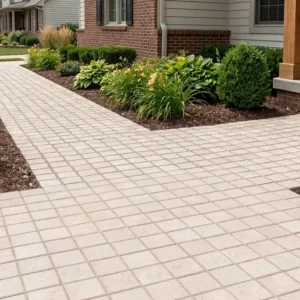
- Solid paths — continuous paving, usually two units wide — for working routes that carry barrows, luggage and nightly traffic
- Threshold moments — a landing at a gate, a widened pause before a view — where a path stops being circulation and becomes a place
Stepping stones, done so ankles agree
The stepping-stone run looks effortless and rewards precision:
- Units large enough for a confident foot — 18 x 18 in minimum, 24 x 24 in generous
- Spaced to a natural stride, roughly 600–650 mm center to center
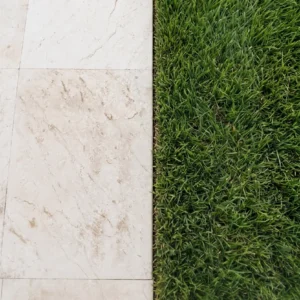
- Set flush or a whisker proud of the lawn, for clean mowing
- Each on its own compacted, drained bed, so seasons cannot rock it
Texture matters even here: a brushed face keeps the barefoot dash to the shower safe when the grass is wet.
Solid paths that survive roots and rain
Jamaica’s gardens grow ambitiously, and paths thread trees whose roots have plans: route with generous clearance from major trunks, bridge minor root zones on deeper flexible bedding rather than cutting roots, and accept gentle curves — they read gracious and dodge trouble at once. Crown or crossfall sheds the island’s rain; flush edges double as mowing strips; and at slopes, the path borrows the step rules — never a ramped scramble of loose material.
Installation method matters as much as the stone itself. Industry guidance separates mortar-set work, sand-set exterior paving and pedestal systems, and stresses that drainage, movement and substrate condition drive long-term performance more than the material name does — the detailing guidance is worth reading before you specify.
Lighting the journey
Paths carry the property’s night traffic, and light stone halves the lighting bill: low markers at intervals, a wash at direction changes, and pale limestone returning enough of every lumen that the route reads continuously without a runway of fittings. Solar markers earn their keep on remote garden runs where trenching power never made sense.
Planting the edges: the path as garden spine
A walkway is the garden’s best planting opportunity: low borders soften the line, fragrance planted at brushing height perfumes every trip, and groundcovers knitting between stepping stones turn a route into a feature. Keep planting off the walking surface itself and choose neighbors whose leaf-drop the weekly sweep can handle — the maintenance calendar walks these paths too.
The weekend project that teaches the property stone
A stepping-stone run is the perfect first stone order: modest quantities, forgiving installation, immediate daily use. Order the units with a few spares, lay the run over a weekend, and the household learns the material — how it feels wet, how it ages, how little it asks — before the terrace and pool projects commit serious budget. Most properties that start with a path do not stop there; the path was the argument.
Jamaica quarries a great deal of its own rock, and it is licensed rather than informal. The Mines and Geology Division issues quarry licenses under the Quarries Control Act covering limestone, marl, shale, andesite and aggregates across the parishes, and separately evaluates high-purity limestone deposits — the division publishes its license register. What that industry supplies is aggregate and fill rather than calibrated dimension stone, which is the gap imports fill.
Materials for the path family
Paths welcome the property’s whole stone vocabulary in miniature:
- Field-matching limestone where the walkway extends the terrace story
- shellstone for barefoot garden routes, where its texture and coolness shine
- basalt stepping accents through gravel or planting, for contrast journeys
The discipline is the usual pair-plus-cameo, because paths in a third random material are how gardens drift into patchwork.
Drainage journeys: paths that manage water
A path is a long thin roof, and routing it well doubles as drainage design:
- Crossfall toward planted swales, which waters the borders with every shower
- A flush stone channel alongside the working path, intercepting hillside flow before it crosses
- A flush mowing edge at the lawn interface, doubling as a clean water stop
Where a route must cross a natural flow line, borrow the crossing logic at garden scale.
The night path, choreographed
Evening gardens are journeys between pools of light, and the path is the choreography: markers at decision points rather than metronomic spacing, a wash where steps interrupt, warm temperatures that flatter stone and skin, and dark gaps left deliberately — mystery is a garden amenity. Pale stone underwrites the whole scheme, carrying legibility between fittings; the result reads expensive precisely because it is restrained.
The path network, planned as a system
Individual paths connect points; a network organizes the property. Draw it once:
- Primary routes — gate to door, door to pool — built solid and lit
- Secondary garden loops, in stepping-stone mode
- Service spurs to bins, pumps and cistern — discreet but real
The network view catches what piecemeal paths miss: routes that should share materials and drainage, crossings that want a widened landing, and the future extensions that sleeve-and-batch foresight makes painless.
Width, and what actually has to pass
Path width is decided by the widest thing that uses it, and gardens are full of things nobody measured. A wheelbarrow needs more room than two people walking; a ride-on mower more than a wheelbarrow; a stretcher or a wheelchair more again, and that is worth a thought on a property where people will age. As a working set:
- 600–750 mm for a single-file service spur
- 900 mm as the practical minimum for a route carrying tools and barrows
- 1,200 mm where two people should walk side by side, which is what a main approach wants
- 1,500 mm at any landing where people stop, turn or gather
Narrow paths are the most common regret in Jamaican gardens, and widening one afterward means lifting both edges and disturbing the planting that grew up against them.
Paths on a slope
Few island gardens are flat, and a route that climbs needs deciding rather than drifting. Below roughly 1 in 20 a path can simply follow the ground and nobody notices; beyond that it starts to feel like effort, and past about 1 in 12 it wants steps rather than a ramp. The temptation is to keep ramping because steps feel like a bigger job, but a long steep path is more dangerous wet than a short flight is dry. Where a route must climb a real slope, break it: a run, a landing, a short flight, another run. The landings give a reason to pause and look, which is what turns a climb into a garden experience rather than a chore.
What a path costs to keep
Walkways are the lowest-maintenance stone on a property and the easiest to neglect, because nobody inspects a route they use every day. Three things drift if left alone:
- Joint sand thins on the stepping-stone runs first, since mowers and hoses take it
- Groundcover creeps over edges until the effective width is half what was laid
- Shaded sections green up long before the open terrace does, because they dry slowest
Ten minutes on the quarterly walk covers all three, and a path kept to its full width still reads as designed twenty years on.
What a garden walkway in Jamaica has to do
A path’s long edges outnumber its surface problems: lawn creeping over flush stones, planting flopping onto the walking line, bed soil washing across after rain. The stone answers: flush mowing edges where lawn meets path (one pass of the mower, no strimming), a raised curb course where beds sit higher, and the drainage-journey logic wherever a slope sends water across rather than along. Edge discipline is invisible when present and defines “scruffy” when absent — the classic stone truth at its narrowest scale.