

Stone Type Matters More Than Color
White pool tile options narrow quickly once you evaluate stone species before finish or format — the material’s porosity, thermal coefficient, and surface hardness determine whether you’ll be resealing every season or walking away for three to five years. White limestone, white travertine, and white marble each present a distinct absorption profile and compressive strength range, and those differences play out visibly at the waterline and underfoot. Understanding what separates these three is where every serious specification begins.
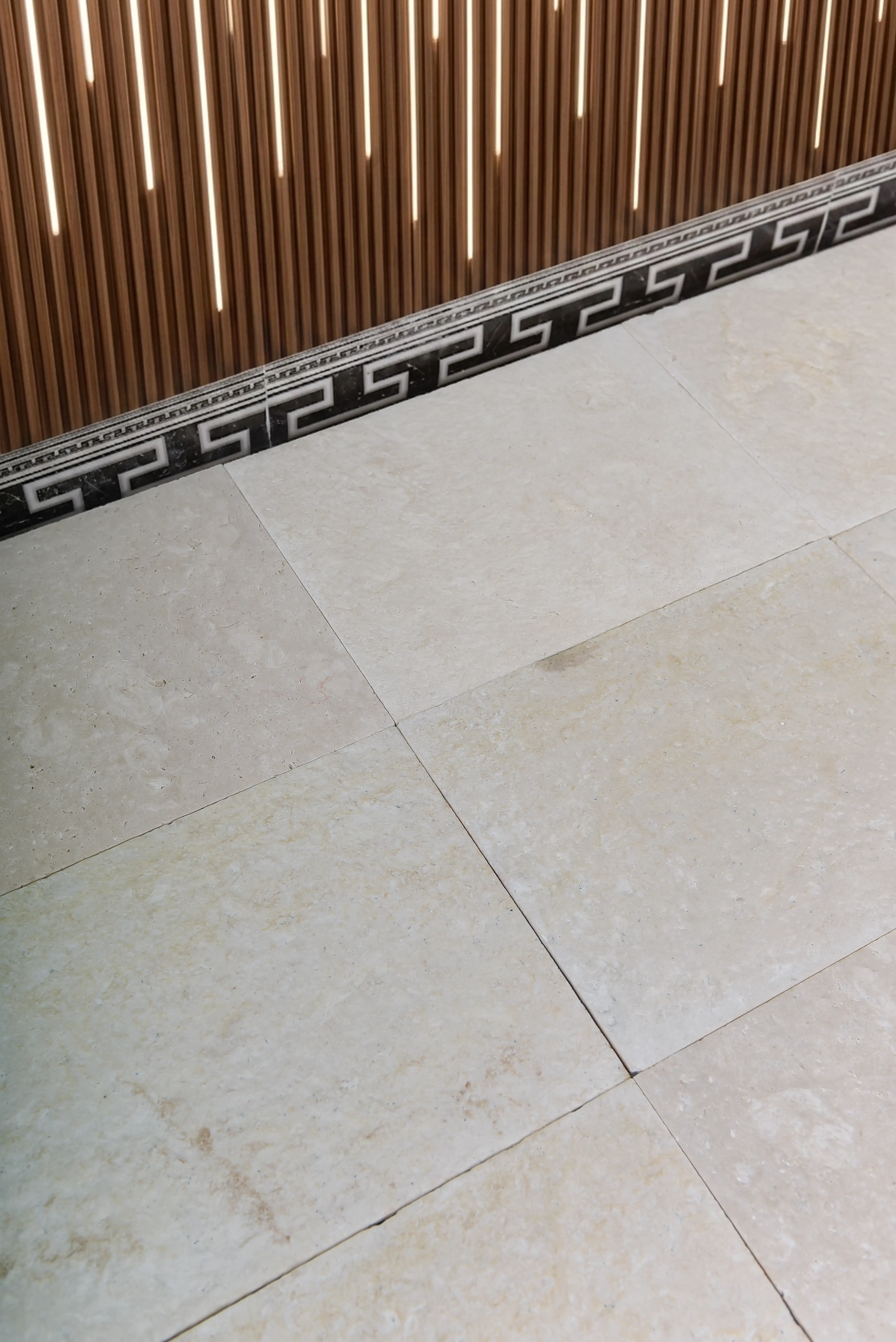
White Limestone: Dense, Cool, and Hardworking
Limestone in a white or cream tone is among the more structurally capable white pool tile options you can specify for an in-ground pool surround. The material’s calcium carbonate matrix keeps surface temperatures measurably lower than dense igneous stone alternatives — a meaningful advantage for barefoot comfort during peak afternoon hours. According to NSI limestone specifications, its open crystalline structure also contributes to moderate water absorption that, with proper penetrating sealer application, stays well-managed across years of pool chemistry exposure.
White limestone pavers in 2-cm thickness are the standard for pool surrounds — 3-cm works better wherever you’re installing over a less-compacted substrate or bridging drainage channels. The surface finish you select changes the slip dynamic considerably: honed finishes test at roughly 0.5–0.6 COF (coefficient of friction) dry, and tumbled or brushed surfaces push that number above 0.65 wet, which is the range recommended by ASTM standards for pool deck applications.
- Porosity typically ranges from 3–8% depending on quarry source — verify absorption data before committing to a paver specification
- Honed surfaces are easier to clean but require more frequent sealing than tumbled alternatives
- White and cream limestone tones reflect solar radiation effectively, reducing surface heat buildup during extended sun exposure
- Thermal expansion coefficient sits around 4–5 × 10⁻⁶ per °F — lower than concrete and manageable with correct joint spacing
White Travertine: The Classic White Tile Pool Specification
Travertine has earned its reputation at the pool edge honestly — it’s a sedimentary stone with a natural vein and pore structure that modulates surface temperature better than most alternatives you’ll evaluate. The filled-and-honed finish you see on most white tile pool applications closes the surface voids with grout or resin, creating a workable indoor-outdoor face that handles chlorinated splash without aggressive degradation. Your specification should call out filled travertine explicitly — unfilled travertine at the waterline traps algae and pool chemistry residue in the open voids, compounding maintenance workload quickly.
White travertine pool tile options sit in a slightly lower hardness range than limestone (Mohs 3–4 versus limestone’s 3–5), which means foot traffic abrasion is a real variable over a 15-year horizon. That said, the material’s interconnected pore structure gives it a natural thermal mass that smooths out surface temperature spikes more effectively than polished marble, which absorbs and retains heat differently. For pools that see significant daily temperature cycling — particularly in climates where night temperatures drop 20–30°F below daytime highs — travertine’s moderate thermal expansion (approximately 4.7 × 10⁻⁶ per °F) keeps joint stress within predictable limits. The ASTM C1527 travertine dimension stone standard covers thickness tolerances and absorption classifications that your submittal documents should reference directly.
At Citadel Stone, we source filled white travertine that’s been quality-checked at the warehouse for consistent fill density — loose or undersized fill is a field problem that shows up six to twelve months post-installation, not at delivery, and it’s worth verifying before the stone goes down. Reviewing our marble pool tile collection gives you a direct comparison point across white-toned pool stone formats in one place.
- Specify filled-and-honed for waterline and coping applications — unfilled travertine is suited only to dry, non-immersive pool deck zones
- Tumbled travertine edges work well for irregular coping profiles and create a naturally textured perimeter detail
- White travertine’s vein pattern adds visual depth that flat-white porcelain tiles can’t replicate at the pool edge
- Sealing frequency for travertine in pool environments: penetrating impregnator sealer every 18–24 months is a reliable maintenance cycle
Coping Pool Tile: Where Material Selection Gets Precise
Coping pool tile selection is a different specification exercise than choosing field tile for the deck or surround — the coping nose overhangs water, takes the brunt of bather exit loads, and faces full UV exposure with little to no shade relief. Stone specified here needs to pass freeze-thaw testing if your project is in a region with genuine seasonal temperature swings. ASTM C97 absorption testing combined with freeze-thaw cycling data (ASTM C880 flexural strength post-cycling) gives you a data-backed basis for specifying coping stone that won’t spall or delaminate within its first decade.
The thermal cycling dimension is particularly relevant at the coping level. A coping piece that spans from sun-heated pool deck concrete to the cooler pool water edge experiences a localized temperature differential that can reach 25–40°F across a single stone unit on a clear summer afternoon. Multiply that by daily cycling over a full season, and joint sealant becomes the critical failure point — not the stone itself. Specify a polyurethane-based joint sealant rated for pool chemical exposure and plan a joint width of 3/8 to 1/2 inch at coping-to-deck connections. Narrower joints don’t give the sealant enough movement capacity to absorb that thermal differential without cracking.
- Bull-nose coping provides a smooth rounded edge that reads well visually and reduces the sharp edge hazard at the pool perimeter
- Bullnose or drop-face profiles in 12-inch width are the most common residential coping pool tile specification
- For commercial pools, verify that coping stone meets PHTA deck and coping load and slip-resistance requirements before specifying
- Thermal expansion joints in coping runs should occur every 10–12 feet — shorter than deck expansion joint spacing because the coping sees higher differential movement
White Marble Pool Tile: Performance Trade-Offs Worth Understanding
Marble delivers the most visually refined white-pool aesthetic on the market — the veining depth and polished luminosity in Carrara or Thassos-style material reads differently than any other stone at the waterline. The trade-off is real and worth stating plainly: marble is calcium carbonate like limestone and travertine, but it has undergone metamorphic recrystallization that tightens its grain structure while simultaneously reducing its resistance to acidic attack. Pool water pH that runs even slightly low (below 7.2) will etch polished marble surfaces visibly within weeks.
Honed marble is a far more practical white pool tile specification than polished — the honed surface doesn’t show etch marks the same way, and it achieves slip resistance numbers in the 0.6–0.7 COF wet range that polished surfaces can’t match. Your maintenance protocol needs to include quarterly pH monitoring and immediate adjustment when levels drop below 7.4. According to PHTA pool deck and coping safety standards, deck surface materials must maintain consistent COF values under wet conditions — polished marble typically cannot clear this benchmark without additional surface treatment. Budget for resealing every 12–18 months with a pH-neutral penetrating sealer specifically formulated for calcite-based stone.
- Polished marble at the pool edge is a maintenance-intensive specification best reserved for minimal-splash zones
- Honed 12×24 or 18×18 formats work well for pool surrounds — large-format marble tiles require a flatter substrate tolerance (3/16 inch in 10 feet)
- Marble’s thermal expansion (approximately 3.4–5.4 × 10⁻⁶ per °F) is within the manageable range for pool deck use, but joints at the perimeter still need to accommodate seasonal cycling
- White marble with grey veining reads warmer in pool water reflection than pure-white tile — factor finish and tone interaction into your design decision
White Pebble Tile for Pool Interiors and Waterline Band
White pebble tile occupies a distinct functional niche — it’s the go-to choice for interior pool shells, waterline accent bands, and spa walls where a textured, natural aesthetic is the design goal. Pebble mosaic sheets typically consist of small river pebbles (8–25mm diameter) set on mesh backing, creating a surface that’s inherently textured due to the convex profile of each stone and the grout lines between them. The COF values for white pebble tile in wet conditions consistently exceed 0.8, which is well above the minimum thresholds for pool interior use.
The grout specification for white pebble tile is where most installations run into long-term trouble. Standard grey cement grout at the waterline traps mineral deposits and algae in the irregular surface, discoloring quickly in pools with high calcium hardness. Specify a white epoxy grout for all white pebble tile applications — it’s chemically resistant to pool water, doesn’t absorb staining compounds, and maintains color consistency at the waterline for substantially longer than cement-based alternatives. The grout joint width across pebble mosaic is typically 1/8 to 3/16 inch, which is tight enough to hold the pebbles in alignment while still allowing the epoxy grout to fill completely without voids.
- Tumbled marble pebble tiles give a rounded, smooth-to-touch surface — river rock pebbles are slightly rougher underfoot
- Consistent pebble sizing across a single installation matters — mixing sheets from different production batches creates visible tonal and texture variation
- White pebble tile on the pool floor is a higher-maintenance interior finish than plaster — vacuum frequency increases with organic load from bathers and surrounding landscape
- Pool chemistry management becomes more critical with any natural stone interior — maintain pH between 7.4 and 7.6 consistently
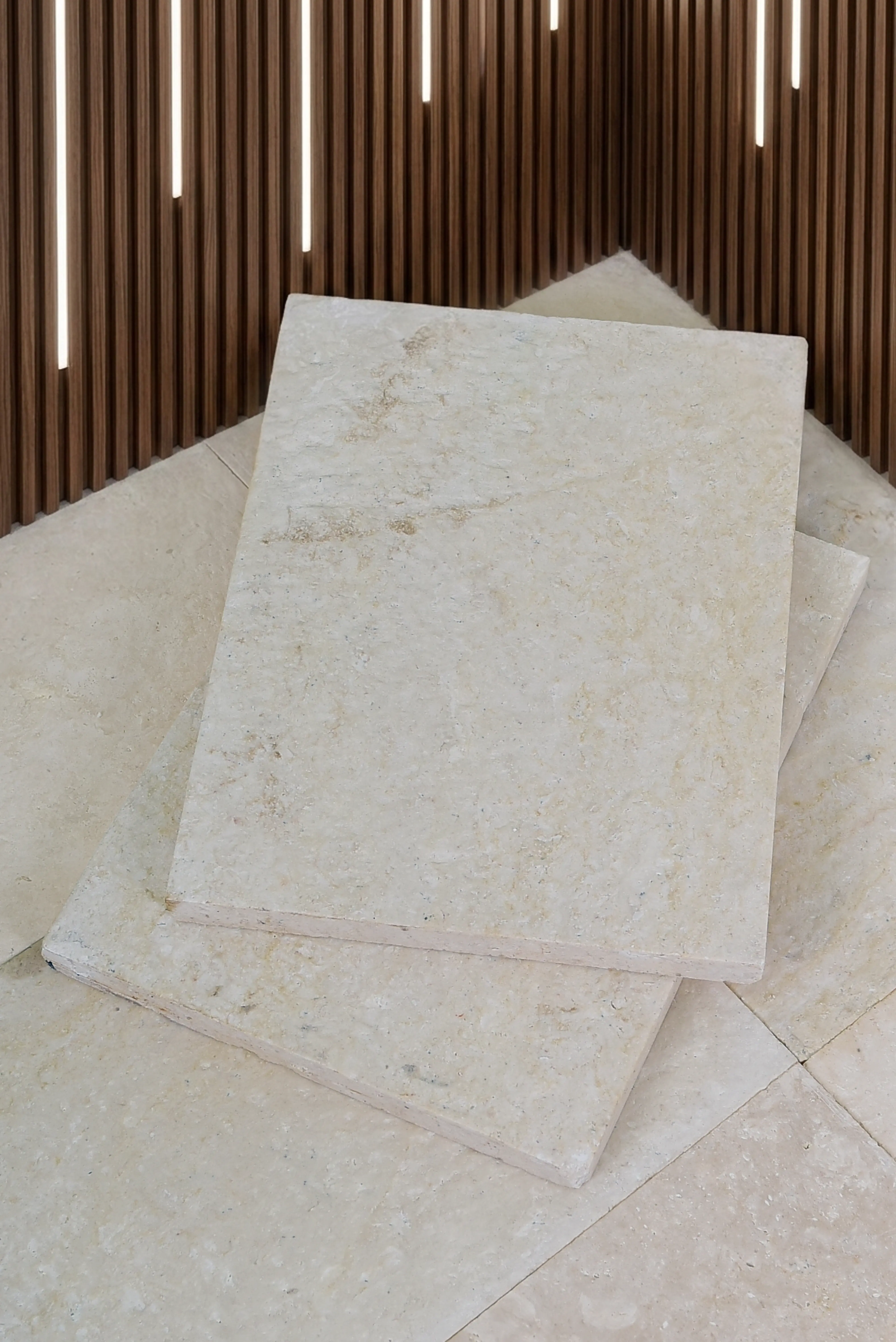
Freeze-Thaw and Thermal Cycling: What Your Stone Specification Must Address
Pool tile in regions with meaningful seasonal temperature swings faces stresses that go well beyond UV exposure and pool chemistry. The freeze-thaw cycle is the primary long-term mechanical threat to any natural stone pool tile installation — water infiltrating micro-pores in the stone expands approximately 9% by volume as it freezes, generating internal pressure that exceeds the tensile strength of many stone types over repeated cycles. This manifests as surface spalling at coping edges, hairline cracks propagating from mortar joints, and eventual tile delamination from the substrate — all of which are preventable with correct material selection and sealing protocol.
The key metric for freeze-thaw resistance is water absorption rate, not hardness. Stone with absorption above 3% by weight (ASTM C97 test method) requires a penetrating sealer with documented freeze-thaw performance data from the manufacturer — not just a standard masonry sealer. Dense white limestone and granite-based coping pieces in the 0.5–1.5% absorption range offer inherent freeze-thaw resistance without sealing dependency, which is a meaningful advantage in cold climates. The day-night temperature range matters even in warmer regions: a 35°F day-night swing over a spring or fall season creates measurable thermal expansion and contraction cycling at grout joints, and joints without adequate movement accommodation fail at the adhesive bond line long before the stone itself shows distress.
- Specify stone with ASTM C97 absorption below 3% for any white pool tile installation in freeze-thaw exposed zones
- Expansion joints at coping returns and pool deck perimeter must be filled with flexible sealant, not rigid mortar — rigid mortar at movement joints is the single most common cause of coping failure in cold-climate pools
- Day-night temperature differentials of 20°F or more require you to increase expansion joint frequency from the standard 15-foot spacing to 10-12 feet
- Verify that tile adhesive carries a freeze-thaw rating from the manufacturer — not all polymer-modified thin-sets are rated for outdoor freeze-thaw exposure
Selecting Grade and Thickness: The Specification Decisions That Define Performance
Grade selection for white pool tile options is where the difference between a 10-year installation and a 25-year one gets written into the specification. Commercial-grade stone (Grade A classification) carries tighter dimensional tolerances — typically ±1/16 inch on face dimensions and ±1/8 inch on thickness — which matters directly for your thinset bed depth and final surface flatness. Residential-grade material in the same stone type can vary by 3/16 inch in thickness across a single pallet, forcing you or your installer to compensate in the adhesive bed, which introduces inconsistent bond thickness and uneven load transfer.
Thickness selection depends on the substrate condition and point load exposure your installation will face. At Citadel Stone, our technical team advises 2-cm (3/4-inch) tile for pool surrounds over a properly prepared concrete deck, and 3-cm (1-3/16-inch) material for coping applications and any zone that sees concentrated foot traffic or furniture legs. The thicker specification’s additional cost pays back over the installation’s life — 3-cm coping pieces have significantly higher flexural strength and resist cracking at the overhang nose where 2-cm material is more vulnerable under bather exit loading. Citadel Stone ships both thickness grades from warehouse inventory, which keeps your project on schedule without waiting for special-order lead times.
- Grade A tile for commercial pools and high-visibility residential projects — the dimensional consistency makes installation faster and the result more professional
- 2-cm pool surround tile minimum on concrete substrate with 95% thin-set coverage — voids under pool tile create the conditions for freeze-thaw failure
- 3-cm coping for all in-ground pools regardless of climate — the structural benefit outweighs the modest cost premium at this format
- Face flatness tolerance for large-format tiles (18 inches or larger): substrate must be within 1/8 inch in 10 feet before tile installation begins
Slip Resistance and Glare: The Two Variables That Determine Daily Livability
A white pool tile specification has to account for two performance variables that purely visual selection processes miss entirely — slip resistance under wet conditions and glare intensity at peak sun angles. Both are solvable with finish selection, and both are worth addressing before the stone order ships from the warehouse rather than after installation reveals the problem. A honed or tumbled finish in any white natural stone achieves wet COF values above 0.6, which clears the threshold recommended under ASTM slip-resistance guidelines for pool deck surfaces. A polished finish on the same material can drop to 0.3 or below when wet — a meaningful difference that pool users feel immediately on bare feet.
Glare from a bright white pool deck is a legitimate comfort and safety concern at midday when sun angle is near vertical. Flat-polished white surfaces reflect significantly more directed light than tumbled or brushed alternatives, and the difference is perceptible. A brushed or sandblasted finish reduces specular reflection while retaining the white color value — you keep the bright, airy aesthetic without the mirror-like glare that makes users squint when transitioning between pool and deck. This consideration is particularly relevant for east-west oriented pools where the afternoon sun hits the far deck at a low angle, concentrating reflected glare directly at sitting areas.
- Tumbled finish: highest slip resistance, most casual aesthetic, lowest maintenance visibility for minor surface imperfections
- Honed finish: good slip resistance, clean professional look, requires sealing every 18–24 months in pool environments
- Brushed or sandblasted finish: strong glare reduction, good slip resistance, slightly more texture underfoot than honed
- Polished finish: restrict to vertical waterline accents or interior spa walls — not recommended for horizontal pool deck or coping surfaces
White Pool Tile Specification: Getting the Final Details Right
White pool tile options cover a wider specification range than the category name suggests — what looks like a color choice is actually a series of material, grade, finish, and joint decisions that determine both long-term performance and daily livability. Start with the stone species that matches your absorption tolerance and freeze-thaw exposure requirements, confirm your coping thickness, and let the finish selection follow from slip resistance and glare targets rather than purely aesthetic preference. If you’re exploring natural stone for adjacent interior spaces where the material transitions from outdoor pool to indoor floor, light travertine interior floor ideas provides useful context on how the same stone family performs in interior applications. Glare management and slip ratings are worth evaluating before choosing white tile, and Citadel Stone carries matte-finish options for both concerns.
Related reading: precast pool coping · pool coping types explained · pool tile installation.