The Core Performance Gap Between Natural Stone and Porcelain
Outdoor travertine tiles carry a thermal mass that porcelain simply can’t replicate — and that distinction shapes everything from your surface temperature at midday to how much flex your base assembly needs to accommodate over a 20-year service life. The calcium carbonate structure of travertine moderates heat absorption differently than the dense, vitrified body of porcelain, and that difference becomes immediately apparent on barefoot surfaces. What the spec sheet doesn’t tell you is how dramatically finish selection amplifies this gap: a tumbled travertine surface and a polished porcelain plank behave like entirely different materials under the same sun exposure.
The comparison most specifiers get wrong is treating this as a purely aesthetic decision. It isn’t. Porcelain and travertine diverge at the structural level — in water absorption, coefficient of thermal expansion, surface friction characteristics, and long-term maintenance requirements. Understanding where each material wins, and where it quietly fails, is the specification work that separates a durable outdoor installation from a costly replacement project.
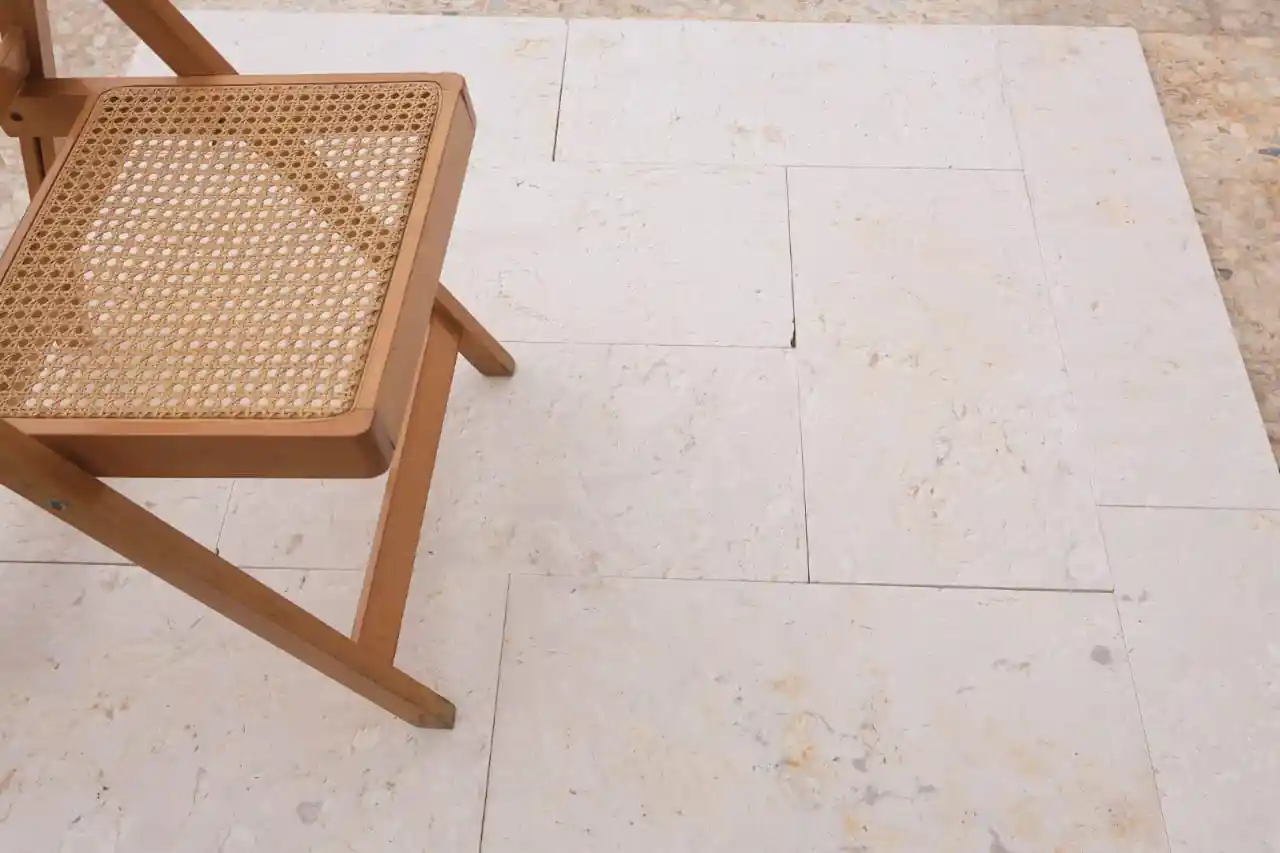
Material Composition: What Actually Drives Outdoor Performance
Travertine is a sedimentary limestone formed through mineral-rich spring water deposition — its interconnected pore network and calcium carbonate matrix give it a coefficient of thermal expansion around 4.7 × 10⁻⁶ per °F. Porcelain, fired at temperatures above 2,200°F, achieves near-zero water absorption (typically below 0.5%) and a denser, more uniform body. Each property creates a cascade of downstream effects when the material meets an outdoor environment.
- Travertine water absorption ranges from 3–9% depending on fill treatment and finish — unfilled travertine sits at the higher end and requires careful drainage management to prevent sub-surface saturation
- Porcelain’s near-zero absorption makes it highly resistant to freeze-thaw damage in regions with repeated seasonal cycling, but its thermal expansion coefficient (roughly 3.5–4.0 × 10⁻⁶ per °F) still demands correctly spaced movement joints
- Travertine’s open pore structure provides inherent surface texture — even a honed finish retains micro-roughness that contributes to slip resistance under ANSI A326.3 wet DCOF testing
- Porcelain requires intentional surface texture engineering (structured, grip-finish, or R-rated surfaces) to meet comparable slip resistance benchmarks outdoors
- Natural colour variation in outdoor travertine tiles means no two slabs read identically — a visual richness that porcelain’s digital printing replicates imperfectly at close inspection
According to Natural Stone Institute travertine properties and outdoor suitability, the open-pore structure and absorption characteristics of travertine actively moderate surface heat in high-UV environments, which directly informs finish and sealing decisions for pool-adjacent applications.
Slip Resistance and Finish Selection for Exterior Use
Your finish choice locks in the slip performance of both materials before a single tile is set. For travertine tile outdoors, tumbled and brushed finishes consistently outperform honed and polished variants in wet-condition testing — tumbled surfaces carry the most texture of the four, and should be specified against the ANSI A326.3 wet DCOF threshold (0.42). Polished travertine outdoors is a liability waiting to happen; the surface closes off almost all of its texture, and will not meet the ANSI A326.3 wet DCOF threshold (0.42).
Porcelain outdoor tiles carry an R-rating system (R9 through R13) that directly communicates slip resistance on inclined wet surfaces. R10 and above is your practical minimum for exposed exterior paving; R11 and R12 finishes are specified for pool decks and areas with frequent water exposure. The challenge with porcelain is that aggressive texture finishes trap organic debris and are harder to maintain clean — a trade-off you need to factor into your long-term maintenance plan.
- Tumbled travertine: the most surface texture — strong performer on pool decks and sloped walkways
- Honed travertine: noticeably smoother — acceptable for covered patios, marginal for pool surrounds
- Polished travertine: very little texture — not appropriate for exterior wet areas
- Porcelain R10: minimum exterior standard — suitable for patios and sheltered terraces
- Porcelain R11–R12: pool decks, spa surrounds, heavy moisture exposure zones
The ASTM C1527 travertine dimension stone standard provides the testing framework that underpins dimension stone selection for outdoor applications — referencing these specifications in your project documentation strengthens your specification defensibility.
Base Preparation, Drainage, and Terrain Considerations
Terrain genuinely changes the specification equation. On a flat, well-drained site, both materials perform predictably on a standard compacted aggregate base. The moment you introduce elevation change — a sloped terrace, a hillside installation, a pool deck that grades away from a structure — the base design becomes a drainage engineering problem first, and a material selection problem second.
Travertine’s higher water absorption means that on sloped sites, water infiltrating through unfilled joints and open pores can undermine a poorly designed sub-base. On grades steeper than 2%, you’ll want a mortar-set system rather than a dry-lay or sand-set approach — this controls lateral movement and prevents tile creep down-slope. Porcelain on the same slope is more forgiving from an absorption standpoint, but its lower friction coefficient on smooth finishes creates a safety risk on inclined surfaces that exterior travertine tiles’ natural texture helps mitigate.
- Minimum 2% surface grade away from structures — applies to both materials, non-negotiable for drainage
- On sites with elevation changes exceeding 8 inches per 10 feet, consult a civil or structural engineer for base reinforcement — standard compacted base specs aren’t designed for sustained hydraulic loading on slopes
- Mortar-bed thickness for sloped travertine installations: 1.5–2 inches over a concrete substrate, with weep screed at the low end of each run
- For hillside or terrace applications, drainage channels at grade transitions prevent hydrostatic pressure from building beneath the tile field
- Expansion joints at 10–12 foot intervals (not the 15–20 feet often cited in generic specs) accommodate thermal movement combined with settlement on uneven terrain
At Citadel Stone, we’ve reviewed enough failed hillside installations to know that the base engineering always costs less to get right the first time than to repair after tile settlement becomes visible. The material rarely fails — the sub-base does.
Thermal Performance and Surface Temperature Comparison
Surface temperature under direct sun exposure is one of the most practically important performance variables for any exterior paving material — and it’s where outdoor travertine tiles have a measurable advantage over dark or dense-bodied porcelain. Travertine’s lighter colourways and porous surface structure reflect and dissipate solar radiation more effectively than a vitrified porcelain body of equivalent colour. Light ivory travertine in direct afternoon sun can run 15–20°F cooler than an equivalent-colour smooth porcelain plank under the same conditions.
Darker porcelain finishes (charcoal, graphite, and near-black tones) are the worst performers in high-heat exposure — surface temperatures can exceed 140°F in sustained sun, making barefoot traffic genuinely uncomfortable and potentially hazardous. The specification lesson here is simple: if barefoot comfort matters for your project, travertine’s natural thermal properties give you a meaningful buffer before any additional cooling strategies are needed.
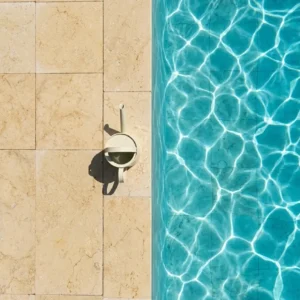
In hot, dry climates where daily UV intensity is sustained, the thermal mass difference between travertine and dense porcelain can shift the entire use-pattern of an outdoor space. Travertine retains warmth longer into the evening — pleasant in shoulder seasons, but worth noting if nighttime cooling is a priority for the space design. For a closer look at how these properties interact with pool environments specifically, our exterior travertine collection covers the full range of finishes and formats suited to outdoor water features.
Maintenance, Sealing, and Long-Term Durability
The honest maintenance comparison here strongly favours porcelain — and any specification that glosses over this point does the client a disservice. Outdoor travertine tiles require penetrating sealer application every 18–24 months in exposed installations, and annually in high-traffic or pool-adjacent zones. Skipping sealer cycles allows mineral staining, efflorescence, and biological growth to establish in the open pore network, which becomes progressively harder to remediate. You’ll also need to address joint sand refill every 3–5 years on dry-laid systems as organic material and traffic gradually displace the fines.
Porcelain’s near-zero absorption eliminates the sealing requirement entirely — a significant labour and cost advantage over a 20-year ownership horizon. Grout joints on porcelain still benefit from penetrating grout sealer, but the tile body itself is maintenance-free from a sealing standpoint. The trade-off is that porcelain chip damage is more visually jarring and harder to repair invisibly than travertine tile outdoors, which accepts colour-matched fill and hides minor impact damage within its natural variation.
- Travertine sealing schedule: penetrating impregnator every 18–24 months for exposed installations — annually for pool surrounds and high-UV zones
- Porcelain maintenance: no sealer required on tile body — grout joint sealer every 3–4 years
- Travertine chip and crack repair: colour-matched epoxy fill blends with natural variation — repairs are largely invisible in tumbled and textured finishes
- Porcelain damage repair: difficult to match factory glaze — damaged tiles typically require full replacement
- Both materials benefit from annual cleaning with pH-neutral stone cleaner — avoid acidic cleaners on travertine, which etch calcium carbonate surfaces
- Expected service life with proper maintenance: travertine 25–40 years, porcelain 30–50 years — though porcelain’s longer theoretical lifespan depends on avoiding impact damage that necessitates replacement
Installation Thickness and Structural Requirements
Travertine tile outdoors is commonly available in 3/4-inch (20mm) and 1.25-inch (30mm) nominal thicknesses for standard patio and walkway applications. The 30mm format is your practical minimum for dry-lay or pedestal systems where point-load resistance matters — particularly on sloped sites where mortar-bed levelling isn’t feasible. Porcelain outdoor pavers have pushed into 20mm thickness as the exterior standard, with some large-format slabs available in 30mm for heavy-traffic or vehicular applications.
The flexural strength difference is where the structural comparison gets practical. Travertine’s ASTM C1527 minimum flexural strength is typically 600 psi, while high-quality exterior porcelain pavers regularly achieve 3,000–5,000 psi. For standard foot-traffic patios and pool decks, travertine’s flexural strength is more than adequate. For applications with occasional vehicular access or heavy point loads, porcelain’s superior flexural performance is a genuine specification advantage. Factor in the weight differential as well: outdoor travertine tiles in 30mm thickness run approximately 15–18 lbs per square foot, which affects truck delivery logistics and substrate loading calculations for elevated decks or rooftop terraces.
Citadel Stone warehouse inventory typically carries both 20mm and 30mm travertine formats in stock, which means your truck delivery lead time is measured in days rather than the weeks you’d wait on special-order import cuts. That logistics advantage matters when project timelines are tight.
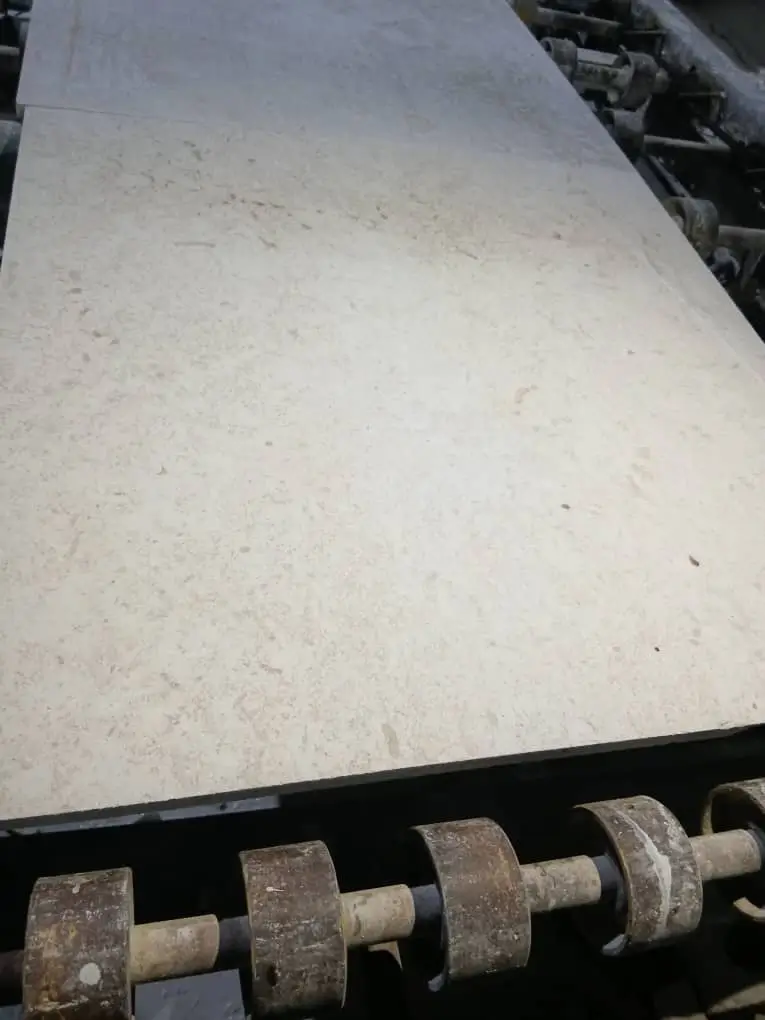
Cost Comparison: Material Price vs. Lifetime Value
The upfront cost picture consistently favours travertine for mid-range specifications — quality outdoor travertine tiles typically price between $4 and $12 per square foot at the material level, depending on origin, finish, and format. Comparable exterior porcelain pavers in large-format or premium textured finishes run $6–$18 per square foot, with high-end rectified formats pushing above $20. The material cost gap narrows significantly when you factor in the sealing and maintenance costs travertine requires over a 20-year horizon.
The USGS limestone and travertine natural mineral formation data provides geological context on the formation and availability of travertine as a dimension stone — a useful reference when clients question why natural stone pricing varies across origins and quarry grades. Understanding the sourcing chain helps you explain the value proposition accurately.
- Material cost (travertine): $4–$12/sq ft typical range — premium Turkish and Mediterranean origins at the upper end
- Material cost (porcelain outdoor pavers): $6–$18/sq ft — large-format and R11+ finishes at the higher end
- Installation labour: comparable for both — mortar-set systems add $2–$4/sq ft over dry-lay regardless of material
- 20-year sealing cost (travertine): approximately $0.50–$1.00/sq ft every 18–24 months — factor into lifecycle budgeting
- Replacement cost advantage: travertine’s natural variation makes future phase-matching from warehouse stock easier than matching discontinued porcelain prints
Making the Right Call on Exterior Travertine Tiles
The decision between exterior travertine tiles and porcelain comes down to what you’re optimising for across the full project lifecycle. Travertine delivers thermal comfort and an aesthetic depth that aged porcelain can’t match — at the cost of a disciplined maintenance commitment and more careful base engineering on challenging terrain. Porcelain wins on structural strength, maintenance simplicity, and freeze-thaw resilience in regions with aggressive seasonal cycling. Neither material is universally superior — but outdoor travertine tile consistently outperforms in pool environments, elevated patio applications, and projects where barefoot surface temperature is a primary concern. As you move from material selection into installation planning, laying travertine around pool decks covers the practical installation steps and base preparation details that make the difference between a solid long-term result and a premature repair call. Travertine from Citadel Stone arrives direct from quarries in Turkey, the Mediterranean, and beyond, offering a choice of surface finishes for poolside walking areas — confirm the wet DCOF against ANSI A326.3.
Related reading: travertine bullnose pool coping · travertine pool coping colors · gray travertine pool coping.