

The stone quarry process determines far more than the raw block dimensions you receive on site — it sets the density, internal stress patterns, and moisture absorption characteristics that define how your finished slab performs over decades. Most specifiers focus on color and finish, but the decisions made from the moment of stone quarry extraction through primary cutting have already locked in the material’s structural ceiling. Understanding that chain gives you a genuine advantage when evaluating slabs, comparing suppliers, or troubleshooting premature failure in the field.
How Quarrying Begins: Extraction Methods That Shape the Stone
Stone quarry operations begin with geological mapping — identifying the formation’s bedding planes, fracture lines, and depth of commercially viable material. That mapping isn’t optional; it determines whether the operation uses wire saw cutting, diamond belt systems, or controlled blasting, and the choice of method has direct consequences for block integrity. Wire saw extraction, standard in premium limestone and marble quarries, generates less internal micro-fracturing than blasting, which is why wire-sawn blocks consistently yield lower absorption variance across a single batch.
Your specification should note the extraction method where possible. Blocks from blasted quarries often show invisible micro-cracks that only become visible under freeze-thaw cycling or hydrostatic pressure — exactly the conditions encountered in heavy-rainfall climates where water infiltration is constant and drainage design is under real stress. For projects in regions with pronounced wet seasons or high annual precipitation, this distinction matters at the material selection stage, not the installation stage.
- Wire saw extraction preserves bedding plane alignment and reduces internal stress concentrations
- Diamond belt cutting is standard for softer formations like travertine and certain limestones
- Controlled blasting is faster but introduces micro-fracture networks that can accelerate moisture ingress
- Quarry depth affects density uniformity — shallow-quarried material often shows greater porosity variation across a batch
Block Processing and Primary Cutting at the Quarry
Once a block leaves the quarry face, it moves through primary gang saws — multi-blade frames that slice the block into slabs at a preset thickness. The thickness tolerance at this stage typically runs ±1.5 mm in well-equipped operations, though some overseas facilities push to ±2.5 mm. That variance sounds minor, but it creates real problems during tiling with natural stone in large-format applications, where lippage is amplified by even subtle thickness inconsistency across the same batch.
The NSI ASTM stone specifications define acceptable thickness tolerances for dimension stone and are the benchmark your procurement team should reference when reviewing quarry certifications. Slabs that fall outside these tolerances before finishing are either reworked or downgraded — and knowing this helps you ask the right questions when reviewing pricing anomalies between batches.
- Primary slab thickness for flooring tile typically targets 10 mm, 12 mm, 15 mm, or 20 mm nominal
- Gang saw blade count determines throughput — high-blade configurations favor softer stones
- Water cooling during cutting affects surface chemistry — excessive mineral deposits can interfere with adhesive bond
- Block orientation during cutting determines whether the finished face shows vein cross-section or vein length
Reading a Quarry Stone Size Chart
A quarry stone size chart communicates block yield expectations — the ratio of usable slab area to total block volume after accounting for saw cuts, edge waste, and natural defects. You’ll typically see this expressed as a percentage yield figure alongside standard block dimensions, often 200 × 100 × 100 cm as a reference unit. The practical implication is that higher-yield formations command premium pricing not because the raw stone is inherently better, but because more of each block reaches the finished product stage.
Understanding slab sizing relative to your project’s format requirements helps you avoid the waste premium. If your design calls for 600 × 300 mm tiles, specifying a quarry that typically yields 240 × 120 cm slabs gives you near-zero off-cut waste. Mismatching slab yield dimensions to your tile format is one of the more quietly expensive mistakes in natural stone procurement — and it’s entirely avoidable with a basic yield calculation before you finalize your order. A well-structured quarry stone size chart from a certified supplier will also indicate tone group distribution, giving you a more complete picture of what to expect across a full batch.
- Standard block reference dimensions vary by quarry region — always convert to your project’s unit system before comparing
- Yield percentages between 65% and 80% are typical for premium limestone and marble formations
- Edge waste increases with smaller tile formats — factor this into your square footage allowance
- Quarry certification documents often include size charts; request them before approving a supplier
Surface Finishing: What Happens After the Primary Cut
The finishing line is where a raw slab becomes a specification material. Honing, polishing, bush-hammering, flaming, and tumbling are all post-cut processes that change the surface texture, reflectivity, slip resistance, and — critically — the effective porosity of the face layer. A polished limestone surface closes the pore structure at the surface plane, reducing absorption at the face but leaving the slab body fully porous beneath. That distinction is essential for drainage-sensitive applications: in outdoor installations subject to standing water or monsoon-level rainfall, a polished finish can trap subsurface moisture if the installation bed and joint design don’t account for lateral drainage.
Bush-hammered and flamed finishes open the surface texture and improve drainage behavior, making them the technically correct choice for outdoor hardscape in high-precipitation environments. According to ASTM stone surface and absorption testing standards, absorption rates between finish types on the same parent material can vary by a factor of three — a detail that rarely appears in standard specification sheets but that changes your sealing protocol entirely.
- Polished finishes: lowest absorption at face, highest reflectivity, not recommended for wet outdoor use without anti-slip treatment
- Honed finishes: moderate absorption, matte appearance, suitable for most interior and protected exterior applications
- Bush-hammered finishes: highest slip resistance, open texture, best drainage performance for outdoor paving
- Tumbled finishes: aged aesthetic, rounded edges, absorption rate similar to honed but with surface micro-texture that manages moisture better than polished
Tiling with Natural Stone: What the Quarry Process Tells You
Tiling with natural stone requires you to trace the slab’s quarry history back to extraction method and formation geology — because those upstream decisions determine your adhesive selection, joint width, and movement joint frequency on site. High-porosity travertine from certain Mediterranean quarries, for example, requires a back-buttering protocol that wouldn’t apply to dense granite from an igneous quarry, even when both arrive at site in identical 600 × 600 mm formats.
The TCNA natural stone tile installation standards document the performance thresholds that govern adhesive open time, joint sizing, and substrate preparation based on stone absorption class. Your installation specification should reference these standards directly rather than defaulting to ceramic tile installation parameters — a substitution that causes more callbacks than almost any other field decision in natural stone work. At Citadel Stone, our technical team reviews quarry-of-origin documentation for every product line to confirm absorption classification before it reaches your project specification.
- Absorption class directly governs adhesive selection — Class A (low), Class B (medium), Class C (high) each require different mortar chemistry
- Thermal expansion coefficients vary between stone families — limestone expands at roughly 8 × 10⁻⁶ per °C versus granite’s 6–9 × 10⁻⁶ per °C range
- Movement joints should be specified every 4.5 m in interior applications and every 3 m outdoors per TCNA guidelines
- Back-buttering is mandatory for stones with absorption above 0.4% by weight to achieve full bed contact
Water Management: How Quarry Characteristics Drive Base Design
The stone quarry process hands you material with a fixed porosity and density profile — what you do with that profile at base design and drainage level determines whether the installation performs for 15 years or 30. For outdoor paving in climates with heavy rain seasons, cyclical flooding risk, or high annual precipitation, your base design must assume worst-case saturation. A dense granite paver from a high-pressure igneous quarry performs entirely differently under hydrostatic loading than a porous limestone from a sedimentary formation, and your sub-base drainage layer needs to reflect that.
Permeable base systems — compacted aggregate with interconnected void ratios above 25% — give you the drainage geometry that prevents hydrostatic pressure from building beneath lower-permeability stone surfaces. For projects in areas subject to intense seasonal rainfall, this design decision is as critical as the stone selection itself. Confirm that your warehouse supplier provides material with documented density and absorption data, because those two numbers drive your base specification directly. For a broader view of how stone products are sourced and classified before they reach your project, the Citadel Stone sourcing overview covers the procurement and quality-check process in detail.
- Sub-base void ratio should be confirmed at design stage for any stone with absorption above 0.2%
- Slope-to-drain minimums of 1.5% to 2% apply regardless of stone type in outdoor applications
- Freeze-thaw regions require deeper aggregate bases to prevent frost heave from disrupting joint integrity
- High-precipitation projects should incorporate channel drains at low points rather than relying on surface runoff alone

From Quarry to Warehouse: The Supply Chain Between Cut and Delivery
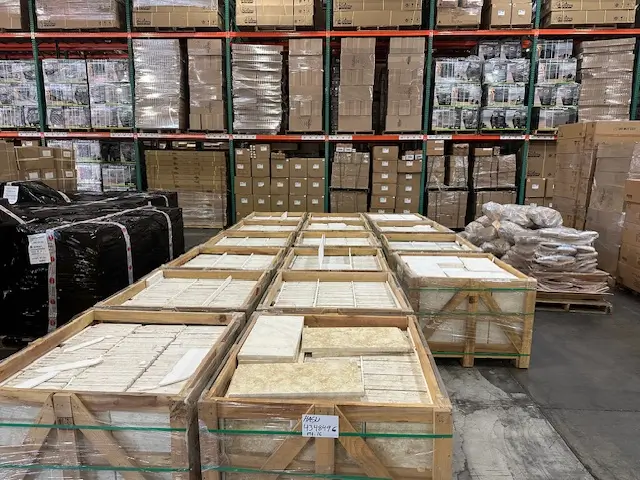
The journey from primary cut slab to your project site typically involves three or four handling stages — finishing mill, quality grading, containerization, and warehouse receiving. Each stage introduces the possibility of thermal shock, mechanical impact, or moisture exposure that can affect the material you actually install. Responsible suppliers conduct incoming inspections at the warehouse level, checking for edge chipping, tone variation beyond the agreed batch tolerance, and surface blemishes that weren’t apparent in the quarry grading photos.
Delivery logistics also affect your project schedule in ways that material selection alone doesn’t reveal. Container shipping from Mediterranean quarries typically runs 6–8 weeks port to warehouse, which means your procurement window needs to open well before the installation date. Citadel Stone maintains ongoing warehouse inventory of core product lines, which reduces lead times to 1–2 weeks for in-stock materials compared to the full import cycle. Truck access at your site is worth confirming early — full-container stone deliveries require a truck with sufficient turning radius and offloading clearance, and a failed delivery attempt adds both cost and schedule delay.
- Request batch photos from the finishing mill, not just quarry samples — finish quality can shift between runs
- Grading standards (Commercial, Select, Premium) vary by quarry and country — confirm the grading standard before ordering
- Warehouse storage conditions matter for porous stones — confirm slabs are stored upright with edge protection
- Delivery truck weight limits vary by road and season — verify local load restrictions before scheduling
Quality Variables the Stone Quarry Process Introduces
Natural variation is unavoidable in quarried material — tone shifts, veining density changes, and minor porosity fluctuations occur even within a single block. The stone quarry process determines how much of that variation reaches you. Premium operations run continuous colorimetric grading on the finishing line, separating slabs into tone groups that allow you to blend batches predictably on site. Lower-tier operations rely on visual inspection alone, which introduces more variation into your installation than most clients expect when they approve a small sample.
According to USGS geological data on volcanic and sedimentary stone composition, mineral heterogeneity in natural stone formations is inherent to the geological process — it is not a manufacturing defect. Setting this expectation with your client before material arrives prevents disputes during installation. Order 10–15% overage on any natural stone project, and retain matched offcuts from the original batch for future repairs — replacement stock from a later quarry cut may not match the tone of your original installation, even from the same formation.
- Tone grouping at the quarry level is the most effective way to manage visual consistency across large areas
- Vein direction can be specified as cross-cut or length-cut — this is a quarry instruction, not a finishing decision
- Batch traceability to a specific quarry block is available from premium suppliers and is worth requesting for high-value projects
- Color variation expands after sealing — always view samples wet before approving a finish specification
Expert Summary
The stone quarry process is not background context — it is the first specification decision in every natural stone project, whether you recognize it or not. The extraction method, block formation, primary cut tolerances, finishing line processes, and supply chain handling all arrive embedded in the slab before you make a single installation decision. Your drainage design, adhesive selection, joint spacing, and sealing protocol all follow directly from those upstream variables. Treat the quarry origin documentation as a specification input, not a marketing asset, and you’ll avoid the failure modes that trace back to mismatched material and installation assumptions.
As you develop your stone project specification, the performance of smooth-finished natural stone in interior applications is another dimension worth understanding — how smooth stone performs on floors and countertops covers finish selection and surface behavior in detail. Sourced direct from quarries in Turkey, the Mediterranean, and beyond, Citadel Stone tracks each block from cut to finished slab.
Related reading: lava stone · what is honed stone · Natural Stone Tile Installation: A Step-by-Step Guide.