

Not every stone paver manufacturer operates at the same specification level — and the gap between them shows up in your finished project, not in a brochure. Stone paver manufacturers vary dramatically in quarry control, dimensional tolerancing, and surface finish consistency, and the difference between a supplier who owns their cutting operation and one who brokers material from a dozen intermediaries becomes painfully obvious when you’re 800 square feet into an installation and your joint lines start drifting. Understanding what separates these manufacturers is the first and most consequential decision on any natural stone project.
What Defines a Stone Paver Manufacturer
The term gets used loosely across the industry, covering everyone from fully integrated quarry operators to importers who apply finishing work domestically. Your specification process changes depending on which type you’re dealing with. A fully integrated manufacturer controls the extraction, gang-sawing, surface finishing, and quality inspection under one roof — that chain of custody translates directly into tighter dimensional tolerances and more consistent material properties lot to lot.
Distributors who source finished slabs and recut them locally occupy the middle ground. They can offer genuine value on customization lead times, but their raw material consistency depends entirely on how tightly they vet their upstream suppliers. What you want to ask any prospective stone paver manufacturer is simple: where does the stone come from, and at what point in the process do you take ownership of it? The answer tells you more than any spec sheet.
- Vertically integrated manufacturers offer tighter batch consistency and direct quality accountability
- Distributors with finishing capability provide faster customization but variable raw material sourcing
- Import brokers offer the widest material variety but the least process control
- Domestic quarries excel in turnaround time but are limited in stone variety compared to international sources
Dimensional Tolerance and Why It Matters
Tolerance is where manufacturers separate themselves in the field. Natural stone paver manufacturers working to a ±1.5mm thickness tolerance give you predictable mortar bed depths and consistent surface planes. Those working to ±3mm or beyond force your installers to compensate at the bed, which increases labor hours and introduces long-term lippage risk. According to Natural Stone Institute fabrication standards, dimensional consistency is one of the primary quality benchmarks for evaluating dimension stone suppliers — and it directly affects installation efficiency and long-term performance.
Your thickness specification should always reference a tolerance range, not just a nominal dimension. Specifying “2-inch pavers” without a stated tolerance is functionally meaningless — you could receive material ranging from 1.75 to 2.25 inches from a loosely controlled operation. Specify “50mm nominal, ±1.5mm” and you hold the manufacturer to a real standard.
- Thickness tolerance of ±1.5mm is achievable from quality manufacturers and should be your minimum requirement
- Length and width tolerances for pavers typically run ±2mm from well-controlled cutting operations
- Squareness variation above 1mm per 300mm of length creates compounding joint drift across large installations
- Request calibration certificates, not just product spec sheets, when evaluating a new supplier
Material Grades and How Manufacturers Classify Them
Here’s what most specifiers miss: stone grading is not standardized across manufacturers the way lumber grades or concrete mix designs are. One manufacturer’s “Grade A” limestone is another’s “commercial grade” — the terminology doesn’t translate. What does translate are the underlying physical properties: water absorption, compressive strength, modulus of rupture, and abrasion resistance. These are testable, objective, and comparable across any source.
The ASTM standards most relevant to paver stone manufacturers are C568 for limestone, C615 for granite, and C503 for marble — each specifies minimum compressive strength and absorption thresholds. ASTM fabrication and quality testing standards provide the technical framework that translates manufacturer quality claims into defensible specification language. Ask your manufacturer which ASTM classifications their material meets and request third-party test certificates, not internal documentation.
- Water absorption below 3% for limestone pavers indicates dense, durable material suitable for exterior use
- Compressive strength above 4,000 PSI is the practical minimum for pedestrian paver applications
- Modulus of rupture above 1,000 PSI matters most for larger format pavers spanning wider joint gaps
- Abrasion resistance ratings become critical in high-traffic commercial and vehicular applications
Comparing Natural Stone Paver Manufacturers by Source Region
Source region carries real technical significance beyond aesthetics — the geology determines the material’s inherent properties. Turkish limestone and travertine quarried from the Denizli and Afyon regions produce material with remarkably consistent color banding and absorption characteristics, making them among the most predictable stones for large-format paver installations. Manufacturers sourcing from these quarries have decades of production data behind their specifications.
Indian granite manufacturers offer exceptional compressive strength — often exceeding 18,000 PSI — which matters significantly when specifying paver stone manufacturers for vehicular load applications. Brazilian quartzite producers have expanded their paver offerings substantially, delivering material with surface hardness values that outperform most sedimentary alternatives. USGS dimension stone fabrication and wholesale industry data provides context on international production volumes and where supply chains are most mature, which correlates with manufacturer process sophistication.
Cross-reference a manufacturer’s stated source region with independent geological data before locking in a specification. Material described as “Turkish travertine” from a reputable producer is technically distinct from material with the same label from a less controlled supply chain.
Surface Finishes and What Manufacturers Can Consistently Produce
Not every manufacturer excels across all finish types — this is a detail that rarely shows up in catalogs but matters enormously in practice. Honed finishes require consistent abrasive sequences with controlled grit progression; manufacturers cutting corners on this step produce surfaces with micro-scratches that show dramatically under raking light. Tumbled finishes require controlled mechanical or hand tumbling with consistent exposure time — over-tumbled material loses its edge definition, and under-tumbled material never achieves the authentic worn character the finish promises.
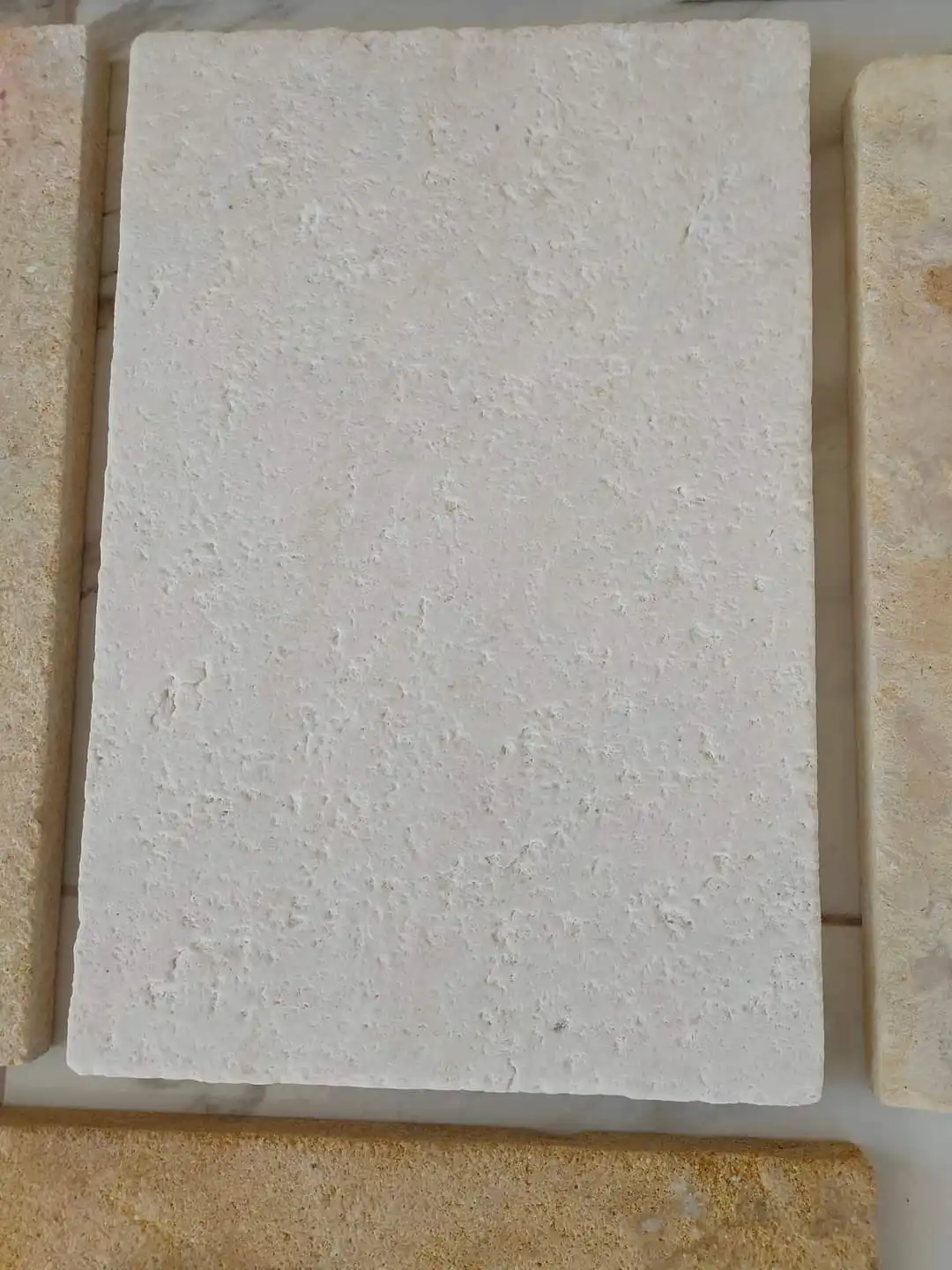
Natural stone paver manufacturers with in-house finishing capability give you far better consistency than those outsourcing finishing work. When evaluating a supplier, request full-size samples of at least three different production runs — color and finish variation between runs is the fastest way to identify a manufacturer without adequate process control. Brushed and sandblasted finishes applied to travertine and limestone also reveal a manufacturer’s skill level quickly; inconsistent brush pressure creates a patterned appearance that photographs poorly and reads as low quality at scale.
- Honed: consistent 220–400 grit sequence required; check for micro-scratch patterns under directional light
- Polished: only relevant for interior applications; outdoor polished stone becomes dangerously slippery when wet
- Tumbled: request edge profile samples — the arrises should be softened uniformly, not randomly chipped
- Brushed: check for consistent texture depth across the full slab surface, not just the center
- Bush-hammered: verify consistent impact density — random patterning indicates manual finishing without quality control
Storm Resistance and Installation Integrity
The manufacturer’s role doesn’t end at the factory gate — material specification decisions made during sourcing directly affect how your installation holds up under mechanical stress from storm events. Joint integrity under wind-driven rain depends on both the paver’s edge geometry and its absorption characteristics. A paver stone manufacturer producing material with tight, consistent edge cuts allows you to maintain joint widths between 3–5mm, which significantly reduces the volume of water infiltration during sustained wind-driven rainfall compared to poorly cut material that forces 8–10mm joints.
Edge restraint performance under wind loading and hydrostatic pressure depends on paver thickness and base bond strength. For exposed installations in regions with significant storm activity, specifying a minimum 40mm (1.5-inch) thickness from your manufacturer is the practical threshold where pavers develop enough mass to resist displacement under the uplift forces created by high wind events. Thinner material — particularly in the 20–30mm range — is genuinely vulnerable to edge displacement when impacted by debris or subjected to repeated wind-pressure cycling across large open surfaces. Hail impact resistance follows the same logic: denser, thicker material from quality paver stone manufacturers handles impact energy without surface spalling, while undersized or poorly finished material fractures at the surface layer.
- Specify minimum 40mm thickness for any installation exposed to open-sky conditions with storm frequency
- Request edge geometry specifications — consistent machine-cut edges allow tighter joints that resist wind-driven water infiltration
- Denser material (lower absorption rates) resists freeze-thaw degradation that follows repeated storm saturation cycles
- Base preparation depth should increase to 8–10 inches compacted aggregate for high-wind exposure zones
Lead Times, Inventory, and What to Ask Before You Commit
The difference between a manufacturer with warehouse stock and one who produces to order can be eight to twelve weeks on your project schedule. Most paver stone manufacturers operating at the international production level work on consolidated container shipments — they batch orders until a full container is ready, then process. That’s efficient for the manufacturer but punishing for a project with a defined completion date. Understanding this before you specify protects your schedule.
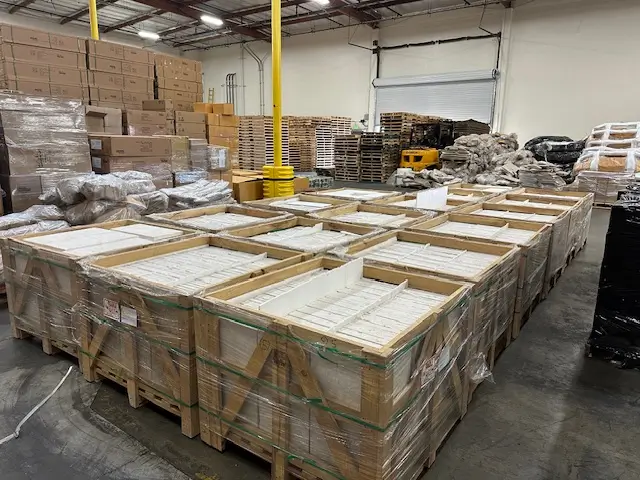
Citadel Stone maintains warehouse stock of natural stone pavers available for immediate dispatch, which typically reduces lead times to one to two weeks compared to the standard six-to-eight-week import cycle. That’s a meaningful schedule advantage on time-sensitive projects. Confirm warehouse stock levels directly before finalizing your material quantities — a manufacturer whose stock levels fluctuate significantly may cause mid-project supply interruptions, particularly on projects requiring multiple truck deliveries staged across phases. Also confirm that the material available from warehouse stock comes from the same production batch as your sample — batch-to-batch color variation in natural stone is real and can be significant.
- Always request the production batch date of warehouse stock and compare it to your sample batch
- Confirm minimum order quantities — some manufacturers require full-container minimums even from stock
- Ask about truck delivery scheduling flexibility, particularly for phased projects requiring multiple drops
- For large projects, request a material hold with a written confirmation before finalizing your purchase order
Before placing your order, explore our outdoor stone paving options to compare available formats, finishes, and natural stone varieties currently in stock for immediate national delivery.
Evaluating Quality Control and Certification Standards
Quality control documentation is the fastest way to distinguish a manufacturer who takes specification seriously from one who relies on visual sampling alone. At Citadel Stone, we conduct warehouse quality checks on incoming material — measuring thickness tolerance across representative samples from each pallet and inspecting surface finish consistency before the material is made available for order. That process catches the 8–12% of material in any given production run that falls outside tolerance, before it reaches a project site.
Third-party laboratory test reports are the gold standard for evaluating stone paver manufacturers you haven’t worked with before. Ask specifically for ASTM C97 (water absorption and bulk specific gravity), ASTM C170 (compressive strength), and ASTM C880 (flexural strength) — these three tests together give you a complete mechanical profile of the material. Manufacturers who can’t provide these reports or who offer only internal testing data should be approached with caution. The Natural Stone Institute’s fabrication certification program provides a useful benchmark for identifying manufacturers who operate to a verifiable professional standard.
- ASTM C97: water absorption and density — request results below 3% absorption for exterior pavers
- ASTM C170: compressive strength — minimum 4,000 PSI for pedestrian, 7,500 PSI for vehicular applications
- ASTM C880: flexural strength — critical for large format pavers over 24 inches in any direction
- NSI accreditation indicates the manufacturer has undergone independent process and quality auditing
Final Recommendations for Specifying Stone Paver Manufacturers
Choosing between stone paver manufacturers comes down to a structured evaluation of four factors: dimensional control, material testing documentation, source region transparency, and supply chain reliability. The manufacturers worth specifying are those who can answer direct technical questions without deflecting — what tolerance do your cutting lines produce, what ASTM tests has this material batch passed, and what does your warehouse stock level look like today. Vague answers to any of those three questions should move a manufacturer down your shortlist.
Your project’s long-term performance depends more on this selection decision than on any subsequent installation variable. A manufacturer producing consistent, tested, well-documented natural stone pavers gives your installation team a fighting chance at achieving the 20-plus-year service life that natural stone promises. One producing poorly toleranced, undertested material forces your installers to compensate at every stage — and the cumulative effect of those compensations shows up as an aging installation within five years. As you plan your hardscape project and consider complementary stone applications, Coronado Stone product details and applications covers another dimension of Citadel Stone’s natural stone range worth reviewing. Stone for nationwide projects ships from premium quarries in Turkey and the broader Middle East region, cut for dimensional accuracy.
Related reading: manufactured vs natural stone veneer · engineered vs natural stone · sintered stone vs quartz.