

What White Travertine Countertops Actually Demand From You
White travertine countertops perform beautifully in the right specification — and frustrate owners who treat them like engineered quartz. The porosity range on white travertine stone typically runs between 3% and 8%, which means unsealed or under-sealed surfaces absorb cooking oils, wine, and acidic liquids within minutes, not hours. Understanding that absorption rate before you commit to a material selection is the difference between a countertop that ages gracefully and one that tells every dinner party story it shouldn’t. Your specification needs to account for sealing frequency, edge profile tolerances, and finish type before the first slab ever leaves the warehouse.
Porosity and What It Means at the Countertop Level
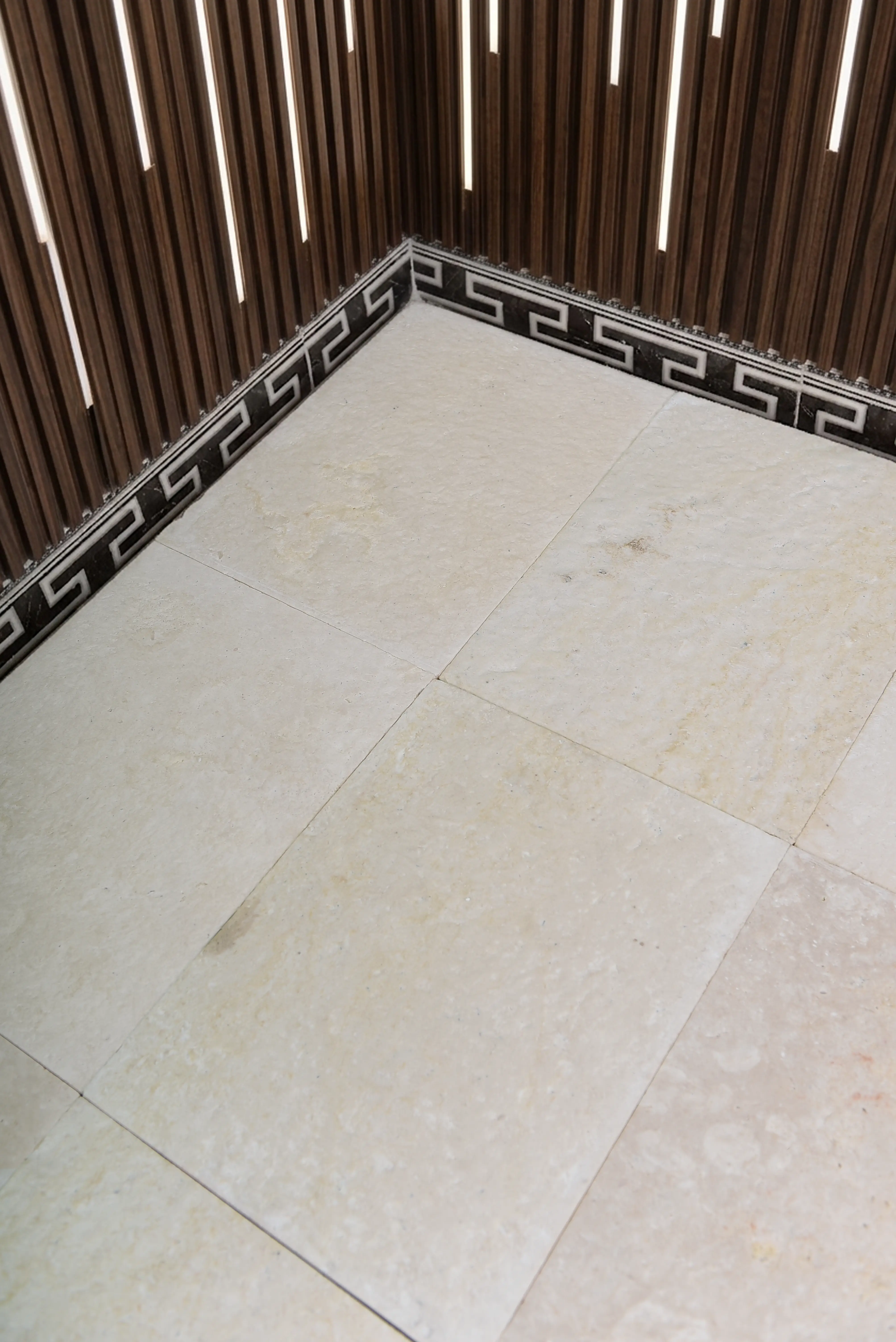
The interconnected void structure in travertine isn’t a flaw — it’s a geological signature. The ASTM C1527 standard for travertine dimension stone acknowledges this, classifying travertine into filled and unfilled categories precisely because the voids are a defining characteristic. For countertop applications, you’ll almost always want filled travertine — voids left open collect debris, harbor bacteria, and create micro-crack initiation points under thermal cycling from hot pans. Filled white travertine stone gives you a more workable surface while retaining the material’s natural warmth and movement.
Surface absorption also ties directly to stain resistance. According to ASTM C1527 travertine dimension stone standards, absorption coefficients vary significantly across travertine grades, which is why specifying a maximum absorption rate in your purchasing documents protects you from receiving material that looks right but performs poorly under kitchen conditions. A 3% or lower maximum absorption spec is a reasonable professional threshold for countertop-grade white travertine countertops.
Finish Selection: Honed, Polished, or Brushed?
Your finish choice shapes the countertop’s daily relationship with water, oil, and cleaning agents more than almost any other single decision. Each option carries a distinct performance profile worth mapping against your project’s use intensity.
- Honed finish — matte surface, moderate sheen, more forgiving of minor scratches and dulling from acid etching; the most practical choice for high-use kitchen countertops
- Polished finish — high reflectivity, visually dramatic, but etching from citrus juice or vinegar shows immediately as dull patches on the polished surface
- Brushed finish — textured surface that hides minor imperfections well, reduces glare, and pairs naturally with informal or rustic design schemes
- Tumbled finish — aged appearance, rarely used on countertops due to uneven surface that complicates food prep and cleaning
For kitchen applications, white travertine tiles cut to countertop dimensions outperform polished surfaces in real-world use. Polished finishes belong in bathrooms and low-acid-contact applications — vanity tops, wet bar surrounds, fireplace mantels — where their visual impact isn’t undercut by daily etching exposure.
Sealing Protocols That Actually Protect Your Investment
A single coat of impregnating sealer at installation isn’t a sealing program — it’s a starting point. White travertine countertops require a penetrating, solvent-based impregnating sealer applied in two coats at installation, with the second coat applied before the first fully cures. This two-coat wet-on-wet technique drives sealer deeper into the pore structure than sequential dry applications can achieve. For kitchen countertops specifically, resealing every 12 to 18 months is a realistic maintenance schedule, not the overly conservative “every few years” advice that leads to stain damage.
The water bead test tells you objectively when a reseal is needed: pour a tablespoon of water on the surface. If it beads and sits for 10 minutes without darkening the stone, the seal is holding. If it absorbs within 3 to 4 minutes, you’re overdue. Your maintenance schedule should be driven by this test, not by a calendar, because traffic patterns, cleaning product chemistry, and environmental conditions vary enough to make fixed intervals unreliable.
Thickness Specifications for Countertop Applications
The Natural Stone Institute’s technical documentation on travertine properties confirms that countertop slabs in the 3 cm (1.25-inch) nominal thickness range deliver the structural performance you need for unsupported spans over cabinet openings. At NSI travertine material guidance, the recommendation aligns with field experience: 2 cm slabs require continuous substrate support — no overhangs beyond 6 inches without reinforcement — while 3 cm material handles overhangs up to 12 inches in most residential applications without risk of flex-induced cracking.
You’ll also encounter book-matched slab configurations for countertop runs that exceed single-slab width. Book-matching white travertine stone pairs mirror-image vein patterns across adjacent slabs — the visual effect in a kitchen island or long run is exceptional, but it demands precise layout planning at the warehouse before fabrication. Confirming that your supplier has matched pairs in inventory before you commit to a design layout saves significant rework cost.
Chemical Sensitivity: What Happens When Acids Meet Travertine
Travertine is calcium carbonate — and calcium carbonate reacts visibly with acid. This isn’t a material defect; it’s fundamental chemistry, and the reaction affects white travertine countertops more visibly than darker materials because etching appears as a light, dull patch against what was a bright white or cream surface. Lemon juice, tomato sauce, coffee, wine, and most bathroom cleaners are acidic enough to etch a polished or honed finish if left in contact for more than a few minutes without a good sealer in place.
- Never use vinegar, bleach, or ammonia-based cleaners on white travertine — all three damage either the stone or the sealer
- Use pH-neutral stone cleaners specifically formulated for calcium carbonate-based materials
- Wipe spills immediately — the sealer buys you time, not immunity
- Etch marks on honed surfaces can be polished out with a fine diamond polishing pad; etch marks on polished surfaces require professional re-polishing to restore
- Hard water deposits from faucet splatter should be removed with a non-acidic descaler, not standard bathroom calcium remover
At Citadel Stone, we recommend briefing clients on this chemical sensitivity before countertop installation is complete — not after the first etch incident. Setting expectations upfront about daily care translates directly into better long-term satisfaction with the material.
Design Integration and Aesthetic Pairing
White travertine countertops occupy a design register that very few materials can match — warm ivory and cream tones with organic veining that reads as refined without being cold. This makes the material genuinely versatile across design vocabularies. In a modern minimalist kitchen, honed frost white marble-adjacent travertine tones hold their own against flat-front cabinetry and brushed metal hardware without competing. In a Mediterranean or Tuscan-influenced interior, the stone’s geological character reinforces the warmth that those design traditions demand.
The material also integrates naturally with broader landscape and outdoor design schemes when the interior extends to covered outdoor kitchens or alfresco entertaining spaces. Desert-influenced xeriscaping schemes with warm sandstone palettes and low-water planting find a clear material echo in white travertine stone’s mineral tones. Contemporary tropical planting schemes — bold leaf forms, humid greens — contrast beautifully with the stone’s cool ivory face, especially in open-plan homes where the interior countertop is visible from an outdoor garden setting. Your selection of vein pattern weight — whether you choose lighter, more uniform movement or more dramatic clouding — should account for how the countertop reads in the context of the broader design palette it inhabits.
Ordering, Logistics, and Slab Selection
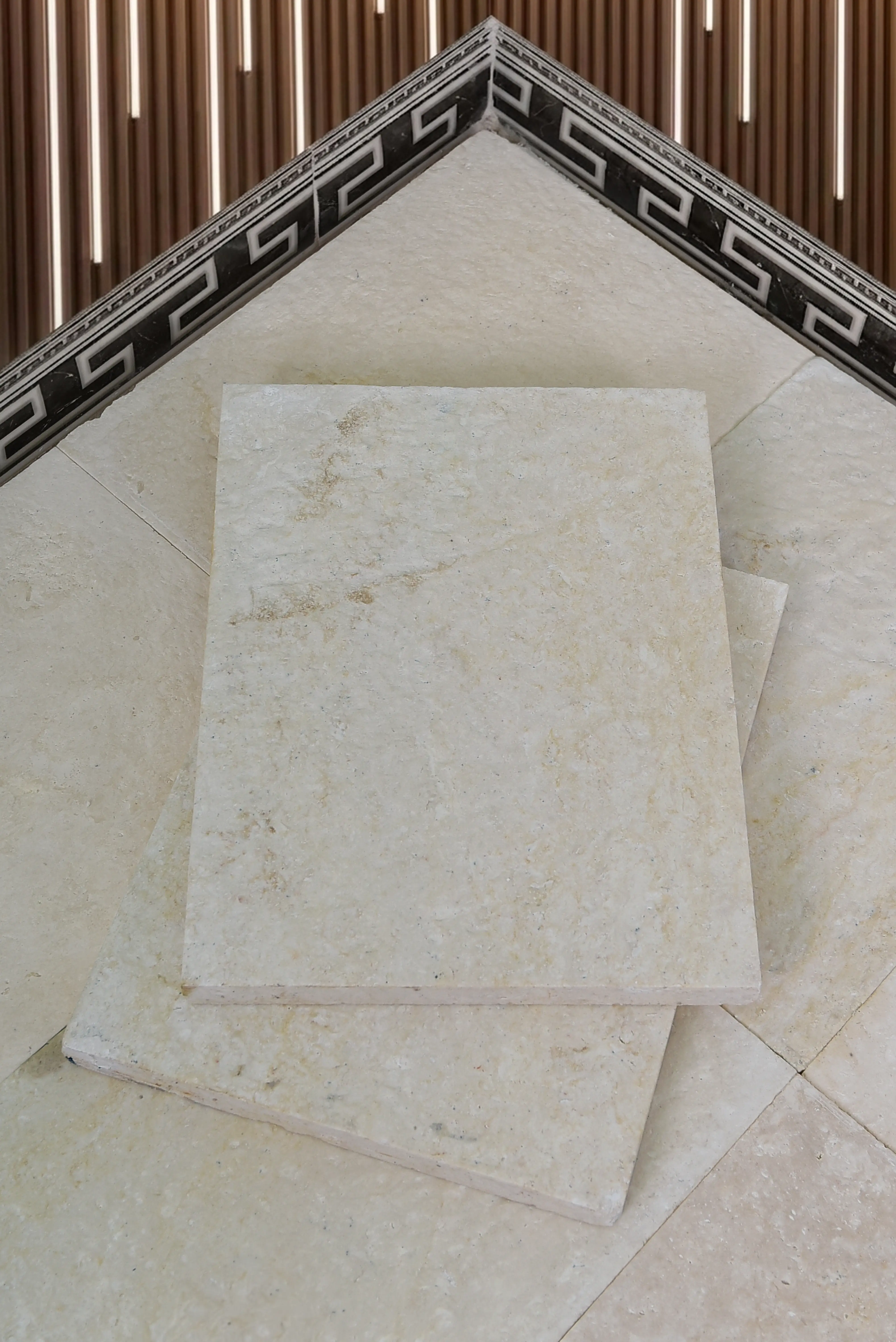
Travertine is a natural material — two slabs from the same quarry block will share tonal family but differ in veining intensity, void distribution after filling, and background colour warmth. Your countertop specification needs to account for this by requiring slab selection in person or via high-resolution photography before fabrication begins. Approving a sample tile and then fabricating from unreviewed slabs is a reliable path to disappointment on larger countertop projects.
For projects requiring matched pairs or specific tone ranges, confirming warehouse inventory levels early in the project timeline is non-negotiable. White travertine stone slabs aren’t fungible commodities — specific lots differ enough that replacing a damaged slab mid-project with new inventory can result in a visible colour mismatch. Verify that your supplier holds sufficient inventory from a consistent batch, and if truck delivery logistics require multiple shipments, confirm that all slabs ship from the same production lot. Citadel Stone maintains inventory from consistent quarry sources, which simplifies this matching process considerably for specification-sensitive projects.
The Natural Stone Institute stone variety specifications provide useful framework guidance on what to expect in terms of natural variation tolerances — reviewing these benchmarks before finalising your purchase documents helps you write realistic acceptance criteria that protect both parties without being unreasonably restrictive.
Comparing White Travertine Against Alternative White Stones
The white countertop category is competitive, and white travertine stone sits between engineered quartz on one end and natural marble on the other in terms of maintenance intensity and visual character. Frost white marble — specifically Bianco Carrara — is the comparison most buyers draw instinctively. Both materials share the calcium carbonate base and acid sensitivity, but travertine’s warm undertones and organic void texture create a more textural, less clinical aesthetic than Carrara’s grey-veined crisp white. Marble’s veining pattern tends toward more dramatic movement; travertine reads quieter and more consistent across large countertop runs.
- White travertine vs engineered quartz — travertine requires more maintenance but delivers a natural material character and heat resistance that engineered products can’t replicate
- White travertine vs white marble — comparable maintenance demands; travertine is typically more affordable per square foot for comparable slab quality
- White travertine vs white quartzite — quartzite is harder and more acid-resistant, but lacks travertine’s warm organic texture
- White travertine vs white limestone — similar geological family, but travertine’s more pronounced veining and void-fill texture gives it greater visual interest for countertop use
The decision between travertine and its alternatives comes down less to absolute performance ranking and more to which trade-offs align with the project’s use patterns and the owner’s maintenance commitment. For buyers who want natural stone character without the full maintenance intensity of polished marble, white travertine countertops offer a well-calibrated middle path — and white travertine tiles present an additional format worth evaluating for backsplash or surround applications where full slab coverage isn’t required.
What Matters Most When Specifying White Travertine Countertops
Specifying white travertine countertops successfully means resolving three decisions before anything reaches a fabricator: filled versus unfilled slab, finish type matched to use intensity, and a realistic sealing and maintenance protocol that the owner will actually follow. These three decisions collectively determine whether the installation performs beautifully for two decades or frustrates within two years. The material itself is exceptional — the specification and care framework around it is what separates outcomes. For projects where you’re weighing white travertine against other natural white stones, understanding the full material profile is essential — how white travertine compares to white marble is a useful next reference point that covers the specification distinctions in detail.
Your countertop project also benefits from reviewing complete slab inventory with your supplier before finalising layout dimensions — confirmed batch availability from the warehouse prevents the costly scenario of sourcing replacement material from a different production lot. When truck delivery schedules span multiple drops, verifying that all material originates from the same production lot is equally critical to achieving a consistent finished installation. For hands-on specification guidance and slab selection support, Citadel Stone countertop travertine provides the technical and sourcing resources to get your project right from the first decision. Sourced from premium quarries in Turkey and the broader Middle East region, Citadel Stone’s white travertine countertops ship as book-matched pairs.
Related reading: pool coping materials compared · pool coping types explained · pool tile installation guide.