

What Limestone Actually Demands From a Driveway
This white limestone driveway guide starts where most installation failures begin: not at the surface level but three inches below it — specifically at the transition zone between compacted aggregate and whatever the native soil happens to be doing that season. Limestone itself is remarkably forgiving mechanically, but it will broadcast every subgrade deficiency through cracked joints and rocking pavers within two to three seasons. The material’s compressive strength typically ranges from 4,000 to 9,000 PSI depending on formation density and quarry source, which is more than sufficient for passenger vehicle loads — but that number becomes irrelevant if the base underneath is moving.
Thickness specification is where most residential projects underperform. For standard passenger vehicle use, 2-inch nominal pavers on a 6-inch compacted aggregate base are the working minimum. Upgrade to 2.375-inch pavers when any commercial vehicle — delivery trucks, moving vans, refuse collection — will access the drive regularly. That additional thickness changes the load distribution geometry in ways that matter at the paver-to-paver joint level.
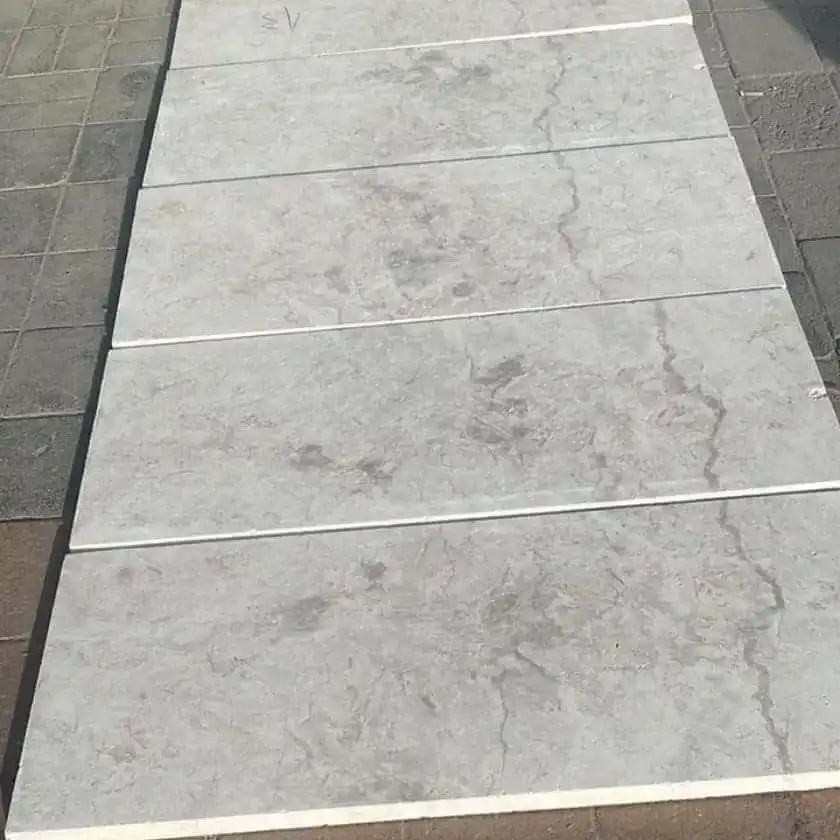
Understanding Natural Stone Driveway Load Capacity
Natural stone driveway load capacity isn’t a single number — it’s a system rating that combines paver thickness, joint sand performance, aggregate base depth, and subgrade bearing capacity. You’ll find limestone pavers for driveway use specified at 2 inches for residential applications, but the aggregate base does the structural heavy lifting. A well-compacted 6- to 8-inch crushed stone base distributes a 4,000-pound vehicle axle load across a footprint wide enough to keep unit bearing stress well below threshold values for typical subgrade soils.
Point loads tell a different story. Scissor jacks, dumpster placements, and delivery equipment with outriggers concentrate force in a way that distributed vehicle weight never does. For those scenarios, spec 2.375-inch pavers minimum, and place a 1-inch bedding layer of coarse angular sand — not fine beach sand — directly beneath the paver. Angular grains lock under load instead of shifting, which is the difference between a stable paver and one that slowly migrates out of plane. According to Natural Stone Institute stone specifications, proper base preparation is consistently cited as the primary determinant of long-term paving performance across all stone types.
Driveway Paver Base Depth Requirements: Getting the Numbers Right
The driveway paver base depth requirements that circulate in generic installation guides are often written for concrete pavers, not natural stone. Concrete pavers have more consistent thickness tolerances; natural limestone pavers can vary ±1/8 inch within a production batch. That variability means your bedding layer has to accommodate slight thickness differences without creating lippage — the technical term for pavers that sit at different heights relative to adjacent units.
Here’s the practical spec breakdown:
- Residential passenger vehicles: 6-inch compacted angular crushed stone base, 1-inch coarse sand bedding, 2-inch minimum limestone paver
- Mixed residential and light commercial traffic: 8-inch compacted aggregate base with two compaction lifts, 1-inch bedding, 2.375-inch paver
- Heavy-duty access (refuse, delivery): 10-inch base, geotextile fabric between subgrade and aggregate, 3-inch limestone where available
- All applications: compact aggregate in maximum 4-inch lifts — attempting to compact 8 inches in one pass produces a hard surface crust over loose material below, which fails unpredictably
- Plate compactor minimum: 3,500 lb/ft² centrifugal force for proper aggregate interlock
The base depth numbers above assume stable, non-expansive soil. If you’re working over expansive clay or poorly draining fill material, those numbers change significantly — more on that in the soil section below.
Soil and Subgrade Stability for Limestone Driveways
Your subgrade is doing one of three things: it’s stable and load-bearing, it’s actively moving due to moisture cycling, or it’s somewhere in the transitional zone between those two states depending on the season. Identifying which category applies to your site before the first paver is ordered is non-negotiable. Expansive clay soils — common across broad swaths of the country — can generate uplift pressures exceeding 5,000 PSF when saturated, which is enough to shift a limestone driveway installation significantly over a single wet season.
Sandy soils present the opposite problem: excellent drainage and low swell potential, but poor bearing capacity when loosely packed. A plate compactor will often reveal sandy subgrades that densify well initially but require geotextile reinforcement to prevent aggregate migration into the native soil over time. Rocky or caliche subgrades may require excavation depth adjustments — caliche layers are frequently shallower than expected and can force a thinner aggregate section than the load calculations require, necessitating a thicker paver to compensate.
The practical test most installers skip: probe the subgrade at multiple points across the full driveway footprint before compacting. A consistent 18-inch depth of stable material is your working target. Soft spots that accept a steel probe with minimal resistance need either geotextile and aggregate reinforcement or localized subgrade replacement before you begin base work. The USGS limestone composition data reinforces that even high-quality limestone performs only as well as the system beneath it allows.
- Expansive clay: extend aggregate base depth by 2–4 inches and consider a geotextile barrier at the subgrade interface
- Sandy subgrade: install a non-woven geotextile fabric to prevent aggregate migration, then compact to 95% standard Proctor density
- Caliche or rocky subgrade: verify excavation depth provides at least 8 inches of aggregate clearance above the hard layer
- Fill material or disturbed soil: allow a minimum 90-day settlement period or use engineered compaction to achieve equivalent density before base work begins
Selecting White Limestone Pavers for Your Driveway
Not all white limestone driveway pavers are specced the same way, and the visual similarity across product lines can create a false sense that they’re interchangeable. The variables that actually matter are absorption rate, abrasion resistance, and finish type — and they interact directly with your maintenance commitment and climate exposure. Absorption rates below 3% are your target for driveways; higher absorption accelerates staining from oil, tire residue, and organic debris in ways that no sealer fully corrects after the fact.
Abrasion resistance is measured by the MOHS hardness scale, but in practical driveway terms, what you’re evaluating is surface wear under repeated tire loading, sand abrasion, and snow removal equipment contact. Dense limestone formations from high-pressure geological environments perform significantly better here than softer oolitic or shell-bearing varieties. Ask for the specific formation data when specifying — the origin quarry tells you more about long-term abrasion performance than the product marketing sheet ever will.
Explore our limestone pavers for driveways to review formation data, thickness options, and surface finish availability before committing to a specification. Having that information early in the design phase prevents costly mid-project substitutions.
Surface Finish Options and Slip Resistance
The finish you specify on white limestone driveway pavers affects three things simultaneously: aesthetic character, slip resistance, and long-term maintenance requirements. Polished finishes are a non-starter for driveways — the dynamic coefficient of friction drops below 0.5 when wet, which puts you in liability territory and defeats the practical function of the surface. The two finishes that consistently perform well in driveway applications are brushed and flamed.
Brushed finishes use wire or abrasive brushing to open the surface texture without significantly altering the stone’s natural character. The result is a moderate texture — typically achieving a static coefficient of friction above 0.6 dry and 0.5 wet, which meets general slip-resistance thresholds for pedestrian and vehicle applications. Flamed finishes apply intense heat to the surface, causing differential crystal expansion that creates a highly textured, non-directional grip surface. Flamed white limestone is particularly effective where wet-weather tire traction is a priority, as the texture depth is more pronounced and self-cleaning under rainfall. Per limestone geological characteristics, the mineral composition of limestone — primarily calcite — responds predictably to thermal finishing, which is why the flame process produces consistent results across production batches.
- Brushed finish: recommended for lighter traffic driveways where aesthetics are the primary driver
- Flamed finish: recommended for steeper grades, wetter climates, or any installation where tire traction under rain is a frequent concern
- Honed finish: acceptable only on flat, level sections with very light traffic — avoid on any grade above 1.5%
- Tumbled finish: appropriate for pedestrian-adjacent sections but not for primary vehicle lanes due to uneven surface plane
Joint Sand, Drainage, and Long-Term Maintenance
The joint sand specification is one detail that gets underweighted in most white limestone driveway guides, but it’s the component with the shortest replacement cycle. Polymeric sand performs well in initial installation — the binders lock joint material against washing and ant excavation — but it requires replacement every 5–7 years as UV degradation and thermal cycling break down the polymer matrix. Plan for this in your maintenance budget rather than treating it as an unexpected cost.
Drainage geometry matters more in driveways than in any other paving application because the volume of water shedding from a vehicle-width surface is substantial. A minimum 1.5% cross-slope is your working standard; 2% is better on wider driveways. Move that water laterally off the surface rather than allowing it to sit in low points where it can infiltrate joint sand and undermine your bedding layer. Installing a perimeter drainage channel on the downslope edge is worth the upfront investment — it extends the effective life of the installation by managing the water that the cross-slope deposits at the edge.
For outdoor stone driveway maintenance tips, the two highest-impact actions are resealing every two years with a penetrating impregnator sealer and replacing joint sand whenever you notice thinning below the surface plane of the paver. Surface cleaning with a pH-neutral cleaner — never acid-based products on limestone — removes organic staining without compromising the calcite surface. Power washing at pressures above 1,200 PSI accelerates joint sand erosion and should be avoided in the primary vehicle lanes. Applying these outdoor stone driveway maintenance practices consistently is what separates a 25-year installation from one that needs intervention at year eight.
Ordering, Logistics, and Project Planning
Project planning for a white limestone driveway installation involves sequencing that most homeowners underestimate. The material order needs to be confirmed before excavation begins — not after — because warehouse availability windows and truck delivery scheduling create interdependencies that affect your installation timeline. Rather than quoting a standard shipping window, Citadel Stone cuts each order at its selected quarries and confirms the lead time once the specification is agreed. That matters when you have an excavation crew scheduled and a concrete contractor waiting for your driveway removal to clear.
Confirm your truck access configuration before ordering. Flatbed deliveries for limestone pavers require clear approach angles and turning radius clearance that many residential driveways don’t naturally provide during the construction phase — particularly when the existing driveway has been removed. Factor in a staging area for material off-loading that keeps pavers protected from subgrade contamination while remaining accessible for installation sequencing. Pallets of limestone should never sit directly on grade without protective sheeting below; moisture wicking from bare soil into the stone bottom layers affects dimensional stability.
- Order 10–15% overage on square footage to account for cuts, breakage, and grading adjustments
- Confirm warehouse stock in a single batch — color and texture variation between production batches can be visible in finished installations
- Schedule truck delivery for a date that allows 24–48 hours between material arrival and installation start, giving you time to inspect and sort pavers by thickness tolerance
- Request a material data sheet with absorption rate, compressive strength, and finish specifications for your project records
Professional Summary
A white limestone driveway installation done properly is a 20- to 25-year asset — done without adequate subgrade analysis and base preparation, it’s a 7-year replacement project. The specification decisions that compound into long-term performance are the aggregate base depth matched to your site’s actual soil conditions, the paver thickness matched to your realistic traffic loading, and the finish selection matched to your slope and rainfall exposure. None of those decisions are complicated, but each one requires site-specific thinking rather than generic chart-reading. At Citadel Stone, we guide specifiers and homeowners through those decisions before the order is placed — the detail work upstream is what separates installations that look the same after 15 years from those that don’t. Planning a broader hardscape project alongside your driveway? Check out white natural stone paver design ideas for creative applications that complement a limestone driveway and extend the material language across your property. White limestone pavers from Citadel Stone used in driveway applications are typically finished with a brushed or flamed surface to improve traction under wet conditions.
Related reading: high-gloss limestone finish performance · setting natural stone pavers on sand · limestone heat absorption around pool areas.