

Proportion is what separates compelling white natural stone paver design ideas from layouts that look flat in photographs and worse in person. The material itself doesn’t do the work — your spacing decisions, pattern direction, edge conditions, and how you handle grade transitions all determine whether the finished space reads as intentional or accidental. These seven design concepts cut through the generic advice and focus on the decisions that actually shape a finished installation.
Clean Linear Patterns for Modern Spaces
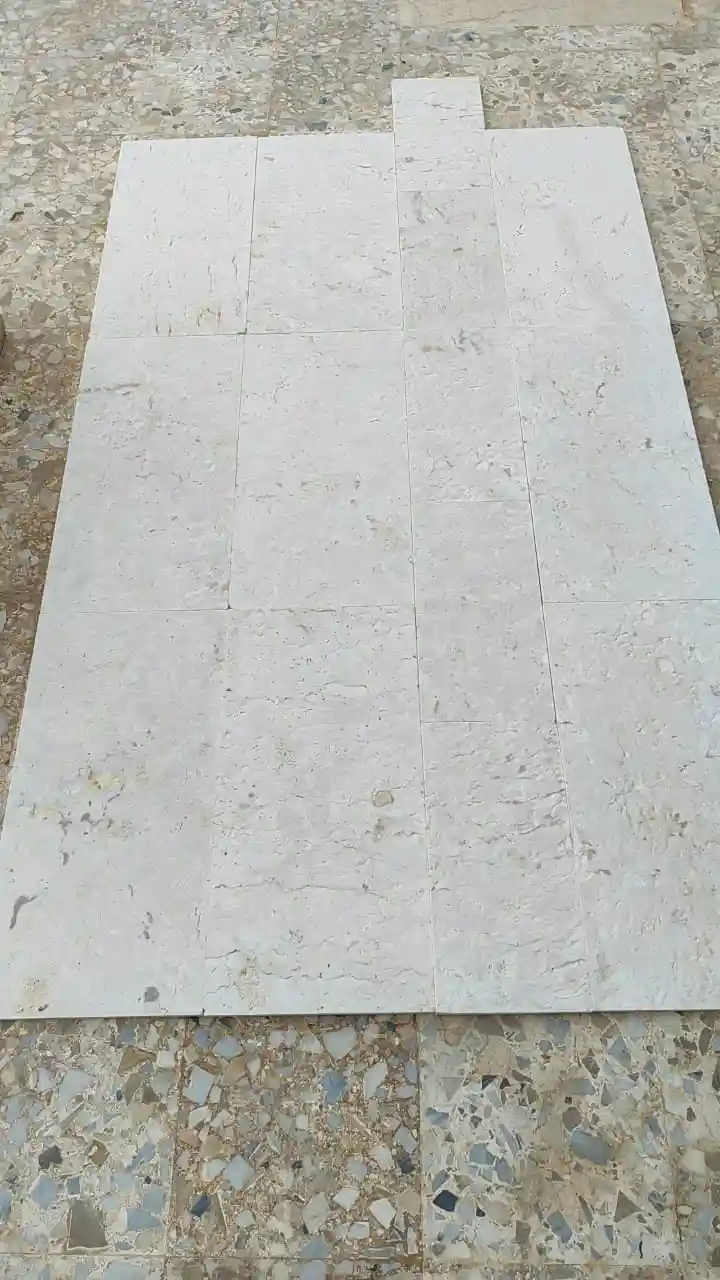
Running bond and stacked joint layouts in white natural stone pavers reward the spaces where architecture is already doing the heavy lifting. You’re essentially amplifying lines that the building or pool surround already establishes. The critical detail most designers miss is direction — a running bond oriented parallel to a long wall compresses the space visually, while a perpendicular orientation pulls the eye outward and makes the same square footage feel larger. For rectangular outdoor patio design with white stone, that single decision changes the spatial experience more than any material upgrade would.
Field performance data confirms that 24×12 plank-format pavers in running bond also reduce cutting waste by roughly 15–20% compared to random ashlar on rectilinear sites — a practical benefit that adds up fast on larger commercial terraces or estate-scale pool surrounds.
Ashlar Patterns and Visual Depth
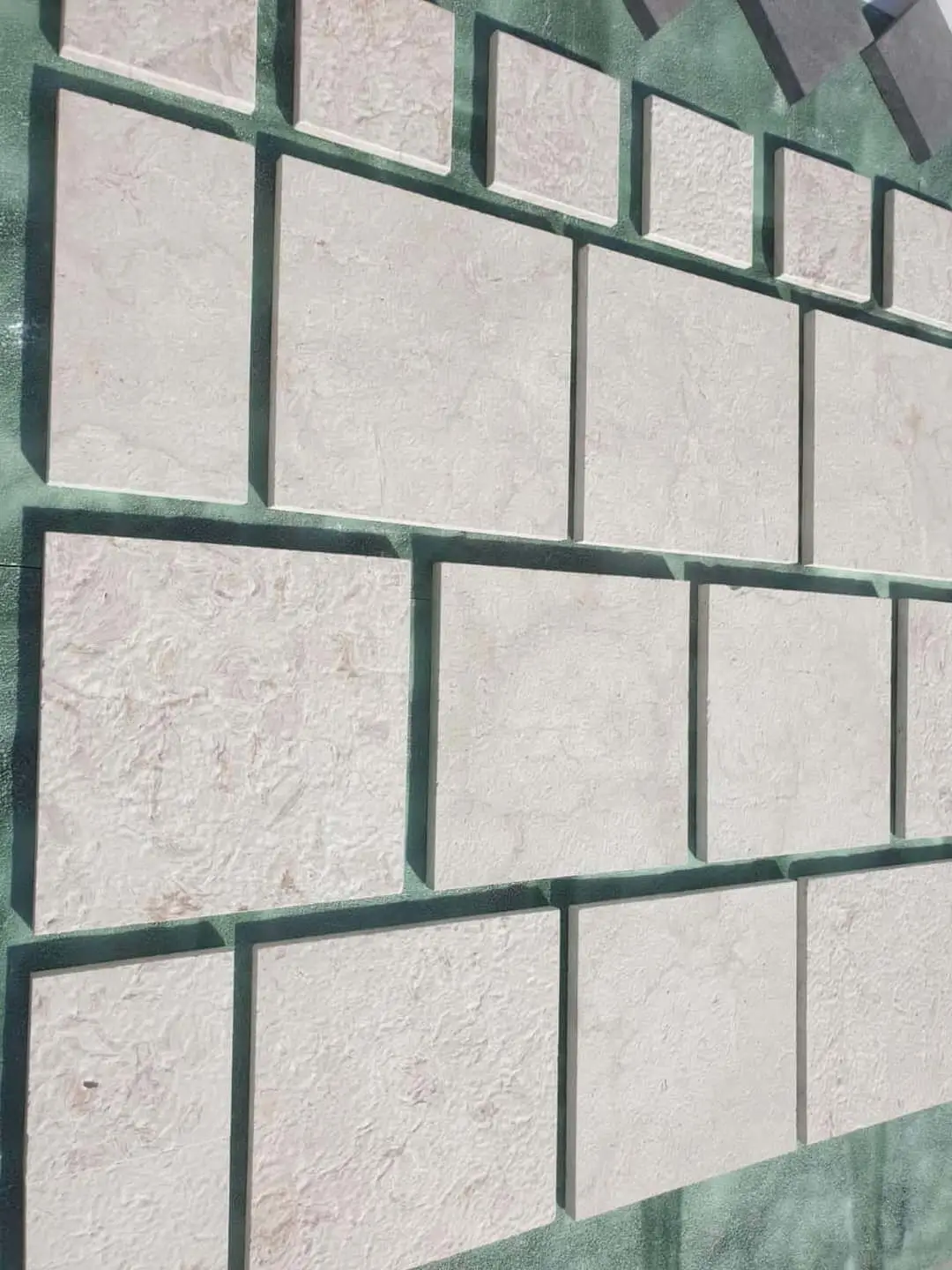
Ashlar layouts — three or more complementary sizes set in a non-repeating sequence — give white natural stone paver design ideas their most organic quality. The pattern mimics historic quarried stonework, and the irregular joint lines break up large expanses without adding visual noise. You’ll want to establish your size ratio before laying starts: a 2:1.5:1 relationship between your large, medium, and small units keeps the pattern balanced without looking forced.
What often gets overlooked in ashlar specification is the minimum joint width. Drop below 3/8 inch on an outdoor ashlar install and you create a grout trap that retains debris and drives moisture into the substrate. According to NSI limestone technical properties, calcium carbonate stones in outdoor settings benefit from joint maintenance that actively channels water away from the face rather than pooling it at edges. Hold your joints at 3/8 to 1/2 inch and you’ll preserve both the aesthetic and the drainage performance.
Pool Deck Layouts That Handle Wet Conditions
A white stone pool deck layout demands a different logic than a standard patio. Drainage gradient takes priority over pattern aesthetics — your 1/8 inch per foot cross-fall toward the pool surround drain isn’t optional, and your pattern choice needs to work with that slope rather than against it. Stacked joints parallel to the fall line create clean water channels; herringbone or diagonal patterns across a slope produce confusing drainage paths and accelerate joint erosion.
Honed finishes in the 400–600 grit range consistently test at a static coefficient of friction above 0.60 when wet — the threshold that meets most residential safety references. Polished surfaces on white limestone can drop below 0.42 when wet, which becomes a real liability on a pool surround. Tumbled-edge pavers add texture at the edges but don’t significantly improve center-field slip resistance — the finish of the face matters more than the edge treatment. For formal pool environments where aesthetics are paramount, a honed face with a tumbled perimeter gives you the visual softness without compromising the wet-surface performance where it counts.
Mixing Natural Stone With Landscaping Elements
Mixing natural stone with landscaping is where white pavers either anchor a garden or disappear into it. The contrast principle is straightforward: bright white limestone reads strongest against dark groundcovers, deep green hedging, and near-black mulch. Pair it with pale gravel or buff-toned plantings and the paver color bleeds into the background. That’s not always wrong — low-contrast designs have their place in soft, naturalistic gardens — but it’s a deliberate choice you should make on paper before the stone goes down.
- Use dark-pigmented decomposed granite as a border infill between pavers and planting beds to reinforce the white-stone edge
- Introduce a single accent material — dark basalt cobbles or a steel edging channel — to create a visual frame that stops the eye at the paver boundary
- Allow planted groundcovers like dymondia or mondo grass to creep into wide joints where foot traffic won’t concentrate — the green-white contrast is striking and the root pressure stays manageable at 1/2 inch joint widths
- Avoid white stone directly adjacent to iron-rich soils without a root barrier membrane — tannins and iron leachate from disturbed topsoil will stain white limestone within a single wet season
The ASLA permeable surfaces guidance reinforces that natural stone and planted borders work best when surface water is actively directed through, not pooled against, the paving edge — a detail that matters especially where grading is tight.
Design Decisions for Elevation Changes and Slopes
Sloped sites require you to resolve a structural problem before the design conversation can begin. A gradient above 2% across your paver field means your base specification changes — crushed aggregate depth increases by at least 1 inch per 3% of additional grade to prevent creep under load. Your pattern selection also shifts: large-format single-size layouts on a slope require more precise height-setting work at each unit to maintain plane, while smaller modular formats — 12×12 or 16×16 — tolerate incremental base leveling more forgivably.
For hillside pool terraces or multi-level garden environments, stepped landing platforms with white natural stone paver design ideas require you to address both the run-and-rise geometry and the drainage handoff between levels. Water doesn’t negotiate with grade — it accelerates down every break in surface continuity. Design your step nosing profiles to direct sheet flow laterally toward channel drains rather than letting it cascade over the face of the riser, which accelerates edge erosion at every step. Keyed risers — where the back of the tread unit seats 1.5 inches into the aggregate base behind the riser — significantly reduce the creep and displacement that flat-placed steps develop over two or three freeze-thaw or heavy-rain cycles.
Light Stone Paving in Minimalist Garden Design
Light stone paving for modern gardens works most effectively when the layout is restrained enough to let negative space do the design work. Oversized pavers — 24×24 and larger — set with 1/4 inch dry joints in a simple grid create the quiet, expansive quality that minimalist landscapes require. Your temptation will be to fill every inch of the garden floor with stone; resist it. Grass or planted ribbon joints between stone fields produce a rhythm that makes the paved areas feel intentional rather than a default fill.
White limestone in these contexts benefits from a consistent finish across the entire installation. Mixing honed and sawn finishes in a minimalist outdoor patio design with white stone creates a visual inconsistency that reads as a mistake rather than a design choice. Commit to one finish and specify it tightly — include the grit range in your specification, not just the finish name, because “honed” means different things to different fabricators. A 400-grit honed surface will read warmer and slightly more textured than a 600-grit version of the same stone, and in a large monochromatic layout you’ll see the difference clearly.
For a full view of available formats and finishes, the Citadel Stone outdoor stone design range covers the white limestone options stocked for immediate dispatch — useful for confirming availability before finalizing your layout specification.
Indoor-Outdoor Continuity Through Threshold Design
The indoor-to-outdoor threshold is where white natural stone paver design ideas either deliver on the concept of spatial continuity or fail at the first joint. Your interior floor finish and exterior paver won’t be exactly the same material — moisture absorption ratings and thickness tolerances differ — but you can create a convincing visual match when you align grout joint width, finish, and paver format across the threshold.
- Match interior and exterior joint widths to within 1/16 inch — even small discrepancies read as a break in continuity when viewed from inside looking out
- Specify your exterior paver finish to approximate (not copy) your interior stone — a honed exterior limestone alongside a polished interior counterpart creates intentional contrast rather than a specification error
- Account for the height differential: exterior pavers typically sit 1/2 to 3/4 inch below the finished floor level for drainage, and your threshold detail needs to address this without creating a trip hazard — a beveled transition strip in the same stone material handles this cleanly
- Check for thermal expansion compatibility across the threshold — your exterior stone will move more than your interior stone, and a rigid bond at the transition point will crack under cycling loads
Pattern Borders and Banding for Visual Framing
A border band in a contrasting material — dark basalt, black limestone, or even a darker tone of the same white limestone — does more specification work than most designers credit. It visually anchors the paver field, eliminates the need for cut edges at the perimeter, and provides a structural containment course that reduces lateral migration of the field pavers over time. For white natural stone paver designs, a 4- to 6-inch border in a complementary darker stone is the minimum effective width — narrower than that and the border reads as an afterthought rather than a designed element.
Banding within the field — parallel stripes of a different format or finish running across a large patio — can manage the perceived scale of an oversize installation. On a 3,000-square-foot pool terrace, a single banding stripe of tumbled-finish pavers every 12 to 15 feet breaks the visual monotony of a uniform surface without disrupting the primary layout. According to USGS limestone data on composition and structure, limestone’s consistent mineral matrix means colour consistency across large-format orders is achievable — a critical practical requirement when specifying banding that needs to match tightly across multiple pallets.
Your warehouse lead time planning matters here too: banding materials sourced separately from your primary field stone should be ordered at the same time, not as an afterthought. Citadel Stone carries coordinating border materials in warehouse stock, which prevents the common project-delay scenario where the field stone is on-site but the border material is still six weeks out.
What Matters Most in White Natural Stone Paver Design
The seven white natural stone paver design ideas here share one underlying requirement: the concept has to survive contact with the physical site. Pattern, finish, format, and border decisions all perform as specified only when your base preparation, drainage geometry, and joint detailing are correctly resolved first. A beautifully rendered layout on a compromised substrate will look exactly as good as the weakest decision in the specification chain — which is to say, not very good at all. Nail the structural layer first, then let the design ambition follow.
As you refine your specification and think through long-term performance, understanding the sealing requirements for white limestone is a practical next step — sealing white limestone pavers correctly covers the maintenance protocols that protect the investment once installation is complete. Citadel Stone carries white limestone in running bond, ashlar, and random patterns, giving designers flexibility to execute a range of outdoor aesthetics.
Related reading: polished white limestone uses and drawbacks · white limestone paver installation steps · white stone pavers for pool decks.