

Black basalt rock’s mineralogy tells you more about its field behavior than any finish specification can. The stone forms when low-viscosity basaltic lava cools rapidly at or near the earth’s surface — a process that leaves virtually no time for large crystals to grow, producing the dense, fine-grained matrix that defines black basalt’s performance profile. That rapid quench is why the material behaves so differently from coarse-grained igneous stones like granite under cyclical loading and thermal stress.
What Is Black Basalt Rock, Geologically Speaking?
Black basalt rock belongs to the mafic igneous family — rocks rich in magnesium and iron silicate minerals, which account for both the characteristic dark colouring and the comparatively high density relative to felsic stones. The primary mineral assemblage typically includes pyroxene, plagioclase feldspar, and olivine, though the individual crystals are so small in aphanitic basalt that you need a hand lens to distinguish them. What you see at the surface is a uniformly dark, essentially homogeneous material — no visible grain, no veining, no fossils.
This is not cosmetic. The fine-grained, interlocked crystal structure is why black basalt rock resists surface abrasion more effectively than many sedimentary alternatives. The mineralogy also means you’re working with a material that has very low water absorption relative to limestone or sandstone — a property that becomes operationally important when you’re specifying for wet environments or freeze-thaw exposure. According to USGS basalt volcanic rock properties, basalt is the most abundant volcanic rock on earth’s surface, which speaks to just how geologically stable this material class is across diverse climate conditions.
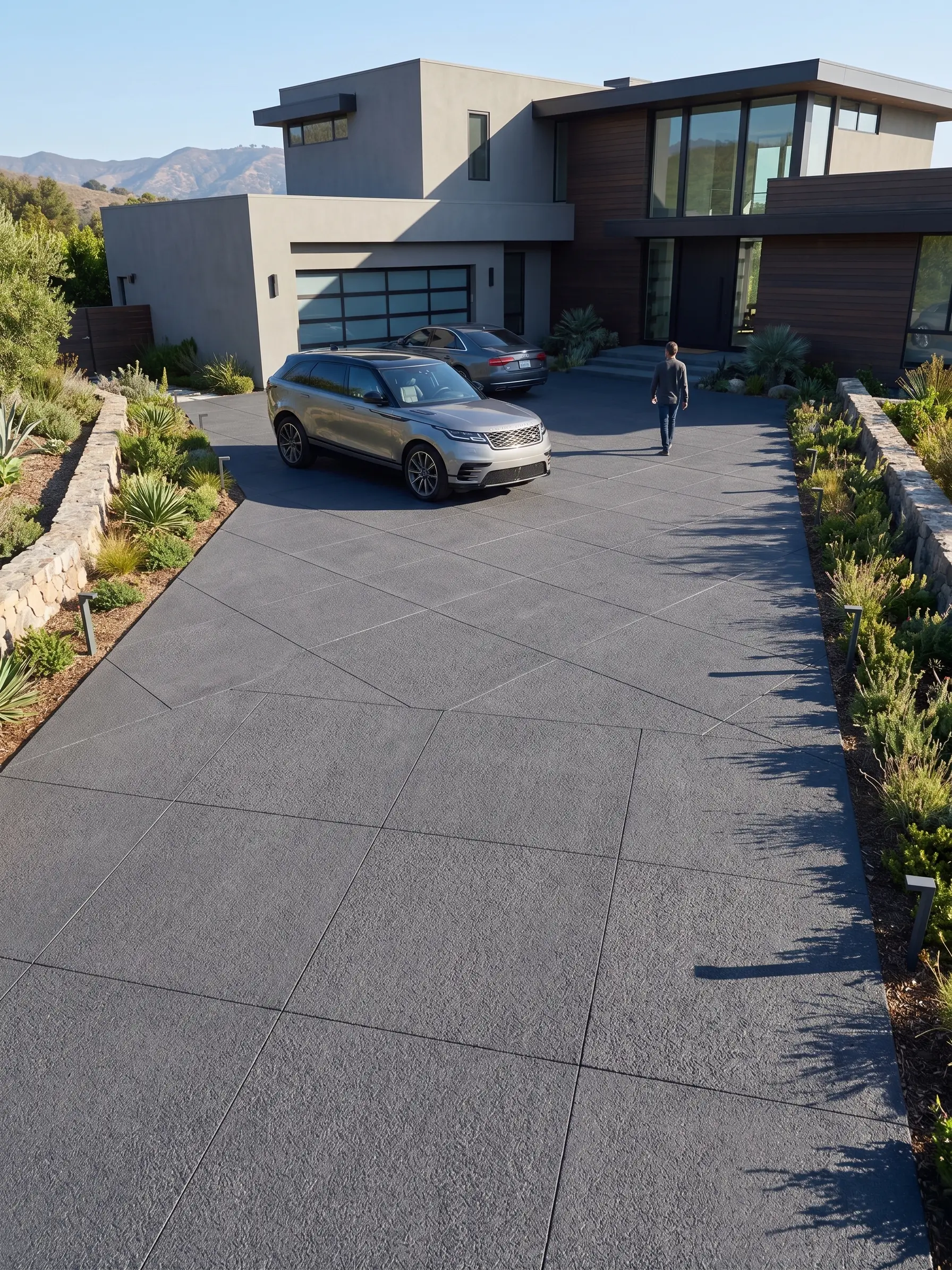
Black Basalt Texture and What Each Finish Reveals
Your finish choice on black basalt changes the visual character of the stone far more dramatically than it does on lighter materials — and the reason is purely optical. The dark base colour makes surface texture contrast stand out sharply, so a honed finish on black basalt reads as a cool, almost reflective grey-black, while a flamed or bush-hammered finish opens the surface and shifts it toward a warmer, matte charcoal tone. Getting this distinction clear before you commit to a finish is essential.
- Honed finish: a flat, matte surface achieved by grinding to a smooth plane without polishing — the black basalt texture presents as consistent and fine, with minimal light scatter
- Polished finish: brings out depth of colour and produces a mirror-like surface, but this is rarely specified for external hardscape because the smooth surface behaviour in wet conditions requires careful consideration of drainage geometry
- Flamed finish: a thermal process that causes differential mineral expansion and micro-spalling at the surface, leaving an open, coarse texture — useful for external applications where surface character matters, particularly on horizontal planes
- Bush-hammered finish: mechanical texturing that produces a dimpled, tactile surface — the black basalt texture after bush-hammering reads as a structured, uniform pattern with strong visual depth
- Brushed or sandblasted finish: lighter texturing options that sit between honed and flamed, often used where a softer visual result is wanted without the full coarseness of flaming
The finish also affects how the stone interacts with moisture. A honed or polished surface retains water visually for longer after rain — you’ll see dark patches persist on polished black basalt for hours after a wet spell, which some designers use deliberately for visual effect, and others find problematic in certain contexts. A flamed or bush-hammered surface dries faster because the open texture has more exposed surface area relative to volume.
Black Basalt Rock Properties: What the Numbers Mean in Practice
Specifiers who’ve worked with basalt across multiple project types know that the headline property figures — compressive strength, density, absorption — only tell part of the story. The interaction between those properties is what governs field performance. You should request the test report from your supplier and review the ASTM test method cited against each figure. At Citadel Stone, we recommend specifying the relevant ASTM method by designation on your drawings so the supplier is obligated to confirm which result corresponds to which test protocol.
- Compressive strength: basalt consistently tests among the higher performers in the natural stone category — request the test report citing the applicable ASTM method for compressive strength of dimension stone from your supplier
- Water absorption: black basalt’s dense crystalline structure gives it notably low absorption — important for freeze-thaw regions where absorbed moisture cycling is the primary degradation mechanism in porous stones
- Density: the mafic mineral content makes basalt one of the denser common paving stones — factor this into your structural calculations and delivery logistics, especially on upper-level installations
- Modulus of rupture: relevant for thin-format tiles and cantilevered coping — again, request the test report; do not rely on generic class figures
- Thermal expansion coefficient: black basalt’s dark colour absorbs solar radiation effectively, which means surface temperatures on exposed installations can run significantly above ambient air temperature in full sun — this directly informs your joint spacing calculation
The Britannica entry on basalt volcanic rock formation confirms the mineral composition that underpins these mechanical properties — the interlocked silicate crystal structure is what gives basalt its characteristically high density and strength profile relative to the sedimentary alternatives. Understanding the geology helps you explain to clients why this material behaves the way it does.
Origin and Supply: Where Black Basalt Comes From
Basalt is geologically widespread — volcanic provinces across the Middle East, Asia, Africa, and Europe all produce commercially viable black basalt, though not all deposits yield stone consistent enough for architectural specification. The uniformity of colour and crystal structure varies between quarry sources, and this is a detail that matters when you’re tiling a large area and need consistent colour matching across multiple production batches.
Citadel Stone sources black basalt at our selected quarries, cutting to order so that colour consistency is managed against the agreed specification rather than pulled from mixed-batch inventory. For projects with strict colour uniformity requirements, discussing batch production with the supplier at the specification stage — before orders are placed — avoids the mismatches that are much harder to correct once material is on site.
The Natural Stone Institute igneous stone paving standards provide a useful reference point for specifiers who need to understand what test documentation is appropriate to request when sourcing basalt from international quarries. Having a clear specification that references the right ASTM methods gives you a basis for quality verification that goes beyond visual inspection of samples.
Seasonal Installation Timing and Temperature Windows
The installation window for black basalt matters more than it does for lighter-coloured stones — and the reason is thermal mass. Once black basalt has been exposed to direct sun on a warm day, the stone surface temperature can be significantly higher than the substrate temperature below it, and this differential affects how setting materials bond during the critical early cure period. Scheduling basalt work for morning hours in warm seasons is standard practice among experienced installers.
- Cold-weather installation: your setting material manufacturer’s stated minimum temperature window governs — never assume a product performs to specification outside that range, and be aware that black basalt’s thermal mass can accelerate heat loss from the setting bed in exposed conditions
- Warm-weather morning work: starting early allows you to lay and adjust stone before surface temperatures climb to the point where open time on the bedding mortar or adhesive compresses — afternoon work in full sun on black basalt pavers is where bond failures begin
- Freeze-thaw scheduling: basalt’s low absorption means the material itself is well suited to freeze-thaw environments, but the installation’s weak point is the joint and bedding system — specifying a polymer-modified mortar and protecting the freshly installed work from freeze events for the manufacturer’s stated curing period is essential
- Rain and humidity: avoid laying stone onto a substrate that is wet from recent rain — the bedding layer’s water-cement ratio changes unpredictably when the substrate introduces additional moisture
- Autumn and spring installations: these windows often give the most stable conditions, with moderate temperatures that keep setting materials within their optimal working range for longer periods
In practice, the installation schedule should be built around the setting material’s temperature and humidity requirements, not the calendar. Review the adhesive or mortar manufacturer’s technical data sheet before confirming a start date — and build weather contingency into your programme, because the failure mode on a rushed installation in marginal conditions is rarely visible until the first full thermal cycle has passed through the installation.
Specifying Black Basalt Pavers for Hardscape Projects
Specifying black basalt rock properties correctly on project drawings is the step that separates installations that perform consistently from those that generate disputes at handover. Your specification needs to call out format, nominal thickness, finish, edge profile, and the test methods by which the supplied stone is to be verified — not just a material name. The phrase “black basalt pavers” on a drawing is a starting point, not a specification.
For external paving, nominal thickness is the first decision. Pedestrian-only areas, vehicular areas, and pool surrounds each carry different point-load profiles, and the required thickness changes accordingly. Your structural engineer or the stone supplier’s technical team should confirm the thickness that the project’s load conditions demand — and that confirmation should be in writing before fabrication begins. For further background on how our black basalt range is specified and supplied, Black Basalt covers the full format and finish options available to order.
Slip performance in wet conditions is a specification concern for any horizontal stone surface. The current standard for wet slip testing is ANSI A326.3, which is measured wet — the finish is the primary variable, and your project’s required performance level should be stated as a finish description and confirmed with a test report from the supplier, available on request. Never use a dry test result to satisfy a wet requirement, and note that ASTM C1028, the static test method, was withdrawn in 2014 and should not appear on current specifications.
Black Basalt Versus Other Dark Stone Options
Designers often shortlist black basalt alongside dark limestone, black granite, and black slate when a uniformly dark paving material is the brief. Understanding what distinguishes basalt from these alternatives helps you make the specification case confidently when clients push back on material selection.
- Black basalt vs black granite: both are igneous, but granite is coarser-grained and typically shows more variation in colour and crystal pattern — basalt reads more uniform at a distance, which suits large, minimalist installations where visual consistency is the priority
- Black basalt vs dark limestone: limestone is sedimentary, with higher porosity and absorption in most cases — basalt’s denser structure makes it better suited to wet or freeze-thaw environments where a limestone might require more aggressive sealing programs
- Black basalt vs black slate: slate is metamorphic and exhibits strong cleavage planes that make it prone to delamination in certain applications — basalt’s isotropic structure doesn’t carry that failure mode, making it more predictable under point loading
- Colour stability: basalt’s dark colour comes from its mineral composition, not surface staining or coatings — it doesn’t fade in the way some treated or coloured paving products do, though surface finish will affect how the colour reads over time as the surface weathers
The practical implication for project planning is that basalt typically requires less frequent maintenance intervention than the porous sedimentary alternatives in comparable exposure conditions. That said, the sealing requirement should still be confirmed with the finish supplier — a honed basalt in a wet kitchen or pool surround application may benefit from a sealer application to simplify maintenance, even if the absorption rate is inherently low.
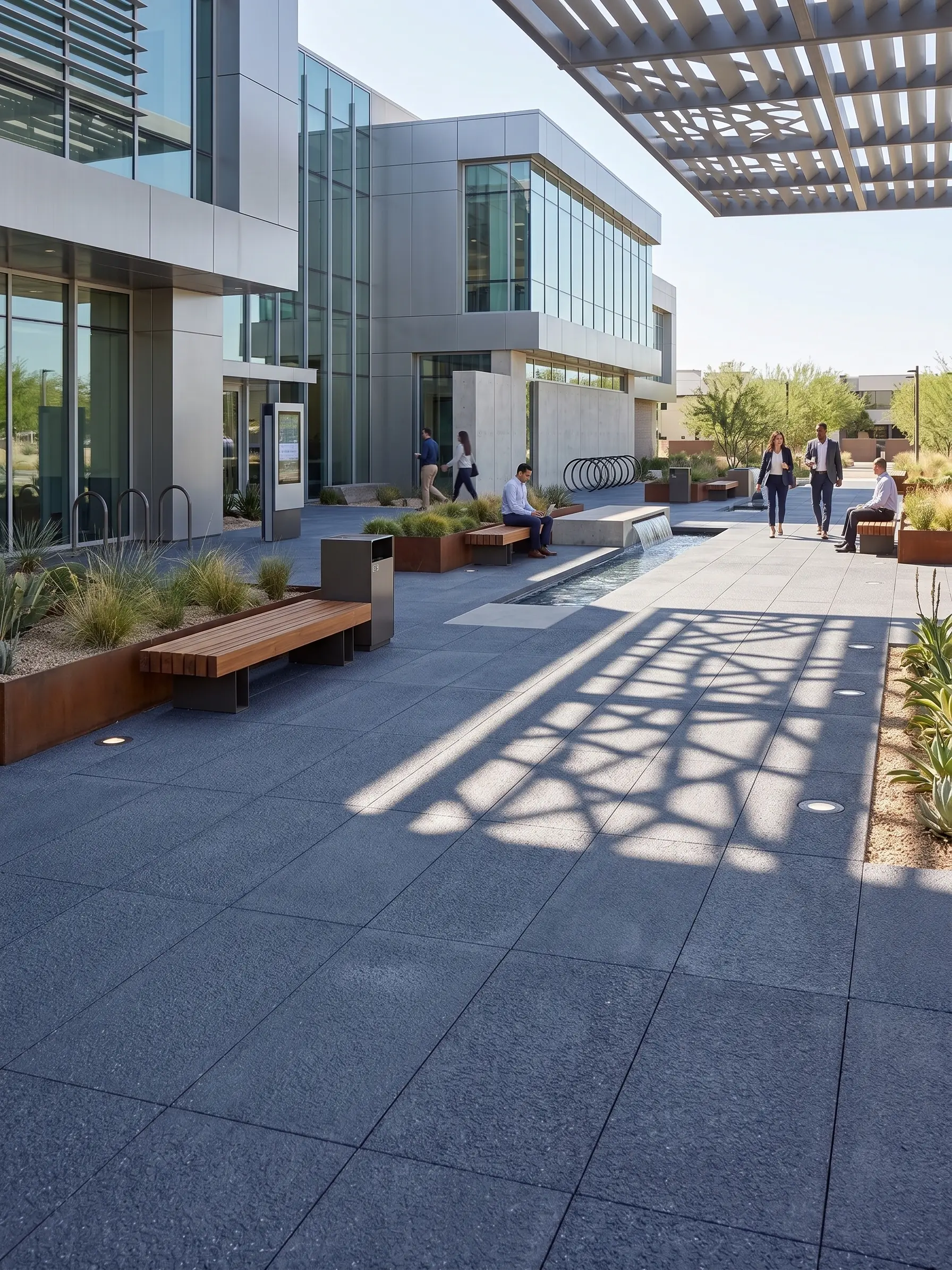
Logistics, Delivery, and Project Planning for Black Basalt
Black basalt’s density has direct logistical implications that lighter paving materials don’t generate to the same degree. Your project’s site access and off-loading arrangements need to be confirmed before the delivery date is set — site access constraints on tight urban installations or residential driveways can limit pallet quantities per delivery run, which affects your programme if the installation schedule is tight.
Citadel Stone arranges and manages delivery from quarry to site, with lead times quoted with the order. The weight of basalt per pallet is higher than limestone or travertine at the same format and thickness, so the off-loading plan — crane, forklift, or manual — should be confirmed as part of the delivery coordination. Don’t leave this to the day of delivery: basalt pallet weights on large-format thick-cut material can exceed safe manual-handling limits without mechanical assistance.
- Order quantities: factor in cuts, waste, and pattern alignment when calculating your order volume — basalt’s dark colour makes tone variation between batches more visible than on lighter stones, so ordering all material from a single production run is worth the upfront planning
- Storage on site: stack pallets on firm, level ground and cover to prevent differential staining from standing water on unbonded surfaces — though basalt’s low absorption means surface staining risk is lower than with porous alternatives
- Seasonal scheduling note: if your project spans a seasonal break, confirm that the setting materials stored on site remain within their stated shelf life and temperature storage range — adhesive and mortar that has frozen in storage does not perform to specification
Getting Black Basalt Rock Specifications Right
Specifying what is black basalt rock correctly comes down to understanding the geology first and letting the material properties follow from that. The rapid volcanic cooling that produces black basalt’s fine-grained, dense matrix isn’t just an interesting geological footnote — it’s the direct cause of the low absorption, high density, and colour uniformity that make this material perform the way it does across decades of service. Your specification drawings should reference the ASTM test methods that correspond to the properties your project demands, and the test reports should be available from your supplier before fabrication begins. For context on how basalt grades and types differ between applications, how basalt grades differ by project type provides a useful reference point as you narrow your specification. Designers and specifiers choose Citadel Stone black basalt for its uniformly dark, fine-grained structure — a direct result of rapid volcanic cooling that few surface materials can replicate.