Why Thickness and Profile Matter More Than You Think
Travertine coping for pools performs in ways that generic coping materials simply can’t replicate — but only when you specify the right profile and thickness for your pool shell type. A standard 12-inch-wide bullnose coping in 1.25-inch thickness works well on a gunite shell with a steel-reinforced bond beam, but that same profile on a vinyl-liner pool requires a different overhang tolerance and a recessed groove detail to keep the liner seated properly. Getting this wrong isn’t a cosmetic issue — it’s a structural callback that costs you twice what you’d have saved by specifying correctly the first time.
The dimensional decisions you make before the first piece is set determine whether your pool coping travertine installation ages gracefully over 25 years or starts showing stress fractures and lippage within the first five. Thickness, profile, and overhang geometry are the three variables that separate a specification from a guess. This guide walks through each one with the kind of precision that makes a real difference on site.
Travertine Grades and Fill Types for Pool Coping
Travertine is a sedimentary calcium carbonate stone formed from mineral-rich spring and geothermal water deposits — and that origin story explains both its visual appeal and its technical quirks at pool edges. The open voids and pitting that give travertine its characteristic texture are the first thing you need to address in a pool coping specification. Unfilled travertine at a pool edge will trap water, chlorine residue, and biological matter in those voids within the first season, leading to surface degradation and staining that no sealer schedule can fully prevent.
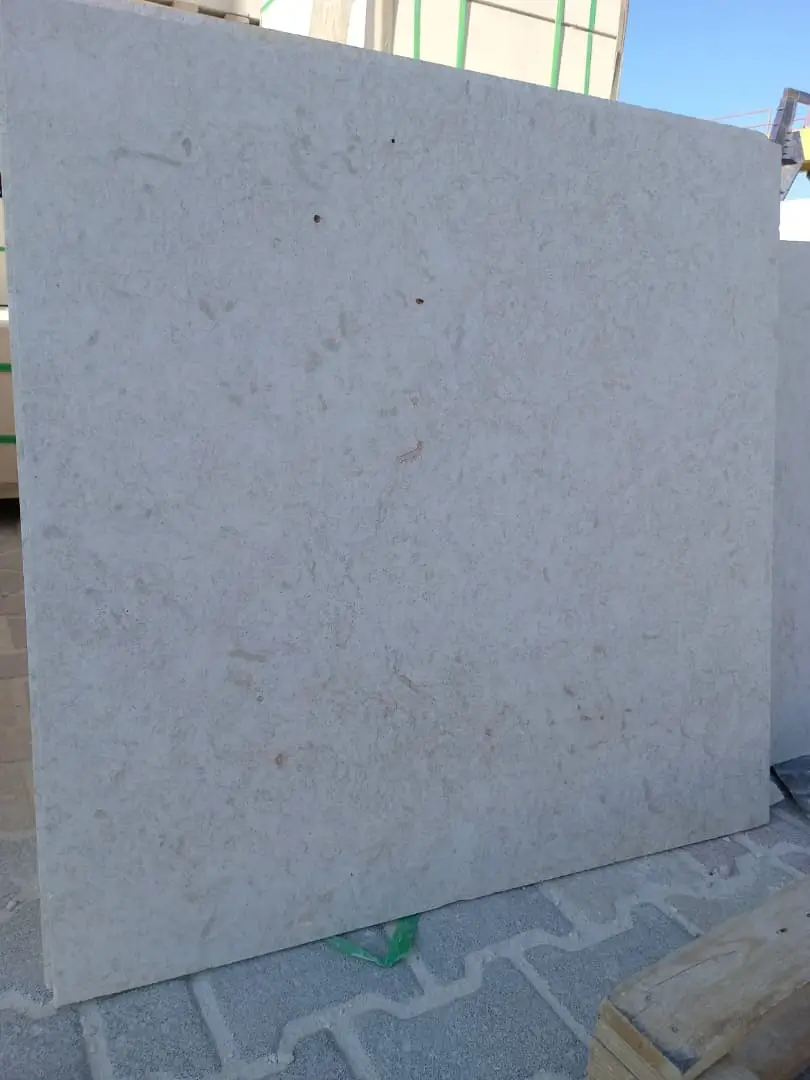
Your travertine coping pool specification should call for filled and honed material, not tumbled or unfilled. Filled travertine uses a grout or epoxy compound to close the natural voids before honing, producing a surface that reads as uniformly smooth while retaining the material’s characteristic veining and warm color range. According to Natural Stone Institute travertine properties and outdoor suitability, travertine’s open-pore structure requires surface treatment decisions early in the specification phase to ensure long-term performance in wet outdoor environments.
Polished travertine is rarely appropriate for pool coping — the slip resistance drops to unacceptable levels when wet, and the reflective surface intensifies glare at poolside. Honed finishes deliver a consistent coefficient of friction above 0.60 static, which meets pool deck safety standards across most jurisdictions. Tumbled finishes increase texture but complicate the tight joint tolerances that a proper coping profile requires.
Profile Options for Pool Travertine Coping
Bullnose and Double Bullnose
The bullnose profile — a single rounded edge facing the pool water — is the most widely used pool coping travertine profile for residential gunite and fiberglass pools. It provides a comfortable grip edge for swimmers pulling themselves out of the water and eliminates the sharp corner that could cause injury. Double bullnose, with both the pool-facing and deck-facing edges rounded, works well on freestanding raised bond beams where both sides of the coping are visible from the surrounding landscape.
Your bullnose radius selection should align with the stone thickness. A 1.25-inch travertine coping piece with a 3/4-inch radius bullnose is the industry standard for residential pools. Go thinner and the bullnose radius crowds the structural edge of the piece; go tighter on the radius and the profile reads as angular rather than truly rounded — a detail that becomes obvious on curved pool sections where each piece catches light at a slightly different angle.
Drop-Face and Cantilever Profiles
Drop-face coping extends a vertical face below the bond beam, concealing the pool shell structure and creating a cleaner finished edge visible from the water. The standard drop is 2 to 4 inches. This profile suits raised-deck designs and infinity edge treatments where the visual transition between the coping and the pool finish needs to be architecturally deliberate. Cantilever profiles — where the coping overhangs the water edge by 1.5 to 2 inches — are favored in modern minimalist pool designs because they create a shadowline at the waterline that reads as a sharp, contemporary detail.
What often gets overlooked with cantilever travertine coping profiles is that the overhang increases the lever arm on the mortar bed. Every swimmer who grabs the overhang edge creates a peel force on the bond. Your mortar specification should shift to a polymer-modified Type S for cantilever installations — standard Type M doesn’t deliver the bond strength needed to resist repeated dynamic loading at that overhang geometry.
Installation Standards and Base Preparation
The single variable that most frequently causes travertine coping for pools to fail isn’t the stone — it’s the bond beam preparation beneath it. A pool bond beam that hasn’t been mechanically cleaned, profiled, and dampened before mortar application will produce a bond with roughly 40% of the shear strength of a properly prepared substrate. That shortfall doesn’t show up immediately; it typically surfaces 18 to 36 months in, when thermal cycling has fatigued the partial bond to the point of delamination.
Your prep sequence before setting pool coping travertine should follow this order:
- Mechanically grind or shot-blast the bond beam surface to remove laitance and open the concrete pores
- Blow out the surface with compressed air to remove all loose debris
- Apply a bonding slurry or SBR primer to the prepared surface and allow it to become tacky before mortaring
- Back-butter each coping piece individually — don’t rely solely on the bed mortar for full coverage
- Target 95% mortar contact across the full underside of each piece, verified by pulling random pieces immediately after setting
Expansion joints in pool coping travertine deserve more attention than they typically receive. The standard guidance calls for movement joints every 8 to 10 feet, but curved pool sections need joints every 6 to 8 feet because the geometric transitions concentrate thermal stress at tighter intervals. Fill those joints with a polyurethane or silicone sealant rated for continuous wet exposure — not grout, which will crack within one season at a pool edge.
Per ASTM C1527 travertine dimension stone standard specifications, travertine used in exterior wet applications should meet a minimum flexural strength of 450 psi and an absorption rate appropriate for the exposure category. Specifying to this standard gives you a defensible baseline for material selection and helps you evaluate competing product claims objectively.
Slip Resistance and Safety Specifications
Pool deck safety codes in most jurisdictions reference the ANSI A326.3 minimum wet DCOF of 0.42 for horizontal walking surfaces at pool edges. Honed travertine coping consistently delivers a wet COF between 0.65 and 0.75 when properly maintained — comfortably above the threshold. The finish that creates problems is polished travertine, which drops to the 0.35 to 0.45 range when wet and represents a genuine liability exposure at any commercial installation.
The PHTA ANSI pool deck stone and coping safety standards provide the regulatory baseline for pool deck and coping surface requirements in the United States. Reviewing these standards before finalizing your finish specification ensures your project aligns with code requirements before the installation phase — not after an inspector’s visit.
Here’s what most specifiers miss when evaluating slip resistance for pool coping travertine: algae and biofilm buildup on a poorly sealed surface can drop the wet COF by 0.15 to 0.20 within a single season. A penetrating silane-siloxane sealer applied annually maintains the surface’s natural texture and inhibits biological growth without altering the COF the way film-forming sealers do. Film-forming sealers create a smooth surface layer that actually reduces friction — the opposite of what you need at a pool edge.
Color, Tone, and Landscape Design Integration
Travertine’s natural color palette — ranging from ivory and cream through walnut and noce — gives you a material that integrates with almost any landscape design vocabulary. In contemporary minimalist outdoor settings, the lighter ivory and silver travertine tones complement the clean geometry of rectangular plunge pools and negative-edge designs. Against tropical planting with large-leaf canopy species, the warmer walnut and classic travertine tones read as grounded and naturalistic rather than stark.
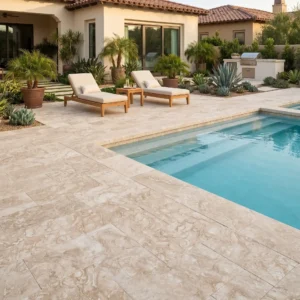
Design professionals working in desert xeriscaping contexts often select lighter travertine tones specifically because the stone’s thermal properties help manage surface temperatures at pool edges — a genuine performance benefit that aligns with the aesthetic preference for pale, arid-landscape palettes. For more traditional colonial or Mediterranean garden settings, the antiqued or tumbled edge travertine profiles (applied to the deck surround rather than the coping profile itself) reinforce the period character of the landscape without requiring the coping piece to compromise on its flat-set precision.
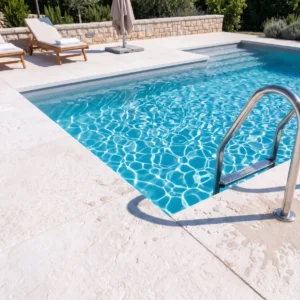
Your landscape architect’s color board should include travertine samples alongside the pool finish color before either is finalized. A light blue pebble finish pool paired with ivory travertine coping creates a cohesive, spa-like visual register. The same ivory coping against a dark charcoal pebble finish reads as high contrast — a deliberate contemporary choice that works well in modern minimalist settings but can feel jarring in naturalistic garden designs. Getting the pairing right before you order prevents costly change orders after the pool finish is applied.
For projects where you need to review the full breadth of format and tone options before committing, our travertine pool coping range covers the standard profiles, dimensions, and color options available for immediate fulfillment from warehouse stock.
Sizing, Dimensions, and Ordering Precision
Standard travertine coping for pools comes in 12-inch and 16-inch widths, with 12 inches being the residential norm and 16 inches better suited to wider bond beams or raised spa surrounds where the visual proportion demands a more substantial coping piece. Lengths typically run in 12-inch, 16-inch, and 24-inch modules. Longer pieces reduce the number of head joints visible around the pool perimeter — a detail that matters significantly on straight-run sections where joint frequency is immediately apparent from the house or entertaining area.
Your order quantity calculation needs to account for two cut categories: radius cuts on curved pool sections and miter cuts at inside and outside corners. A pool with a simple rectangular layout might have 5% cut waste. A freeform kidney-shaped pool with multiple curves and step-out features can run 20 to 25% cut waste — and that waste needs to come from material that matches the veining run of your field pieces. Order from a single warehouse batch where possible, because travertine has natural color variation between production runs that becomes visible when you mix lots mid-installation.
Verify your warehouse stock availability before finalizing the installation schedule. Travertine coping in specific profiles and dimensions can have lead times of 4 to 6 weeks on back-ordered runs. Citadel Stone maintains consistent warehouse inventory across standard pool coping profiles, which typically keeps fulfillment to 1 to 2 weeks for in-stock items — a meaningful advantage when a pool contractor’s timeline doesn’t accommodate extended waits.
- Standard 12-inch width suits most residential gunite and fiberglass pools
- 16-inch width is better proportioned on raised bond beams and spa surrounds
- 24-inch length modules minimize visible head joints on straight pool runs
- Add 15–25% to your linear footage for curved sections and corner miter cuts
- Order from a single warehouse batch to maintain consistent veining and tone across the full perimeter
Sealing, Maintenance, and Long-Term Performance
Travertine pool coping operates in one of the most chemically aggressive environments a natural stone surface encounters — constant chlorine or salt exposure, UV radiation, thermal cycling between wet and dry states, and physical abrasion from pool equipment and foot traffic. A sealing protocol that accounts for all four stressors will deliver 20 to 25 years of serviceable performance. A protocol that ignores any one of them will show visible degradation within 5 to 7 years.
Your initial sealing should use a penetrating silane-siloxane impregnator applied to clean, dry stone before the pool is filled. Two coats with a 30-minute interval between applications is the standard protocol — don’t skip to a single heavy coat, because travertine’s absorption rate means the first coat partially saturates the surface while the second coat penetrates to the depth that matters for long-term protection. Allow a full 72-hour cure before water contact.
- Reseal every 18 to 24 months under normal residential pool conditions
- Increase resealing frequency to annually in saltwater pool environments — salt chlorination accelerates sealer breakdown at the surface
- Clean coping surfaces with a pH-neutral stone cleaner — avoid acidic cleaners, which etch the calcium carbonate surface
- Inspect grout and sealant joints annually and repoint any open sections before the next pool season
- Address efflorescence early with a dry brush and pH-neutral cleaner — don’t let mineral deposits harden on the surface
The interaction between pool chemistry and travertine surface chemistry is worth understanding at a technical level. Chlorinated water at standard pool pH (7.2 to 7.8) is effectively neutral toward calcium carbonate — it won’t etch the stone. But if pH drifts below 7.0, the water becomes slightly acidic and will begin surface etching at a rate that becomes visible within one season. Saltwater pools present a different chemistry: the salt itself is benign, but the electrolytic chlorination process can produce localized pH fluctuations at the coping edge that a standard residential pool owner rarely monitors. If your client is running a saltwater system, build a pH monitoring schedule into the maintenance guidance you provide.
Cost, Value, and Material Comparison
Travertine coping for pools sits in the mid-to-premium tier of pool edge materials — above precast concrete and pavers, below premium granite or quartzite coping. The value proposition is strong: travertine delivers natural stone aesthetics, manageable surface temperatures in direct sun (significantly cooler than dark granite or concrete under equivalent UV exposure), and a proven track record of 20-plus-year performance in residential pool environments when properly specified and maintained.
Comparing travertine against brushed concrete coping on a first-cost basis misses the lifecycle picture. Concrete coping at a pool edge typically requires resurfacing or replacement within 10 to 15 years as freeze-thaw cycling and chemical exposure degrade the surface. Travertine’s dense calcium carbonate matrix — when properly sealed and jointed — resists that degradation cycle significantly better. The 15 to 25% premium over concrete coping on initial installation cost is often recovered within the first replacement cycle of the competing material.
Against pool coping travertine alternatives like bluestone or limestone, the comparison is closer. Bluestone offers excellent durability and a cooler-toned aesthetic that suits contemporary and coastal design vocabularies well. Limestone is chemically similar to travertine but typically denser and less porous, requiring less aggressive sealing maintenance. The decision between travertine and limestone at a pool edge usually comes down to aesthetic preference and budget — both materials perform comparably when correctly specified. For projects where the pool deck and coping need to read as a unified material surface, travertine’s wider color range and more pronounced veining character typically make it the lead choice over limestone’s more uniform appearance.
Decision Points for Travertine Coping for Pools
Specifying travertine coping for pools correctly requires you to make a sequence of decisions that compound on each other — and the further down the chain you are before revisiting an earlier choice, the more expensive the correction becomes. Start with profile selection tied to your pool shell type and bond beam geometry. Lock in your fill and finish specification before ordering — filled and honed is the default for pool edge applications, and deviating from it requires a clear technical justification. Confirm your mortar type against your overhang profile; polymer-modified Type S is the right choice for cantilever and drop-face installations, not a premium upgrade.
Your sealing and maintenance protocol should be specified and documented before the pool is filled — not handed to the homeowner as an afterthought. The installations that fail early almost always trace back to a maintenance gap in the first two years, before the initial sealer has been refreshed. Build the first resealing appointment into the project closeout documentation and your clients will thank you when the coping still looks right after a decade of use.
The broader pool deck material context matters too — your coping selection should inform the deck paver specification, not compete with it. If you’re reviewing the complete deck surface alongside your pool travertine coping decision, the travertine pool deck options and cost breakdown covers how the same material performs across the full deck field, including thickness requirements, finish options, and value comparisons against alternative deck materials that pair well with travertine coping.
At Citadel Stone, we work directly with project teams from specification through delivery — reviewing profile options, confirming batch consistency for curved pool perimeters, and coordinating truck delivery schedules to align with installation windows. Getting the details right before the truck arrives is what separates a clean installation from a field problem that costs everyone time. Cut to standard 12-inch depths, travertine coping for pools from Citadel Stone arrives ready for edge installation on most residential pools.
Related reading: pool tile · Modern Pool Tile Ideas That Pair With Travertine Decks · outdoor travertine pool pavers.