Island rooms are not showroom rooms
The typical urbanizacion house runs long and rectangular, with a living area that opens through sliding doors to a covered terraza and a marquesina at the front. San Juan apartments push the same idea vertically: a deep, narrow plan with the balcony doing the work of a garden. Neither shape matches the wide square room that tile displays are built around. Format decisions that ignore this produce awkward cuts at every wall and a floor that fights the architecture instead of settling into it. The marquesina adds a further wrinkle, since it carries a car and needs a paver section rather than a tile even when the owner wants the terraza look to continue across it.
Reading the plan before reading the size chart
Three measurements settle most format arguments before any stone is chosen. Take them first and the rest of the decision gets easy.
- The short dimension of the room, which decides how many full tiles fit across and how wide the cut at each wall ends up.
- The door line to the terraza, because a joint that lands hard against a threshold reads as a mistake forever.
- The direction of the longest sightline, which is what the eye follows when it walks in.
- Any change of level, since steps and thresholds want their own pieces rather than offcuts from the field.
The adoquin memory, and what it does not teach
Everyone reaches for Old San Juan when talking about paving here, and it is worth being accurate about it. The blue adoquines of the old city were cast from iron-furnace slag carried as ship ballast from the sixteenth century onward and laid in the streets during the 1800s. They are not natural stone and they are not cobblestone. What they do teach is scale and rhythm: small units, tight joints, a surface that reads as a made thing rather than a printed pattern. That lesson transfers cleanly to a modern courtyard even though the material does not. New patios in Ponce and around the metro borrow the rhythm constantly, and done well it reads as local without pretending to be a restoration.
Formats that behave on a terraza
Outdoor areas take the weather, the furniture and the traffic, and they punish overreaching formats faster than interiors do.
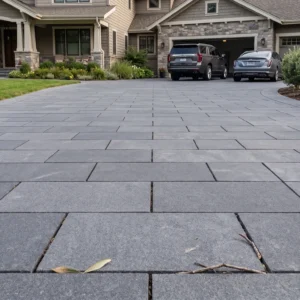
- Large, thin pieces are more likely to rock or crack over any imperfection in the slab, so exterior work favors a heavier section.
- Modular multi-size layouts absorb an irregular terraza outline far better than a single repeating format.
- A defined border piece gives the terraza an edge and hides the awkward geometry where the slab meets planting.
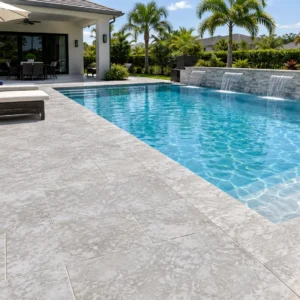
- Steps and pool coping want purpose-made pieces with a finished edge rather than field tile cut down on site.
Calibration is what makes a large format work
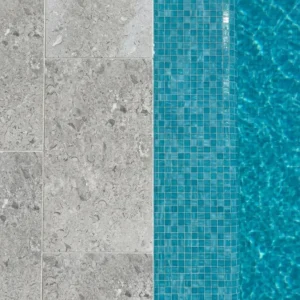
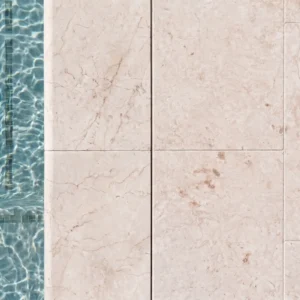
Puerto Rico’s reinforced concrete slabs are a good substrate, which puts the tolerance burden on the stone. Thickness variation that nobody notices in a small format becomes lippage in a large one, and lippage on a bare-foot floor is both an appearance problem and a trip hazard. This is where factory-calibrated material separates itself from split or hand-dressed stock, and it is why buyers moving up in format usually ask about calibrated limestone tile sizes before they ask about price.
- Consistent thickness lets a setter hold a flat plane without building the bed up piece by piece.
- Square, sawn edges give predictable joints, which is what makes a tight modern layout possible.
- Batch-matched tone keeps a long open-plan run reading as one floor rather than two deliveries.
- Documented absorption tells your specifier how the stone will behave in a wet exterior zone.
Layout carries as much weight as format
The same tile laid three ways produces three different rooms. A straight stack running the long axis lengthens a narrow living area. A half-offset bond disguises minor variation and suits busy family floors. A modular mix reads relaxed and forgives an irregular boundary. Diagonal arrangements look generous but consume noticeably more material at the perimeter, which matters when every piece has crossed water to get here. For exterior work in particular, choosing the arrangement early changes the quantities you order, and our reference on proven paver laying patterns shows how each option behaves across a real area.
Getting the order to San Juan, Ponce or the cayes
Format affects logistics more than people expect, because bigger pieces mean heavier crates and more careful handling at every stage.
- Mainland stone arrives as domestic freight, since Puerto Rico is inside US customs territory and no federal duty line applies.
- Jones Act carriage on US-flag, US-built and US-crewed vessels raises freight but supports frequent scheduled sailings from Jacksonville and Port Everglades into Puerto Nuevo.
- IVU sales-and-use tax of 11.5 percent, being 10.5 percent state and 1 percent municipal, applies to total landed cost including shipping and insurance through the SURI portal.
- Vieques and Culebra deliveries add a barge leg from Ceiba, so allow for it in both cost and schedule.
Draw it, then order it
A twenty-minute sketch of the field, with the door line and the border marked, prevents the two most common regrets on an island floor: a sliver cut against the terraza threshold and a format that swallows a narrow room. Send us the plan with the quantities and we will confirm the cutting list against it. The floor plan should choose the tile, and never the other way around.