Why Bathrooms Are a Different Problem
Everywhere else in the house, water is an occasional visitor. In a bathroom it is a permanent resident. Water arrives daily, in volume, onto a floor crossed by bare wet feet, in a room that is small enough that every fitting forces a cut. Add an island climate where the room may never fully dry between uses, and you have the one space where a poor decision shows up within months rather than years. Almost every wet room failure traces back to falls, waterproofing or the threshold, and almost none of them trace back to the stone itself. That is worth saying plainly at the start, because most of the money and worry in a bathroom specification goes to the visible material rather than to the details that decide the outcome.
Falls, Drainage and the Work You Cannot See
The floor has to move water to a drain, which means the substrate must slope before a single tile is laid.
- A linear drain against one wall allows a simple fall in one direction and suits rectangular units.
- A center drain needs the floor to fall from four directions, so every tile around it is cut on a twist.
- Waterproofing sits under the bedding and must run up the walls and across the threshold.
- Falls and membrane details have to be agreed before the setting plan is fixed, never afterward.
None of this is visible when the room is finished, and all of it decides whether the room lasts.
Format Choices for a Wet Floor
Size and joint count matter more in a bathroom than anywhere else in the house.
- Smaller units follow a fall more easily and are the practical choice inside a shower area.
- Larger units suit the dry part of the room, where fewer joints mean less to clean.
- Joint width is a grip decision as much as an appearance decision on a shower floor.
- Plan cuts around the toilet, the vanity and the drain before ordering, not on site.
The Threshold Is Where Jobs Fail
The line between the wet room and the rest of the house does more work than any other detail in the build.
- Carry the waterproofing membrane through and up at the threshold rather than stopping it at the door frame.
- Use a full unit or a purpose-cut piece as the threshold, never a narrow sliver that will crack.
- Keep both sides at the same level where possible, and where a step exists, make it obvious rather than subtle.
- Change the surface texture at this line if you need more grip, keeping the same stone and tone.
- Set the change point under the closed door leaf so it reads as intentional from both rooms.
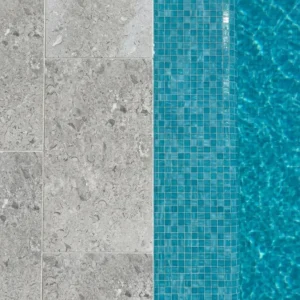
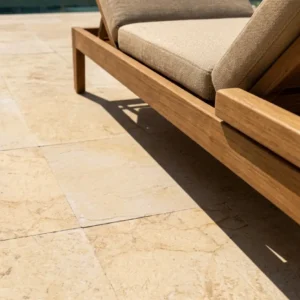
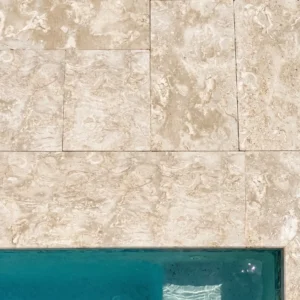
For the field of the room, wet room floor tile options in a dense pale limestone give you a floor that stays bright in a room with a single small window, which describes a great many bathrooms here.
Walls, Niches and Shower Benches
Vertical surfaces are where you can be adventurous, because nobody stands on them. A polished or honed wall in the same stone as the floor gives a calm, expensive-looking room without the slip risk. Shower niches should be formed with a slight fall so water drains out rather than sitting on the shelf, and the top edge of a niche is worth detailing in a single piece to avoid a joint that will always look wet. A bench or seat needs a solid, well-supported slab rather than a tile on a hollow frame, and it should be set with a barely perceptible fall so it never holds a puddle.
Water Supply, Hardness and Marks
Water on these islands comes from surface storage, groundwater and rainwater caught on the property, since there are no permanent rivers or streams, so what dries on your shower wall varies from house to house. Cistern-fed water leaves different marks from mains supply, and both can leave a residue on a dark surface that a pale one hides completely. That is a genuine argument for pale limestone in a bathroom. Wipe down the shower after use, and keep acidic descalers away from the stone entirely, since the products sold to remove those marks are precisely the ones that etch a calcium carbonate surface on contact.
Fixings, Fittings and Access
The small metal items in a bathroom cause more visible trouble than the large stone ones.
- Specify non-ferrous or stainless fixings throughout, particularly in coastal properties exposed to salt air.
- Choose a drain grating that will not rust and stain the units around it.
- Leave a means of access to traps and valves that does not require breaking a tiled surface.
- Keep spare units from the original shipment so a future repair matches the floor it sits in.
Ordering for a Bathroom Fitout
Bathrooms generate cuts, so the wastage allowance is higher here than in an open living space. Order the bathroom stone with the rest of the house in one shipment: material lands at St John’s Deep Water Harbour on direct sailings from Florida, duty runs on the CARICOM Common External Tariff, ABST has stood at 17% since 1 January 2024, and Customs requires a broker once a shipment passes EC$5,000 or six lines. Barbuda deliveries move on a separate small-vessel leg to River Wharf. Full detail on that process sits with island-wide stone supply and logistics. Spend your money on the falls, the membrane and the threshold, and the stone will do the rest.