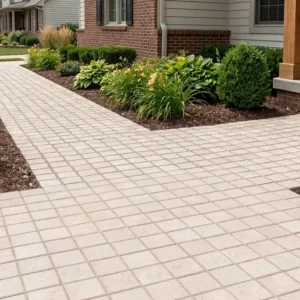
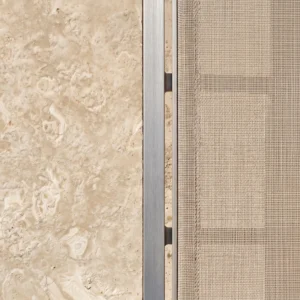
Supply chain failures account for more project delays than almost any other variable in large-scale construction — and stone supply problems contractors face often don’t surface until a critical phase is already underway. The gap between what was ordered, what arrived, and what actually matches your spec sheet can derail timelines, inflate costs, and create warranty headaches that linger long after the job closes. Understanding where those failures originate gives you the leverage to prevent them rather than react to them.
Why Supply Failures Hit Large Jobs Hardest
Scale amplifies every weak point in a supply chain. On a small residential patio, a short shipment might mean a one-week delay and a second truck delivery. On a commercial plaza, hotel courtyard, or multi-building development, the same problem can idle an entire crew, push back concrete pours, and cascade into penalty clauses. The larger the project, the more phases depend on stone arriving in the right sequence, in the right volume, and from the same quarry lot.
Natural stone also behaves differently from manufactured materials in one critical way: it isn’t uniform. Two shipments from the same quarry, pulled six months apart, can differ noticeably in tone, veining density, and surface texture. That variation is manageable when you’re aware of it — but catastrophic when a project is halfway installed and the second delivery doesn’t match the first. Experienced specifiers learn to treat lot consistency as a procurement requirement, not an afterthought.
The Six Most Common Stone Supply Contractor Problems
Most stone supply problems contractors face fall into recognizable categories. Knowing which type you’re dealing with helps you apply the right fix — and knowing which ones are preventable changes how you write your procurement specs.
- Short shipments that leave you without material mid-installation, requiring partial work stoppage
- Lot number mismatches causing visible color and texture inconsistency across the same surface
- Incorrect material thickness — especially critical for structural applications and flush-finish installations
- Damaged stone from inadequate crating or improper truck loading, often discovered only on-site
- Extended lead times from suppliers with no domestic warehouse inventory
- Substituted material when the specified stone is out of stock and the supplier ships an alternative without prior approval
Each of these is preventable, but prevention requires early-stage procurement discipline rather than reactive problem-solving. The contractors who avoid most of these issues treat stone supply as a specification exercise, not just a purchasing transaction.
Lead Time Realities Most Contractors Underestimate
Here’s what most project schedules get wrong: they budget for transit time but not for inventory availability. If your supplier has to import the material after your order, you’re looking at a 6–10 week cycle — quarry extraction, fabrication, container booking, port processing, and domestic freight. That window doesn’t compress regardless of how urgently you need the stone.
Suppliers with domestic warehouse stock operate on a fundamentally different timeline. Truck delivery from a stocked warehouse typically runs 5–10 business days depending on freight routing, versus the 6–10 week import cycle. The difference matters enormously when your concrete subbase is already poured and curing, or when a landscape contractor is scheduled to begin planting in three weeks. Citadel Stone maintains warehouse inventory across multiple product lines, which is why lead times for many orders run 1–2 weeks rather than two months.
Verify warehouse availability before you finalize your project schedule — not after you’ve committed to installation dates. Ask the supplier specifically whether the material is in stock domestically or whether the order triggers an import. That single question can save your timeline.
Lot Matching and Color Consistency on Multi-Phase Projects
Color variation complaints are one of the most common post-installation disputes in large natural stone projects, and they almost always trace back to procurement decisions made weeks before installation began. Stone supply problems contractors encounter related to color are particularly frustrating because the visual mismatch is obvious to every stakeholder — owners, architects, and end users all see it immediately.
The fix isn’t complicated, but it requires deliberate process. Your procurement spec should require the supplier to pull all material for a given phase from the same quarry lot number. For projects spanning multiple phases or installation windows, you need to either reserve sufficient inventory from a single lot or establish with your supplier what the maximum acceptable visual range is between lots. According to Natural Stone Institute stone variety and technical specifications, color and texture variation is a natural characteristic of quarried stone — the goal is managing expectations and sourcing consistently, not eliminating inherent variation.
Document lot numbers for every delivery. This creates a traceable record that protects you if color disputes arise post-completion, and it gives your supplier accountability for what they shipped.
Thickness Tolerances and Structural Specifications
Thickness inconsistency is a technical problem that materializes as a field installation problem. Supply issues related to thickness typically show up when you’re setting pieces and discovering that adjacent units have enough height difference to create a lip — a trip hazard, a ponding risk, or simply an unacceptable finish quality. It wastes time grinding or shimming individual pieces, and it’s entirely avoidable with tighter procurement specifications.
Standard tolerance for natural stone dimension products is typically ±1/16 inch for honed and polished finishes, and ±1/8 inch for sawn or split finishes. In practice, inferior fabrication produces much wider variation. Your spec should call out tolerance explicitly and require the supplier to confirm compliance. For structural applications — particularly load-bearing natural stone pavers on elevated decks or over voids — thickness directly affects load distribution and flexural performance under point loads.
- Specify nominal thickness AND tolerance in writing — do not rely on verbal confirmation
- For large format pieces (24 × 24 and up), thickness consistency matters more because longer spans amplify the effect of variation
- Request a sample batch before full delivery on high-stakes projects to verify actual versus specified thickness
- Thicker sections (1.5 inches or more) are more forgiving on slightly uneven subbase conditions — a practical buffer for tight installation timelines
Damage in Transit and Crating Standards
Your material can leave the warehouse in perfect condition and arrive on-site with corner breaks, face cracks, and edge chips that make pieces unusable. Transit damage is a supply chain problem that falls between supplier and carrier responsibility — and without clear documentation, the dispute resolution process is slow and frustrating. The practical impact is the same regardless of who’s responsible: you’re short material and behind schedule.
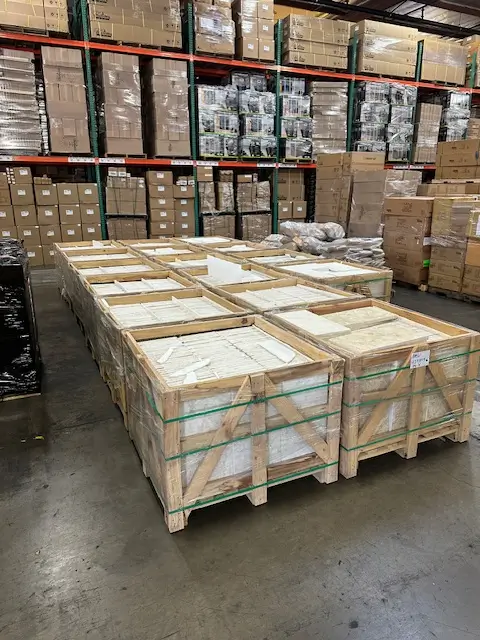
Proper crating significantly reduces transit breakage. Natural stone should be palletized vertically (on edge) for slab formats and horizontally in layered stacks for pavers, with adequate cushioning between pieces. Truck loading matters too — stone should be loaded last-on-first-off when possible to minimize the number of handling events. Verify with your supplier what their standard crating protocol is before you place a large order. If they can’t describe it specifically, that’s a signal about their damage rate.
When your truck delivery arrives, inspect the crating before signing the delivery receipt. Document any external crate damage photographically before uncrating, then photograph individual piece damage as each layer is uncrated. That documentation establishes the damage occurred in transit, not on-site, which matters for claims resolution. According to ASTM dimension stone quality and testing standards, natural stone should be evaluated against defined quality parameters before acceptance — applying those principles at delivery receipt protects your procurement position.
Citadel Stone contractor order support
Substitution Risk and How to Prevent It
Material substitution without contractor approval is one of the most damaging stone supply problems contractors face — and it happens more often than you’d expect when a supplier runs out of inventory and opts to fill the order with a “comparable” alternative. The problem is that comparable by their definition rarely means identical by your specification. Surface finish, absorption rate, compressive strength, and visual character can all differ meaningfully between stone types that a supplier might consider equivalent.
Your purchase orders should include explicit language prohibiting substitution without written approval. Any deviation from specified material must trigger a formal review before shipment — not after delivery. This is particularly important for projects where the stone is specified by an architect or landscape designer with specific aesthetic integration requirements. A hospitality project designed around the warm tones of a particular limestone, for instance, cannot simply accept a grey-toned substitute because it’s the same thickness and price range.
Design integration considerations are real procurement constraints, not aesthetic preferences. Projects that integrate stone with specific planting palettes, water features, or architectural cladding have material requirements that flow from the design brief — and substitution disrupts those relationships. Locking in substitution prevention language protects both the technical specification and the design intent simultaneously.

Ordering Strategy for Large and Phased Projects
Your ordering strategy has more impact on supply chain stability than almost any other procurement decision. Contractors who order stone phase by phase — waiting until one phase is complete before ordering the next — expose themselves to every supply risk discussed above: lot mismatches, stock depletion, and lead time delays. A better approach is to forecast total project requirements upfront, place a consolidated order or a confirmed reservation against a single lot, and schedule phased releases from that reserved inventory.
Overage calculation is part of a sound ordering strategy. Natural stone projects should carry a 10–12% overage for standard cuts, and 15–18% for irregular format work or complex patterns. That buffer covers breakage, cut waste, and future repair or matching needs. It also provides a cushion if initial quantity estimates were slightly off — which they almost always are on large jobs where field conditions vary from plan dimensions. The USGS dimension stone production and use data documents the scale and variability of natural stone sourcing across different quarry types, which underscores why procurement planning needs to account for real-world supply variability rather than assuming steady availability.
- Calculate total square footage from final construction documents, not preliminary plans
- Add overage percentage before placing your order — do not plan to order more later
- Confirm lot reservation in writing with your supplier, including how long the lot will be held
- For phased projects, schedule delivery releases around your subbase and installation sequence — not just your overall completion date
- Coordinate truck delivery access with your site superintendent in advance to prevent receiving delays
Vetting Your Stone Supplier Before Problems Start
The best time to assess a supplier’s reliability is before you’re dependent on them. Stone supply problems contractors encounter on large jobs are often predictable based on a supplier’s infrastructure, inventory practices, and communication protocols — all things you can evaluate before signing a purchase order.
Ask specific operational questions rather than general ones. Does the supplier stock material domestically, or does every order trigger an import? Do they track quarry lot numbers and maintain lot segregation in their warehouse? What is their standard process for handling short shipments or damaged delivery claims? How do they communicate lead time changes — proactively or only when asked? A supplier who can answer these questions with specific process details is operating at a different level than one who responds with general reassurances. At Citadel Stone, our technical team provides lot number documentation and warehouse availability confirmation as standard parts of the order process — because those details prevent the disputes that hurt project timelines.
Reference checks with contractors who have run similar project scales with the supplier are also worth the effort. A supplier’s behavior on a small residential order may differ significantly from their performance under the volume pressure of a commercial project.
Spec Wrap-Up
The stone supply problems contractors face on large jobs are almost always rooted in procurement decisions made before the first piece is installed. Lot consistency requirements, thickness tolerances, substitution prohibitions, overage calculations, and supplier vetting protocols are all specification-stage decisions — not site-stage reactions. Getting them right at the front end is the difference between a project that flows smoothly and one that stalls in disputes over color, shortages, and damaged material. As your project’s hardscape decisions come together, understanding how different supplier models affect reliability is equally important — choosing the right stone supply partner is a decision worth researching before your project schedule locks in. Citadel Stone batches orders by quarry lot number, a practice that reduces color variation complaints commonly reported on multi-phase construction projects.
Related reading: stone supply company comparison · stone veneer supply guide · paving stone supply cost.