Heat underfoot is its own problem
Air conditioning fixes the air. It does nothing for the floor. On a Dorado terraza that has taken direct sun since ten, the surface underfoot is the part of the room your body argues with. The island builds in reinforced concrete more thoroughly than almost anywhere in the hemisphere, so the structure beneath your finish is a dense slab that banks whatever the day hands it. Stone is the finish layer here, not the structure, and that layer decides how much stored heat reaches your feet.
Why pale stone reads cooler than dark tile
Two things drive the sensation. The first is how much solar energy a surface takes in rather than throws back. The second is how the material moves that energy once it has it.
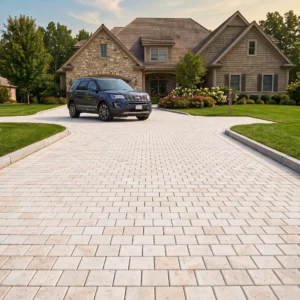
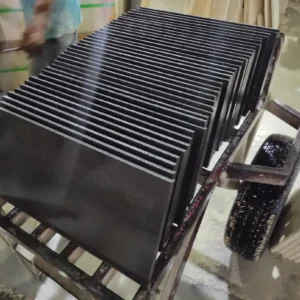
- Light, near-white surfaces bounce back a large share of direct sun instead of banking it, so an open terraza does not build the same afternoon charge as charcoal porcelain.
- Dense stone warms and releases gradually rather than spiking, so a floor does not go from pleasant to punishing inside an hour of clear sky.
- Shade recovers a pale floor quickly once the sun swings past, which matters on the west-facing balconies of Condado and Isla Verde.
- Joints and setting beds store heat too, so a tighter joint on a pale field keeps the whole assembly reading lighter.
Two climates, one island, two specs
Nobody who has driven from Ponce to Rio Grande in a single morning believes Puerto Rico has one climate. The south around Ponce and Guanica is dry and hard-lit; the north and the slopes toward El Yunque are wet, green and often overcast. Those are different flooring problems. A dry-south terraza fights glare and stored radiant heat, so tone does most of the work. A wet-north patio spends more of its year damp, which pushes grip and drainage ahead of heat comfort. Specify by area rather than by house.
What the concrete slab does to floor temperature
Because the structure is concrete nearly everywhere, your stone is thermally tied to a large mass. That helps at night and works against you at the end of a long clear day.
- A full mortar bed conducts more slab heat into the tile than a raised pedestal deck does, which is why metro rooftop amenity areas often go pedestal-set.
- Ventilated shade over a terraza does more for comfort than any change of material, and it lets a pale floor stay pale rather than bake.
- Interior floors under cover barely register the issue, so the argument is really about exterior and semi-covered zones.
- Pale stone beside a pool cuts glare and heat together and keeps the coping from becoming the hottest thing on the deck.
Test the floor where the floor will live
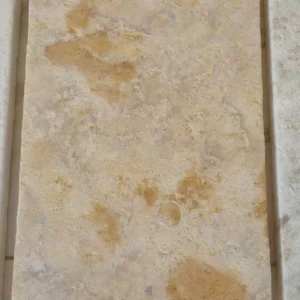
Comfort is measurable in the simplest possible way: stand on a sample at noon. That is why we ship small pieces before anyone commits to a field. Put a candidate on the actual terraza, in the actual orientation, and leave it through the hottest part of the day. A brochure cannot tell you whether the west corner of your balcony is workable in August. Ten barefoot minutes will. Most island buyers narrow their shortlist to pale limestone floor tiles on that basis.
What it takes to land stone in San Juan
Puerto Rico sits inside US customs territory, so stone moving from the mainland is a domestic shipment. There is no federal customs duty line and no international clearance leg, which removes a whole category of cost and delay.
- The Jones Act requires US-flag, US-built and US-crewed vessels on mainland-to-island carriage, which lifts freight against a foreign-flag comparison.
- The same rule delivers frequent scheduled sailings from Jacksonville and Port Everglades into San Juan at Puerto Nuevo, so lead times are predictable rather than opportunistic.
- IVU sales-and-use tax runs at 11.5 percent, being 10.5 percent state plus 1 percent municipal, computed on total landed cost including shipping and insurance.
- It is administered by Hacienda through the SURI portal with an electronic declaration of imports, and use tax falls due at filing unless you hold a bond.
- IVU is not a customs duty and CBP does not collect it; confirm the current rate and your own filing position with your accountant before budgeting.
Post-Maria standards still shape the finish layer
Maria in September 2017 reset how the island builds. The Puerto Rico Building Code 2018 and the Puerto Rico Residential Code that followed were drawn from the 2018 I-Codes with local amendments, adopted on FEMA Mitigation Assessment Team recommendation, with wind resistance recommendations running roughly 150 to 200 mph by risk category. Floor finishes are not the structural story, but they inherit the culture.
- Exposed roof terraces get mortar-set or restrained assemblies rather than loose-laid fields.
- Perimeters are detailed on the assumption that wind-driven rain will find them.
- Drainage is sized for a downpour, not a drizzle, which also keeps standing water off a hot floor.
- Your designer or engineer confirms how the code applies to your project; a stone supplier does not.
Choosing a floor for four in the afternoon
Work in order: tone, then exposure, then finish, then format. Pale before dark, shaded before open, and always tested on site rather than on a screen. For ports, lead times and how an order actually runs, our stone supplier in Puerto Rico overview covers the logistics in detail. A floor that stays comfortable at four in the afternoon earns its keep every single day of the year.