Barefoot is the default setting
On Grand Cayman people move from a pool deck to a covered terrace to a kitchen without shoes, often at the hottest hour of the day. A floor that stores heat becomes the one detail nobody forgives, and stone gets blamed for it far more often than it deserves. Surface temperature is not a single property you buy along with the material. It is the result of four things you control at the specification stage: tone, finish, exposure and bedding. Get those right and stone is the most comfortable hard floor available on the island, indoors or out. Get them wrong and the same stone becomes the thing guests complain about at noon.
What actually makes a floor feel hot
The same tile can read cool in a shaded courtyard and punishing on an unshaded roof terrace, which is why blanket claims about materials are close to useless here. Before you narrow the stone, run through the variables that move the number most.
- Tone: pale surfaces reflect a large share of incoming sun, while saturated dark tones absorb it.
- Exposure: unshaded hours per day matter more than which stone you finally picked.
- Finish: a textured face holds a thin film of air and reads softer against skin.
- Bedding: a mortar-set terrace over a slab stores heat differently from a pedestal-set deck.
- Air movement: a breeze across a damp surface sheds heat faster than any material choice.
Pale limestone on open decks
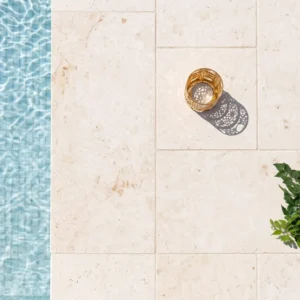
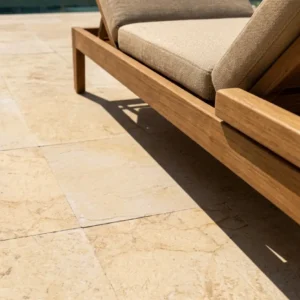
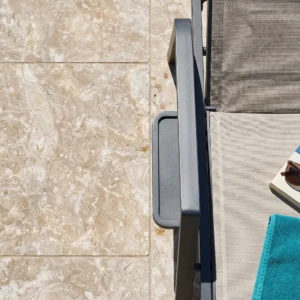
Pale, warm-white limestone is the workhorse for exposed Cayman surfaces, and heat is only part of the reason. It reflects rather than stores, it hides salt haze better than a dark saturated tone, and it sits naturally beside the white render and pale timber that define island residential work. The pale limestone tile ranges we bring in are calibrated for thickness, which matters more than most buyers expect. A consistent section beds evenly, avoids hollow spots, and keeps a terrace flat through the wet and dry cycling that island decks live with all year round.
Where dark basalt still earns its place
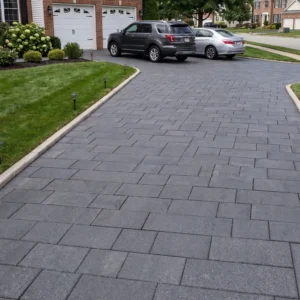
Dark stone is not disqualified by the climate. It is placed with intent. Basalt is dense, grippy and visually calm, and there are positions where those qualities clearly outrank surface temperature on a summer afternoon.
- Shaded entry courts and covered arrival colonnades.
- Driveway aprons and vehicle crossings that need mass under wheel loads.
- Border courses and framing bands set against a pale field.
- Interior floors in conditioned rooms, where solar gain never enters the argument.
Shade, breeze and the pool deck
On Seven Mile Beach amenity decks, the projects that succeed treat shade as part of the paving package rather than an afterthought. Pergolas, deep overhangs and planting break a large field into zones, and the specification follows those zones instead of running one tone across everything. A pale field with a darker band under a covered walkway looks deliberate and performs better than a uniform mid-tone that is too dark in the sun and too flat in the shade. Plan for wet-out as well, because a pool surround spends much of its day damp and every stone darkens when it is wet.
Indoor comfort in conditioned rooms
Indoors the argument flips completely. Stone cooled overnight by air conditioning stays pleasantly cool through the morning, which is one of the quieter reasons island buyers keep choosing it over timber and vinyl. A few details protect that benefit and cost nothing to draw.
- Keep the format generous so the grout network does not interrupt the surface.
- Run the same stone inside and out in different finishes for a continuous read.
- Detail thresholds flush where sliding doors open onto a terrace.
- Allow movement joints where the floor crosses from conditioned to unconditioned space.
Code, duty and landed cost
Two local realities shape the order as much as the material does. Construction answers to the Cayman Islands Building Code, whose 2016 edition has been the working reference, with a successor edition based on the 2021 IBC anticipated; confirm the current edition with the Central Planning Authority before drawings harden. Duty is the other. Building materials on Grand Cayman have attracted a concessionary flat rate near 15% against a general rate around 22%, while Cayman Brac and Little Cayman have carried a full building-materials waiver extended through 31 December 2030, administered by Customs and Border Control. Rates move, so confirm the current rate with your broker before you budget a floor. You can see how our Cayman Islands stone supply is organized on our country page.
Prove it on site
Order small samples, place them outdoors on the actual site, and stand on them barefoot at two in the afternoon. That one test settles more arguments than any table of reflectance figures, and it costs a week of patience. A short checklist keeps the trial honest.
- Test in the position the floor will occupy, not on a shaded work bench.
- Compare at least two tones side by side rather than judging one alone.
- Wet one half of each sample so you see the surface both dry and damp.
- Leave the pieces outside for a week before anybody makes a final call.
Remember that George Town works as a lighterage port, so cargo is barged ashore from ships at anchor rather than lifted from a deep-water berth. Pallets pass through an extra handling stage and should be tightly banded and wrapped, and one container of 3 cm stone lands roughly 3,000 to 3,400 square feet in a single movement. Choose the tone first, prove it barefoot on site, and let finish and layout carry the rest.