Why a Curacao floor runs hot
Curacao does not have a rainforest climate, and copy written for one will mislead you. The island is hot semi-arid: published records put annual rainfall at roughly 450 to 650 mm, about 18 to 26 inches, depending on which record you use, and under 700 mm on all of them. The dry stretch runs from around January to September, with the wetter months arriving from October to December, which reverses the rhythm people expect elsewhere in the region. So the thermal problem is not humid air pressing on a cool slab. It is hours of direct sun on hard surfaces, day after day, with a steady wind across the top of them.
Tone, glare and an 1817 argument
Tone is where most conversations start, and here it carries some local history. In 1817 the governor banned painting houses white because the glare was held to damage the eye. Whatever one makes of the medicine behind that order, the observation under it was sound, and it transfers directly to floors. A very pale, very flat outdoor surface returns light in a single sheet, into the room behind it and into the eyes of anyone sitting on the terrace. Tone governs how much solar energy a surface takes on; texture governs how the reflected light leaves it. Choose both together rather than settling tone first.
Texture is what your foot reads
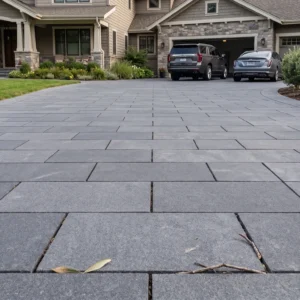
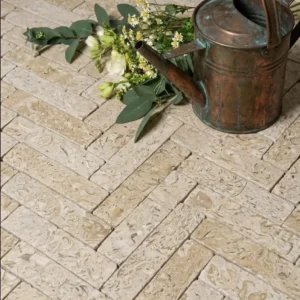
Two floors of the same color can feel different underfoot because of what has been done to the face. A sawn or honed face is flat, so it reflects in one direction and holds a slightly warmer feel against bare skin. A brushed, tumbled or bush-hammered face breaks the surface into small peaks and hollows that shed light in many directions and give the foot points of contact rather than one continuous plane. Under wind-blown grit, that broken face also disguises the fine scratching a polished surface would show. Points worth weighing:
- How much of the area is crossed barefoot, and at what hour of the day
- Whether the surface sits in open sun or under a gallery or overhang
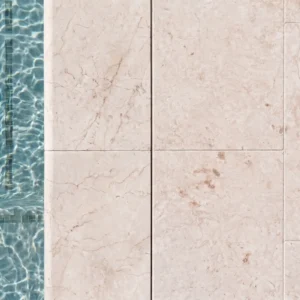
- How close it runs to the pool, where wet feet change the priority
- Whether blown sand reaches it from the windward side
- How often anyone will realistically wash it
Shade and the trade wind do the heavy lifting
Orientation matters more than any product decision. Read the aspect of the site first, then pick the stone to suit that reading:
- East and north-east: near-constant trade wind, usually quoted at 15 to 25 knots, carrying salt and grit
- West and south-west: the leeward, sheltered side, out of the constant wind
- Under a gallery or overhang: cooler than any stone selection can make an open terrace
- Enclosed courtyard: little air movement, so warmth lingers into the evening
Indoors, the floor is a heat store
Inside the house the calculation flips. A stone floor takes on temperature slowly and gives it back slowly. In a shaded, cross-ventilated room that is exactly what you want, because the floor sits below air temperature through the afternoon and keeps the room feeling steady. In a room with unshaded west-facing glass, the same mass absorbs sun all afternoon and releases it into the evening. The floor is not the fault there; the glazing is. Start from limestone tile chosen for daytime comfort and then study the room it is going into, because shading, glazing, air movement and ceiling height will move the result further than the stone does.
Where the terrace meets the room
Terrace and interior are usually specified as one job here, since doors stand open and the same traffic crosses both. Four junction decisions carry most of the result:
- Give the outdoor face more texture, since it takes rain, grit and wet feet
- Keep the indoor face smoother, because it is cleaned differently
- Resolve the level change at the door in the same stone
- Land the joint where the door closes, so the floor reads as one surface
What sits under the stone
Curacao supplies the layers beneath a floor rather than the floor itself. Mining Company Curacao, founded in 1874 after phosphate was found in the Tafelberg near Santa Barbara, publishes a list of crushed and graded materials, including base course at 0 to 50 mm, presieved sand at 0 to 3.5 mm, several aggregate grades and selected boulders up to 3.5 metric tons. No dimension stone or finished paving unit appears on that list. Imported cut stone therefore is not standing against anything the island produces; it is the wearing surface laid over locally produced ground. State that relationship plainly in the specification:
- Local base course and bedding sand below
- Imported dimension-sawn stone as the wearing surface above
- Falls and drainage sized for a cloudburst, not for average rainfall
- Jointing and edge restraint chosen for salt exposure
Test it on your own site
No description survives contact with the real site, so test before committing. Put a piece down in the room or on the terrace it is meant for, leave it through a full afternoon, and stand on it barefoot at four o’clock. Wet half of it and walk across the join. Look at it under the glare you actually get, not under showroom lighting. If the work sits in Punda, Otrobanda, Pietermaai or Scharloo, the historic inner city was inscribed by UNESCO in 1997 and hardscape there goes through the Monuments Office as well as the planning department, so allow time for it. Our notes on how we supply Curacao projects cover the shipping and clearance side. Choose tone for the light, texture for the foot, and let the site settle the rest.