Why slope decides most sett jobs here
Very little of Puerto Rico is genuinely flat. Between the Cordillera Central, the karst hills and mogotes of the north, and the terraced urbanizacion lots cut into every ridge above the San Juan metro, most residential paving on this island happens on a grade of some kind. That single fact changes how setts behave. A sett laid on level ground is held by the units around it and by its edge restraint. A sett laid on a fall is also fighting gravity, water moving downhill through the joints, and the small slumps that follow a heavy week of rain. Slope work is decided less by the stone than by what sits under and around it.
Two rainfalls on one island
Specifying a hillside in Rio Grande under the shoulder of El Yunque is not the same job as specifying a slope above Ponce or Guanica on the dry south coast. The north and east catch heavy, sustained rain driven up against the mountains. The south runs dry for long stretches and then takes a season’s worth in a few hours. Both patterns punish a gradient, in opposite ways. Northern sites need continuous drainage capacity and joints that will not wash out week after week. Southern sites need a base that survives long dry shrinkage and then absorbs a sudden downpour without cutting a channel through the middle of the terrace.
The concrete base you may already have
Puerto Rico builds in reinforced concrete more thoroughly than almost anywhere in the hemisphere, and on a sloped site that is an advantage. Many terraces, ramps and driveways already sit on a structural slab, so the stone becomes the finish layer rather than the structure. Mortar-setting cobbles onto a sound, correctly graded slab removes most of the movement risk that unbound construction carries on a fall. Where no slab exists, a bound base compacted in thin lifts is worth the extra day on site. What does not survive a real island gradient is a thick loose bedding layer and optimism.
Deciding where the water is allowed to go
Water is the real client on a slope. Route it on paper before the first sett is bedded, because retrofitting drainage into finished stonework is expensive and always visible afterward.
- Fall across the slope wherever the design allows, so water crosses joints rather than racing along them.
- Break long runs with a channel, a threshold or a step, so no single sheet of paving collects the whole hillside.
- Keep discharge away from the toe of retaining walls and away from planted terraces that will erode.
- Allow for the first flush after a dry spell on southern sites, which arrives carrying grit and leaf litter.
- Check that outfalls still work when the ground upslope is fully saturated, not only in ordinary rain.
Size, thickness and joint choices on a grade
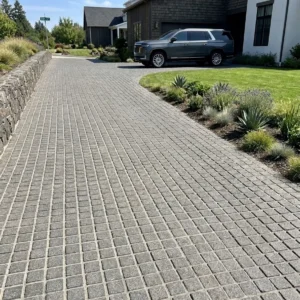
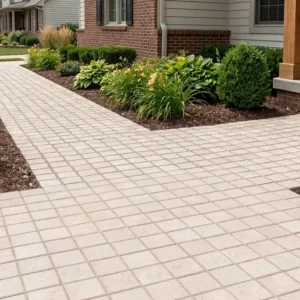
Small units are the reason setts suit slopes at all. A field of small blocks follows a warped surface that a large-format slab simply cannot, and every joint is another chance to correct the line. If you are weighing formats, start from the sett options for island sites and work backward from the gradient rather than from a picture.
- Smaller face sizes track a changing gradient with far less lippage between units.
- Deeper units give more side friction and more tolerance if bedding is disturbed.
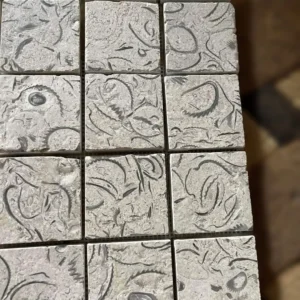
- A riven or textured top face keeps grip on the wet stretches a slope guarantees.
- Joint width should stay consistent; wandering joints read as failure on a fall even when the stone is sound.
Edges, steps and the conten detail
On a slope the edge is doing structural work. The conten, the curb line that defines almost every urbanizacion street and driveway on the island, is often the strongest anchor available, and it should be used deliberately rather than met by accident.
- Build a continuous restraint along the downhill side before the field is laid, not after.
- Use a soldier course or a set band to change direction cleanly at a step nosing.
- Keep step risers consistent; a hillside terrace is exactly where mismatched risers become a trip hazard.
- Detail the junction between new stone and existing conten so water is not trapped behind it.
Setting out on ground that is not flat
Setting out is where hillside jobs are won or lost, because a string pulled level across a fall tells you very little on its own.
- Work from a fixed datum at the top of the site and step down in measured increments.
- Check the falls at every band instead of discovering the error at the bottom.
- Lay a dry trial run across the worst part of the slope before bedding anything.
- Photograph the trial, because the crew that finishes a job is not always the crew that started it.
Sequencing a hillside job
Season matters. Excavated hillside ground left open through a wet spell is a liability, so keep exposed cuts short and protect them. The 2018 Puerto Rico Building Code and the Puerto Rico Residential Code, adopted after Hurricane Maria on the recommendation of a FEMA Mitigation Assessment Team, set wind resistance expectations across a broad band by structure type and risk category. Ground-level paving is not a wind element, but the railings, walls and shade structures it abuts certainly are, so coordinate those fixings before the stone closes over them. Background on regional supply sits on our Puerto Rico stone hub if you are still scoping. Get the water and the edges right and a sett slope will outlast everything built around it.