Three Numbers, Not One
People ask what setts cost in Grenada as though there were one figure. There are three, and they move independently. The first is the stone, priced by area or by crate at the point of supply. The second is landed cost: freight, duty, tax and the charges that attach at the port. The third is installation, which for hand-laid setts is a substantial line in its own right and the most sensitive to weather and site conditions. A budget carrying only the first number will be wrong by a wide margin, in the direction that stops a job halfway through.
The Landed Cost Stack
Grenada is a full CARICOM member, so extra-regional stone pays the Common External Tariff, and the charges apply in a set order.
- Duty runs from zero to forty-five percent depending on the ten-digit tariff code, and is assessed on the CIF value.
- Value Added Tax follows at the standard rate of fifteen percent, calculated on the CIF value plus the duty rather than on the goods alone.
- A Customs Service Charge also applies to imported merchandise; confirm the current rate with your broker before budgeting it.
- An Environmental Levy exists but attaches to specified items rather than acting as a general charge on all imports, so ask whether it touches your commodity code.
- Declarations go through ASYCUDA World on the standard customs entry form; an importer registered as a declarant may file directly, though a first shipment usually goes through a licensed broker.
Labor Is Usually the Bigger Half
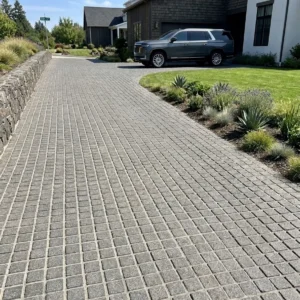
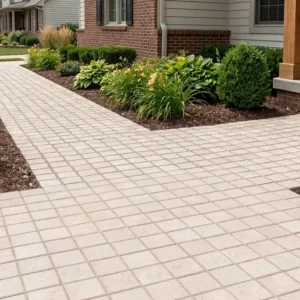
Setts are laid one at a time. That is the entire economic story. A crew that drops a large slab in seconds will place dozens of small units across the same area, and the skill of the layer shows in the finished line more plainly than in any other paving type. On a curve or a slope the rate falls further still. Price labor by the day and by the square foot, take a rate from someone who has laid setts rather than slabs, and never assume a flat-terrace rate transfers to a hillside court. Knowing cobblestone volumes and crate counts in advance lets a contractor price the days honestly instead of padding for uncertainty.
Phasing Around the Wet Season
The calendar matters as much as the drawing. The dry season runs roughly from January to May and the wet season from June to December, with the heaviest rain in the storm months.
- Aim to complete bedding and jointing inside the drier months wherever the schedule allows it.
- Order early enough that stone is on the island before that window opens, not during it.
- Split large areas into sections that can each be finished and closed within a few dry days.
- Keep crates covered and off the ground, since standing water and grit spoil a face before it is ever laid.
- Leave drainage and sub-base work in a state that survives a heavy shower at every stopping point.
Freight to Carriacou and Petite Martinique
Grenada, Carriacou and Petite Martinique are one country but three islands, and the freight differs. Stone lands at the Port of St George’s; moving it further is a separate leg with its own cost and timetable.
- Tyrrel Bay is Carriacou’s only port, and the ferry dock at Hillsborough is roughly fifteen minutes away by taxi.
- The Osprey catamaran carries passengers and light cargo only, so crated stone cannot travel on it.
- Heavy cargo and vehicles move on vessels such as the Dolly C and the Tyrrel Bay Express, booked separately.
- Build the extra leg into both the cost and the program, and confirm the sailing schedule with the operator before you fix dates.
- Confirm lifting arrangements at both ends, since a crate that cannot be handled at the receiving dock is a stranded crate.
Crates, Coverage and Wastage
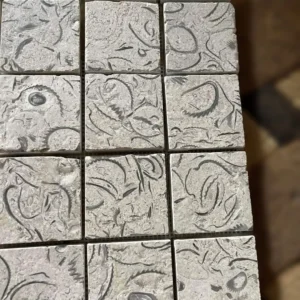
Stone is sold by the crate, and a crate is a fixed quantity. That one fact causes more budget surprises than tariff rates do. Work out the area, add for pattern and cutting, then round up to whole crates instead of ordering the theoretical minimum. Allow a margin for handling breakage, for units you will reject on sight, and for the repair you will want in five years when a service trench crosses the paving. Keeping a spare crate dry under cover is the cheapest insurance on a stone job, because a later order will not match the first exactly and one crate alone ships at a far worse rate.
What a Real Quote Needs
The fastest route to a figure you can build to is a complete brief.
- Total area, broken into flat, sloping and curved sections.
- The format and depth you want, or the duty the surface has to carry if you are unsure.
- The delivery point, including whether the site is on Grenada, Carriacou or Petite Martinique.
- Your target month on site, so shipping can be worked backward from it.
- Whether the stone needs size-sorting before crating.
Send those five lines and get the crate count priced against your own schedule rather than a generic one.
Building the Budget
Domestic construction is commonly quoted in East Caribbean dollars while resort work is often priced in US dollars, so agree the currency before comparing figures. Then hold the three parts separately in the budget. If the stone price moves you will see it immediately. If freight moves, you will see that too. And if labor turns out to be the number that decides whether the job goes ahead, you will have discovered that at the planning stage rather than in week three on site.
Price the stone, the landing and the laying as three separate lines, and the total will hold.