Why Anguillian Plans Curve
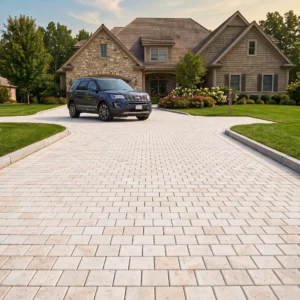
Look at how villas here are laid out and a habit shows up quickly. Buildings open toward a bay, drives sweep in rather than arrive head-on, and the arrival court is shaped by the turn a vehicle needs rather than by a drawing board. Add pool surrounds, planted islands and terraces that follow a shoreline, and the straight run of paving becomes the exception. Pattern choice therefore has to start with the curve, not be adjusted for it afterward.
Patterns That Turn and Patterns That Do Not
Some layouts absorb a radius almost invisibly. Others fight it and leave a trail of tapered cuts along every arc. The difference is whether the pattern has a natural center or an inherent direction, and it is worth deciding this before anyone starts setting out.
- Radial and arc-based layouts turn by design, because curvature is built into the geometry
- Concentric coursing follows any smooth curve and needs only tapered joints, not tapered stones
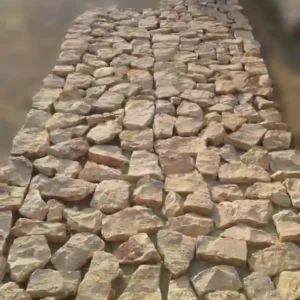
- Random coursing hides irregularity well but wants a disciplined layer to stay honest
- Strong directional bonds look excellent on a straight run and awkward on a bend
Radial Fans in a Villa Court
The fan is the classic answer to paving that has to turn, and it works because each fan is generated from its own point. Set out well, radial fans laid in stone give a court movement without chaos, and they forgive gentle changes in width along an approach drive. Set out badly they drift, and drift in a fan is visible from the balcony above. The discipline is in the string lines and the first two courses, and in choosing a unit size small enough that the joint taper stays modest across the arc.
Running Bond and Its Limits on a Curve
A straight bond is the most economical pattern to lay and the easiest to keep true, so it earns its place on approach runs and long terrace edges. On a curve, though, it forces a choice: either the courses stay parallel and the joints open toward the outside of the bend, or the units get cut and the bond breaks down. On a shallow, generous radius the first option is acceptable. On a tight turning circle it is not, and that is where a radial layout or a concentric course pays for itself. The practical test is simple: walk the arc with a string line and see whether the joint at the outside of the bend stays within the width you would accept on a straight run. If it does not, change the pattern rather than the tolerance.
Setting Out an Arrival Court
A court reads as one surface or it does not, and that verdict is decided in the first hour of setting out.
- Fix the centers and radii on the ground before any stone is bedded
- Lay a dry trial arc to see how the joint taper looks at full size
- Start from the most visible line, usually the entrance, and work outward
- Keep the crossfall in mind while setting out, since pattern and drainage share the same surface
Cuts, Closers and Perimeters
Every curved layout produces cut units where the field meets its boundary. The aim is to keep those cuts substantial, regular and off the main sight line. Because coursing setts around a radius lets you adjust with small increments, the perimeter can usually be closed without the fragile slivers a large format leaves behind. A cut narrower than about a third of the unit will loosen sooner or later, so redistribute the arc rather than accept it.
- Cut on a saw rather than by chipping, so the arris stays crisp and square
- Spread an awkward closer across several courses instead of one thin sliver
- Keep the smallest cuts where planting or an edging will sit against them
- Bed every cut piece fully, since a partly supported closer is the first to rock
- Dry-lay the closing course before fixing anything along a visible arc
Sizes, Sorting and Tone Across a Court
Curved work is unforgiving of inconsistency because the eye follows the arc and reads any drift along it. A few habits at the crate prevent most of the problems that show up later from a first-floor window.
- Sort by depth as units leave the crate, so a laid panel never needs shimming
- Blend from several crates at once rather than emptying one at a time
- Set the darkest and palest units aside and distribute them deliberately
- Keep one format across a single court, and change format only at a real boundary
Natural stone carries variation, and on a curve that variation becomes a visible band if it arrives crate by crate down one side of the court.
Drainage Through a Curved Surface
Anguilla has the lowest rainfall in the Lesser Antilles and takes much of it in short, heavy bursts, mostly in September and October. A curved court has to shed that burst without ponding at the inside of the turn, which is exactly where a fall gets lost if pattern and levels were planned separately. Decide the drainage lines with the setting-out, not after it, and remember that a paved court on a rainwater-harvesting island is a collector as much as a surface. Set out the curve on the ground first and the pattern will look inevitable.