The Hardest Working Square Yard
Every villa driveway has one small area that takes far more punishment than the rest of it. The apron, where the drive meets the road and where vehicles slow, stop and turn, absorbs braking, steering and standing loads inside a few square yards. Turning is the cruel part. A wheel that rotates while the vehicle is barely moving grinds sideways across the surface instead of rolling over it, and that shear is what lifts, chips and displaces paving which would carry the same weight happily in a straight line. Aprons rarely fail from weight alone. They fail from twist, and they fail at the point where the surface is least restrained.
What a Provo Driveway Actually Carries
Design for the heaviest thing that will ever arrive, not for the family car. On Providenciales that list runs longer than most owners expect, and much of it turns up during construction before anyone has thought seriously about the finished surface.
- Delivery trucks carrying block, aggregate and lumber through the build
- A water truck topping up a cistern during a dry stretch of the year
- Septic and waste vehicles reversing to the same fixed point every visit
- Pool and landscape vans turning in an identical spot each week
- Boat trailers swinging wide across the apron on the way to the ramp
Depth, Format and Bond for Turning Loads
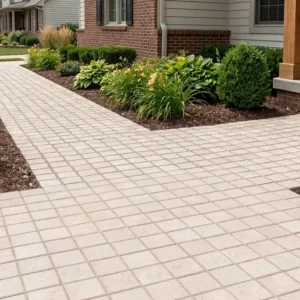
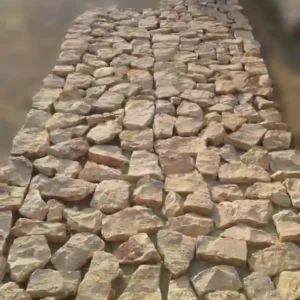
Setts answer turning loads better than slabs because the failure mode is different. A small unit cannot bridge, so it cannot crack across a void; it transfers load straight down into the bed instead. Depth is the specification that earns the most, and an apron unit should sit deeper than the field paving behind it. Bond matters nearly as much. An interlocking layout resists the sideways push of a steering wheel far better than aligned joints, which hand any movement a straight line to travel along. That thinking sits behind cobblestone units for apron work.
The Base Does the Real Work
Good aggregate is imported here. Local gravel exists only as a by-product of limestone screening and is soft, so it is not recommended for concrete use, and the quarter-inch pea gravel and three-quarter-inch concrete gravel used in a driveway base arrive by ship along with everything else. Since the base is imported whichever surface goes on top of it, reinforced poured concrete under a bedded sett apron reads as a sensible structural decision rather than an indulgence. Cure it fully before the first vehicle crosses, and resist the temptation to let an early delivery truck test it for you.
Restraint, Fixings and the Road Edge
An apron gives way at its edges long before it gives way in the middle, and salt air makes the wrong fixing a short-lived one.
- Haunch every exposed edge in concrete, not only the road side
- Use stainless fixings, because salt air corrodes standard metals fast
- Keep cast zinc alloys out of anything holding the paving together
- Detail the road transition so no sett is left standing proud of it
- Check the line again after the base cures and before pointing begins
Drainage Where the Drive Meets the Road
Around 43 inches of rain reaches the islands each year, and it arrives in heavy concentrated periods on flat, poorly draining ground. An apron that sheds water onto the public road is a nuisance. An apron that sheds water back toward a garage or a lower level is an insurance claim. Set a channel across the head of the drive, fall the paving into it, and size the outlet for a burst rather than for an average year on paper.
Why the Step Up Is Smaller Here
Landed cost in the Turks and Caicos Islands looks intimidating until you compare it with the alternative. Building supplies arrive well above average US cost, and a container from Miami to Providenciales is priced much like a container heading to Asia. But the blocks come predominantly from the Dominican Republic, the good aggregate comes by ship and the lumber comes by ship. Because the conventional materials are imported anyway, the marginal step from imported concrete to imported natural stone is smaller here than in almost any other market. Look at the formats in bedded sett courses for driveways before deciding stone is out of reach.
- Duty is assessed on CIF, so freight forms part of the taxable value
- There is no VAT and no general sales tax to stack on top of duty
- Building materials attract a reduced duty rate plus a Customs Processing Fee
- Confirm the rate and HS classification using TCI Customs’ Tariff Finder
- A licensed customs broker is recommended rather than legally required
Sequencing an Apron on a Live Site
The apron should be one of the last things built, which is awkward, because it is also the route every delivery uses. Work the sequence backward from that conflict and the finished surface survives the build.
- Form and pour the base early, then protect it under boards and gravel
- Keep heavy deliveries on a temporary track until the field is laid
- Lay the apron after the drive so levels resolve neatly toward the road
- Point and cure with the site closed to vehicles for a full week
An apron survives on depth, restraint and patience, in that order.