Four numbers, not one
Ask what setts cost on Bonaire and the honest answer is a question in return, because the figure that matters is built from parts that behave very differently. Material is priced by format and depth. Freight is priced by container and schedule. The import levy is a percentage applied to a defined value. Installation is priced by hours and by difficulty. Treat them as one number and you cannot tell which part moved when the total changes.
- Material, quoted by unit size, depth and finish rather than by a blended area rate.
- Freight, quoted per container with a known sailing and cut-off.
- Import levy, calculated on a defined customs value.
- Installation, driven by pattern, cutting and site access.
- Contingency, which on curved or stepped work should sit with the material line.
Zero duty and an eight percent levy
Bonaire’s import position is genuinely simple, and it is worth stating plainly because it is unusual. There is no import duty: the rate is set at nil for all goods. The operative levy is ABB, the Algemene Bestedingsbelasting, and on Bonaire it applies at 8% on the delivery and import of goods, with 6% on services. There is no VAT and no BTW. The import declaration is filed with Douane Caribisch Nederland, and both businesses and private individuals are liable for ABB on import. One caution: Saba and Sint Eustatius use different rates, 6% on goods and 4% on services, so do not carry a figure across from another island.
How the levy is calculated
ABB at import is charged on the customs value, which is the value of the goods plus insurance plus transport costs. That mechanic has a practical consequence worth planning around, because it means freight and insurance are inside the taxable base rather than outside it. A cheaper material price shipped inefficiently can land at a higher figure than a better sorted, better packed load. It also means the delivered figure cannot be reconstructed from a material rate alone, so ask for the freight and insurance components in writing if you want to model the levy yourself rather than take a single delivered total on trust.
Freight is a schedule as well as a cost
The weekly service from Florida is the backbone of any Bonaire budget. It departs Port Everglades on Saturday and reaches Kralendijk on Thursday, a five-day direct sailing, and documentation cut-offs fall midweek depending on cargo type. Equipment runs to 20, 40 and 45 foot dry containers as well as flat rack, open top and break bulk.
- Fill containers deliberately, since part loads carry the same fixed costs across fewer units.
- Work backward from the cut-off, not forward from the order date.
- Confirm handling and storage arrangements at the port before the vessel arrives.
- Keep packing lists tied to phases, so a delivery can be released to the right part of the site.
Labor is where setts differ
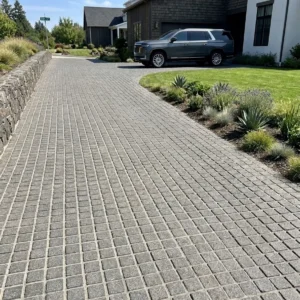
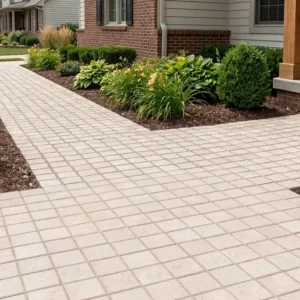
Small units cost more to lay than large panels and less to repair, and that trade is the real decision. A sett surface is laid piece by piece, so pattern complexity, cutting at edges and the tightness of any arcs all move the hours. On the other side, a damaged area can be lifted and reset without touching a whole bay, and levels can be corrected locally years later without a demolition. Judge the two together rather than comparing installation rates alone. Access is the other variable people forget to price. A crew working a narrow entrance, a stepped garden or a plot that cannot take a delivery truck close to the laying face will move every pallet twice, and those hours belong in the estimate rather than in the argument afterward.
Phasing that actually helps
Phasing is where most of the avoidable cost sits. Start by fixing cobblestone volumes for a first phase that covers a complete, usable area, then hold the remainder.
- Phase by finished area, never by percentage of the total, so each stage leaves something usable.
- Keep one format and one depth running across phases to avoid a visible line later.
- Order the heavy traffic zones early, since those are the hardest to retrofit.
- Reserve a small overage from the first phase for repairs rather than relying on a future match.
Pricing in dollars
Bonaire is a special municipality of the Netherlands, and it has used the US dollar as official currency since 1 January 2011, replacing the guilder. For a US supplier that removes an entire layer of budget noise: the material price, the freight and the delivered figure are all in the same currency the client is working in, with no conversion assumption buried in the total and nothing to revise if a rate moves before delivery.
Getting a number you can build to
A usable price comes from a layout, not from a square footage. Send the drawing, the traffic positions and the phase boundaries, and ask for a written price against your drawings before committing to a program.
- Give the finished area by zone, with pattern noted for each.
- State the depth needed for vehicle areas separately from pedestrian areas.
- Say when each phase is expected on site, so sailings can be matched to it.
- Ask for material, freight and levy shown as separate lines.
Separate the lines, phase by usable area, and a sett budget becomes something you can actually manage.