Why Small-Format Layouts Unlock Scabos Travertine’s Full Character
Scabos travertine’s defining feature — those deep walnut, rust, and cream bands — reads completely differently at 4×4 versus 12×12. Cut small, the veining creates a mosaic-like rhythm that larger slabs simply can’t replicate, multiplying the visual information per square foot in a way that makes small-format Scabos travertine one of the more compelling layout decisions in natural stone specification today.
The crosscut orientation matters here more than most specifiers realize. When you crosscut Scabos at small dimensions, the natural layering creates concentric oval patterns that stack beautifully in a grid — almost like a topographic map rendered in stone. Vein-cut at the same small size produces bold parallel stripes with a very different energy. Decide which character suits your project before ordering, because mixing orientations mid-job creates visual noise rather than the layered depth you’re after.
Layout Patterns That Perform Best with Small Scabos Tiles
Your layout pattern choice does more than direct the eye — it affects how the veining integrates and how forgiving the installation is when field-cutting around obstacles.
- Straight-set grid: The most direct approach, and the one that showcases Scabos banding in a disciplined, repeating rhythm — works well in bathrooms and shower surrounds where the banding becomes the primary design statement
- Offset brick pattern at 50% or 33%: Breaks up the repetition of tight veining and is particularly effective when using a blend of Scabos fill and cut tiles, because the offset disguises minor tone shifts between batches
- Versailles pattern: Mixing small Scabos formats (2×2, 4×4, 4×8) in a repeating random-seeming arrangement creates depth; this is where Scabos truly behaves like a travertine mosaic, especially on larger floor fields
- Herringbone: Demands precise cutting tolerance — natural travertine has dimensional variation, so confirm your supplier’s calibration spec before committing to herringbone on a large floor plane
- Diagonal / diamond set: Enlarges perceived room dimensions and works especially well with small-format Scabos on narrow corridors or elongated pool surrounds
The Versailles pattern in particular rewards careful dry-lay planning. At Citadel Stone, we recommend laying out a full 4×4 repeat section dry on a flat surface before setting anything, because it lets you audition the tonal distribution and catch any batching inconsistencies before mortar is involved.
Indoor Applications: Floors, Walls, and Feature Panels
Small-format Scabos travertine handles indoor environments exceptionally well, largely because of how the scale interacts with grout joint geometry. More joints per square foot give you better control over minor substrate irregularities — a practical benefit that gets overlooked in purely aesthetic discussions.
For flooring, 4×4 tiles set in a straight grid with 1/16″ to 1/8″ joints create a surface that reads refined but not sterile. The warm amber-rust tones of Scabos absorb and re-emit ambient light in a way that polished surfaces don’t, so a honed or brushed finish on small tiles produces a genuinely warm, layered floor rather than a reflective one. Shower walls and wet rooms are another strong application — according to NSI travertine properties and outdoor suitability, travertine’s open-pore structure benefits significantly from correct sealing protocols in wet environments, and that applies here too.
Feature panels and accent walls are where small Scabos really separates itself from larger format stone. A floor-to-ceiling panel using 2×2 or 2×4 Scabos tiles creates a texture that photographs as rich tapestry-like depth rather than flat stone. Pair it with Citadel Stone patterned travertine options to extend the warm banding theme across adjoining surfaces without exact color-matching pressure.
Outdoor Applications: Patios, Pool Surrounds, and Benches
Outdoors, the small-format decision brings a structural advantage alongside the design one. Smaller tiles are less prone to the rocking and lippage that develops when larger slabs bridge minor voids in a compacted base — particularly relevant on patios where base settlement is a long-term reality.
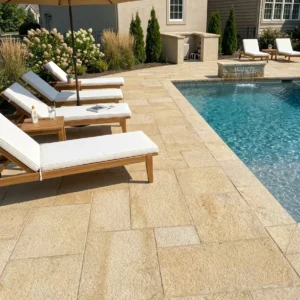
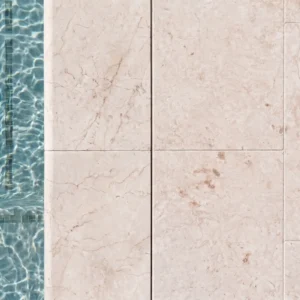
Pool surrounds are a natural fit. The smaller scale of the tile means the surface texture varies more frequently underfoot, which increases tactile grip compared to large-slab installations of the same finish. Your finish selection still determines the surface’s behavior when wet — always confirm the specific finish against ANSI A326.3 wet DCOF requirements before specifying for a pool deck, because the finish is the variable that drives wet-surface performance. A travertine bench incorporated into a pool or garden setting in small Scabos tile creates an especially cohesive look, because the same banding that reads across the floor continues vertically without jarring contrast.
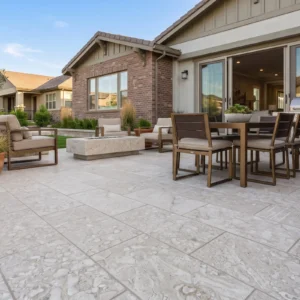
For outdoor patios, honed Scabos in a Versailles or offset brick pattern offers a surface that handles outdoor furniture, foot traffic, and seasonal changes in base conditions. In areas with pronounced terrain variation or slopes, your drainage design becomes particularly important: small-format tiles over a properly graded substrate drain more predictably than large slabs, because each joint acts as a micro-channel directing water toward your designed drainage points. Grade your substrate at a minimum 1/8″ per foot away from structures before setting any tile — this is non-negotiable on hillside terraces and elevated decks where water pooling accelerates stone degradation.
How Scabos Compares to Other Travertine Varieties
Specifiers frequently ask how Scabos sits relative to ivory and walnut travertine — and the honest answer is that the coloration difference is significant enough to affect the entire design palette around it.
- Ivory travertine: Cooler, lighter background tones with subtler veining — reads as neutral and pairs with a broader range of wall colors, but lacks the warm depth that defines Scabos
- Walnut travertine: Deep chocolate-brown tones with less color range per tile — dramatic but less versatile than Scabos for mixed indoor/outdoor schemes
- Peruvian travertine: Typically exhibits a creamy beige base with softer banding — a closer relative to Scabos in warmth, but with less tonal contrast, which produces a more uniform appearance in small-format layouts
- Scabos travertine: The widest tonal range of the common commercial varieties — rust, walnut, cream, and amber bands within a single tile create the layered visual depth that makes small-format layouts compelling
The ASTM C1527 standard for travertine dimension stone covers the dimensional and physical property benchmarks that govern commercial supply — ASTM C1527 travertine dimension stone specifications are worth reviewing when specifying for commercial or institutional settings, because the grading and fill requirements directly affect what you receive. Where peruvian travertine and other softer-banded varieties may meet those thresholds comfortably, Scabos’s broader tonal range adds a design variable that the standard does not capture.
Fill and Finish Decisions for Small-Format Scabos
Travertine arrives in two fundamental conditions: filled and unfilled. For small-format tiles, this decision carries more weight than it does with larger formats, because the voids represent a higher percentage of the exposed face area relative to tile perimeter.
- Filled travertine: Grout or epoxy fill closes the natural voids before installation — creates a cleaner, more consistent surface and is the correct choice for kitchen floors, shower floors, and any surface that will receive heavy foot traffic or food exposure
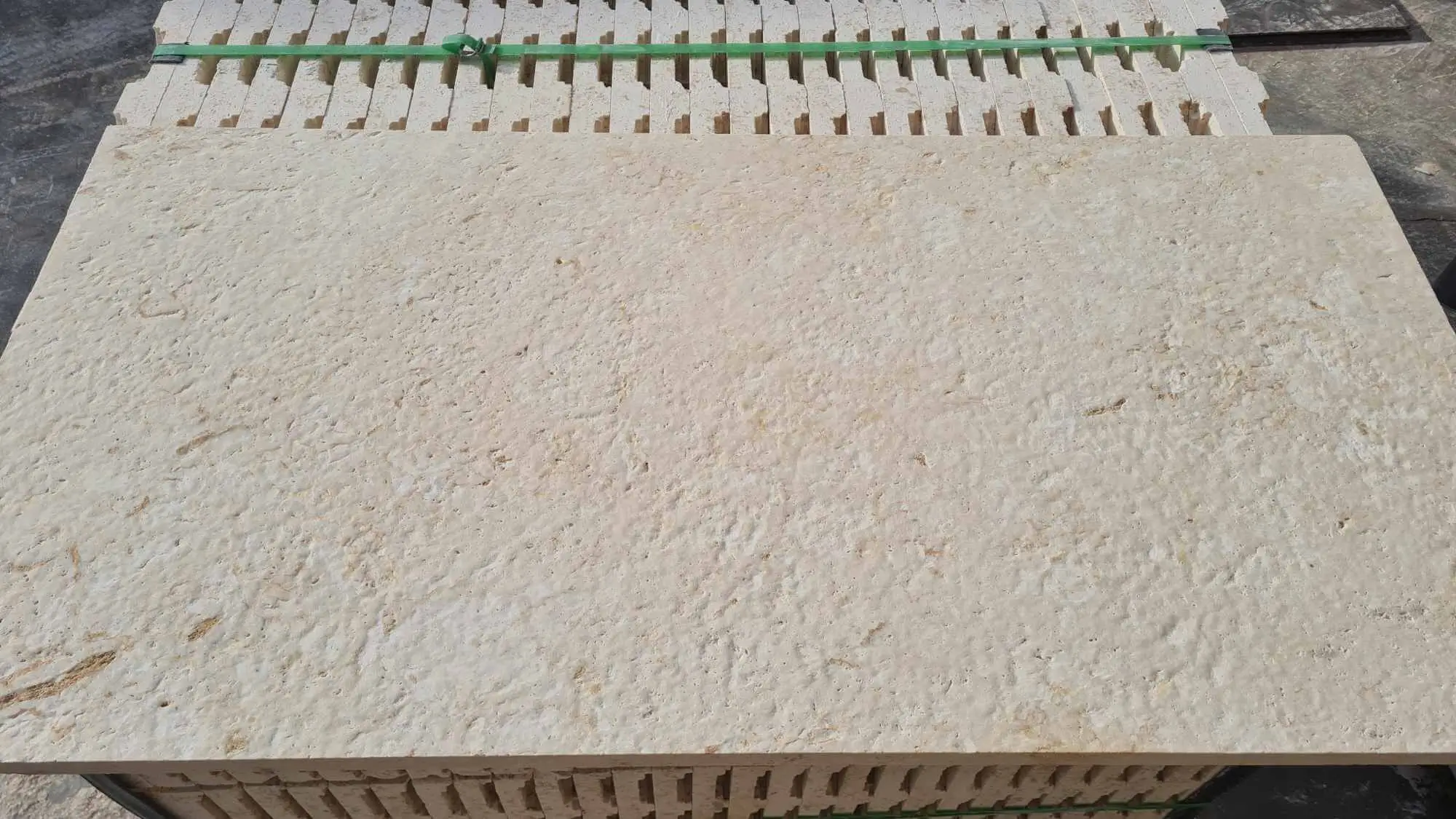
- Unfilled travertine: Retains the natural pit texture — contributes to the material’s rustic, aged character and is appropriate for accent walls, low-traffic floors, and certain exterior applications where the texture reads as a design element
- Honed finish: Smooth, matte surface that showcases Scabos banding without the glare of polish — the most versatile finish for both indoor floors and outdoor patios
- Brushed finish: Wire-brushed texture that emphasizes the stone’s natural layering — particularly effective in small-format layouts where the brushed texture adds three-dimensionality to the banding pattern
- Polished finish: High reflectivity that amplifies the warm amber tones — best reserved for wall applications and feature panels, not recommended for wet or high-traffic floors
Base Preparation and Terrain Considerations
Small tiles are more honest about substrate quality than large ones — they telegraph every hollow, high spot, and inconsistency in the setting bed. Your base preparation work is arguably more consequential than tile selection for the long-term performance of the installation.
For interior floors, a minimum 3/4″ thick mortar bed or a latex-modified thin-set over a deflection-controlled subfloor is the correct starting point. For exterior patios and terraces, particularly on sloped or elevated sites, your compacted aggregate base needs to follow the designed grade precisely before any setting bed is placed. On hillside installations, base erosion at the downslope edge is the most common failure point — consider a perimeter restraint at grade transitions and ensure your drainage design routes water to daylight rather than allowing it to pool beneath the tile field. The USGS limestone and travertine mineral formation data confirms that travertine’s characteristic porosity means water management at the substrate level is especially important for long-term installation integrity.
Citadel Stone ships small-format Scabos travertine on palletized crating from warehouse stock, which means your truck delivery scheduling should account for job-site access — narrow driveways and sloped approaches sometimes require a smaller vehicle, so flag access constraints when you place your order to avoid staging delays.
Grout Joint Selection and Sealing Protocol
Grout joint width in small-format travertine layouts does more design work than most installers acknowledge. A 1/16″ joint in a straight-set grid nearly disappears, making the tile field read as a continuous surface — the banding flows across joints with minimal interruption. A 3/16″ joint in the same layout creates visible rhythm, separating each tile as an individual element.
Color-matching your grout to the mid-tone of Scabos — a warm sand or light walnut — produces the most cohesive result. High-contrast grout (white or charcoal) emphasizes the grid structure and shifts the aesthetic toward a more geometric, contemporary look. Neither is wrong, but the choice should be deliberate.
Sealing is required on all travertine installations, and the application timing matters. For honed and brushed Scabos, apply a penetrating impregnator sealer after installation and before grouting — this protects the stone face from grout haze penetrating the open pores. Follow with a second application after grouting. For exterior applications, reseal every two to three years depending on climate exposure and foot traffic volume. Skipping this maintenance cycle is the most common reason travertine surfaces lose their warmth and develop staining over time.
Getting Your Scabos Travertine Specification Right
Scabos travertine in small formats rewards careful pre-planning — layout pattern, orientation, fill condition, and finish all carry real design and performance consequences that you’ll want to resolve before the first tile is set. Your base preparation quality directly determines whether the installation holds its character for years or begins showing distress within a season, particularly on exterior terraces and sloped sites where drainage geometry is critical. For projects that mix floor and wall applications, maintaining the same finish and fill condition across both planes creates visual continuity that larger-format stone simply can’t achieve at the same budget point. As you build out the full hardscape picture for your project, exploring tumbled travertine for complementary outdoor surfaces can help you assess how different formats and finishes work together across a complete installation. Scabos travertine from Citadel Stone blends warm bands across small tiles for layered floor and wall designs.
Related reading: how to polish travertine tile · travertine border tile ideas · small travertine bathroom ideas.