Dominicans say their island has a river for every day of the year, and the landscape makes the boast believable: waters everywhere — pouring off the heights, braiding through valleys, arriving at the sea in village after village. For builders this is the cluster’s richest hydrology and its most serious one: nearly every property lives near moving water, and the ones that thrive were designed knowing it. This is the river island’s building guide.
Reading water at Dominican scale
The river-property fundamentals apply here as the baseline — honest flood-line reading, respect by distance, wet-season personality studied before design — and Dominica raises every stake: catchments are steeper, rain events heavier, and rivers that murmur in April can command their valleys in October. The reading extends beyond the channel: slopes shed sheet water in cloudbursts, springs emerge where geology decides, and the site survey maps all of it — existing flow paths, saturated ground, the routes storm water has already chosen — before a single platform is drawn. On this island, hydrology is the first architect.
Drainage as the primary design
Dominican hard landscaping is water infrastructure wearing garden clothes: terrace falls sized for cloudbursts, channels and rills that celebrate what they manage, stone-armored swales carrying slope water past buildings, culvert aprons and discharge points built to survive their own storms, and the gradient water discipline running at the island’s intensity. The design opportunity matches the duty: nowhere else in the cluster can gravity water be composed so naturally into the landscape’s daily theater — rills beside stairs, spouts from terrace walls, the property’s own storm story told in stone channels that run musical all wet season.
- Design every surface as part of a drainage route rather than a finish.
- Fall paving toward a defined channel instead of toward the nearest edge.
- Oversize drainage, since the rainfall figures here are not comparable to the region.
- Keep permeable ground wherever the plot can absorb its own runoff.
Living rooms beside living water
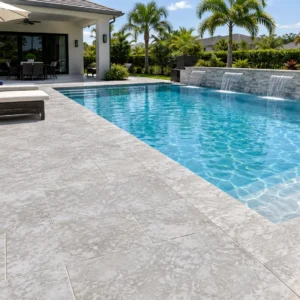
The river terrace is Dominica’s signature outdoor room — cool air, white noise, the green corridor’s privacy — and its craft follows the riverside rules at full pitch: platforms above the honest flood line, the damp-valley finish package underfoot, sightlines and earshot composed deliberately, and the wilderness left in charge beyond the respect line. River-bathing access adds the island’s particular joy: steps and entry aprons at the swimming pools rivers carve, built massive and sacrificial-minded below the storm line, refined above it — the water-access stair logic translated from sea to river.
Crossings, bridges and the valley commute
Valley properties cross water as daily life, and Dominican crossings earn the full engineering respect: spans and clearances sized for the wet-season river, abutments founded on competent ground, decks and approaches surfaced for grip in permanent humidity, and stepping-stone crossings reserved for genuinely gentle reaches. The two-stone pattern serves again — structure from engineered concrete and local volcanic mass, wearing surfaces from calibrated imports — and every crossing carries its maintenance covenant: inspection after serious storms, debris cleared while small, the channel treated as the neighbor it is.
- Design crossings for flood flow rather than for the everyday stream level.
- Keep abutments well back from the channel so the bank can move.
- Use units heavy enough not to travel in a flood event.
- Plan an alternative route for the days the crossing is under water.
Springs, cascades and the property’s own waters
Many Dominican properties hold their own water features by deed — a spring line, a cascade, a river pool — and stewardship is the design brief: development held back from source zones, access built light and reversible, bathing spots given stone footing without domestication, and the watershed courtesy rules — no chemistry, no runoff shortcuts — observed as law. Done well, a property’s own waters become its identity; the island’s best-loved addresses are named for theirs.
The reward of the wettest island
What Dominica returns for its hydrology is the cluster’s most alive landscape: gardens that grow while you watch, air the rivers condition, and outdoor rooms with soundtracks no design budget could buy. The stone package’s role is permanence amid all that motion — surfaces the water cannot claim, channels that give it somewhere beautiful to go — and the Nature Island supply guide plans it valley by valley, flood line first, always.
The warm waters: hot springs and the volcanic spa
Dominica’s waters run hot as well as wild: the volcanic interior steams with springs — the famous valley baths, the bubbling streams, the geothermal seeps that make whole hillsides breathe — and properties near them inherit the region’s most distinctive wellness asset. Building beside the warm waters follows the volcanic-neighborhood briefing with Dominican intensity: mineral-rich flows stain pale surfaces on schedule, so spring-fed features and soaking pools run dark stone and relaxed expectations while pristine registers keep to rain and pipe water; sulfurous air near active seeps accelerates every metal on the accelerated schedule while stone sits exempt; and the ground itself is mapped before design, its warm zones hosting hardscape and bathing courts rather than the planting that sulks over them.
The spa opportunity is the island’s own genre: soaking pools terraced into hillsides on the hot-spring model, stone-decked rest platforms between warm and cold plunges, and the wellness-garden craft running with geothermal water instead of boilers — luxury infrastructure the volcano operates free. Detailing respects the medium: generous drainage for mineral flows, surfaces selected for warm-wet grip, junctions between bathing stone and natural rock left honest, and the maintenance calendar accepting mineral patina as the aesthetic it genuinely is. Guests cross oceans for what these valleys offer as landscape; properties that frame the warm waters well — reverently, robustly, in stone that ignores the chemistry — hold the rarest amenity in the Caribbean wellness market: the real thing, still steaming.
What the regulations require on a watercourse site
Building near water is a documented obligation here. The Physical Planning Building Regulations 2022 require site plans to show the location of any watercourse, call for topographic surveys on building sites with slopes exceeding 15 percent, and set out foundation plan requirements including the general foundation type and the type of soil on which the foundation will rest. On this island most parcels trigger at least one of those.
- Show every watercourse on the site plan rather than only the obvious one.
- Commission a topographic survey as a matter of course on sloping ground.
- Record the soil type under each foundation rather than assuming uniformity.
- Expect the drainage design to be examined as closely as the structure.
- Keep hard surfaces clear of the channel so a flood has somewhere to go.
How much water actually arrives
The scale of the rainfall is what makes this island different. The Caribbean Institute for Meteorology and Hydrology country profile records the west coast receiving just above 2,000 mm a year while the interior exceeds 7,620 mm, a Canefield average of 1,764.4 mm between 1982 and 2015, a wettest month of 539.4 mm in August 2007 and a driest of 0.4 mm in February 2010, with the wet season running June to November.
- Design for the interior figure if the site sits inland or upslope.
- Size gullies and channels for a 500 mm month rather than an annual average.
- Expect long dry spells too, since the same island records near zero months.
- Keep joints open so water leaves the surface rather than sitting on it.
Living on ground that water already owns
On an island with this many rivers, almost every plot is on a route water has used for a long time. The successful projects read that route first and design around it; the ones that fail try to redirect it and discover during the first real storm that the water remembers where it used to go.
- Trace the historic water route across the plot before setting any levels.
- Leave the natural channel doing its job rather than culverting it.
- Set built work above the flood line rather than at the water’s edge.
- Treat the lowest terrace as replaceable rather than as permanent.
River island stone and the water that shapes it
Dominica has more running water than anywhere comparable, and hard landscaping here is drainage infrastructure that happens to be walked on. Show the watercourse, survey the slope, size for the interior rainfall and build above the line water already claims. Our Dominica stone supply guide sets out the formats, finishes and lead times that suit this island. You do not get to negotiate with a river on this island, so the specification has to agree with it from the start.