A large share of Grenada’s finest homes are built by people who are somewhere else — owners in London, Toronto or New York assembling a Caribbean future between video calls. Remote building has a reputation for stress that it only half deserves: the projects that go wrong are rarely wrecked by distance itself, but by decisions made with the wrong information at the wrong moments. Stone, as the most permanent and visible of the finishes, rewards a deliberate remote method — and the method is learnable.
Decisions that travel well
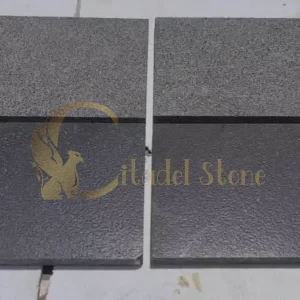
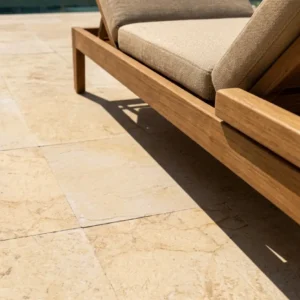
More of the stone package can be decided remotely than owners expect, provided the information is physical rather than photographic. Samples ship to wherever you are: the correct ritual is the same one you would run on site — wet and dry viewing, morning and evening light, held against fabric and paint samples for the interiors they will meet — conducted on your own windowsill. Formats, finishes, layouts and details resolve over drawings and video walkthroughs; quotes, datasheets and the cutting list are documents wherever you sit. What a screen genuinely cannot convey is tone-in-context and quality-of-laying — and the remote method exists precisely to cover those two gaps.
The eyes you appoint
Every remote build needs a person on the ground with authority and taste — architect, project manager or a trusted local professional — and the stone package should be explicit in their brief. Two checkpoints matter most. The sample-on-site check: your approved sample, photographed against the actual walls and garden in the island’s light, closing the tone-in-context gap before production. The mock-up check: a laid panel of the real stone, jointed and finished as specified, inspected by your appointee before the main field is laid — the single most effective quality gate in all of construction, and it works at any distance. The sample-box method translates directly; only the courier address changes.
The paperwork spine
Remote trust is built from documents that reconcile. The quote itemizes so the broker can price landed cost and you can compare honestly. The cutting list becomes a contract exhibit — every special dimensioned, every quantity stated. Production and loading photographs arrive before the vessel sails; the packing list travels with the crates; and your on-island appointee reconciles crates against it at delivery, photographing anything questionable before it moves. Payment maps to the same spine — deposit, stage evidence, balance at verified arrival — with escrow holding the final tranche until the reconciliation closes. Nothing in the chain requires your presence; everything in it requires the chain to exist. The St. George’s shipping guide details the freight legs it hangs on.
- An itemized quote, so the broker can price landed cost and you can compare honestly.
- A cutting list treated as a contract exhibit, with every special dimensioned.
- Production and loading photographs delivered before the vessel sails.
- A packing list traveling with the crates and matching them piece for piece.
- Retained samples held on site and referenced in every later conversation.
A communication rhythm that works
Distance fails at the moments a five-minute site conversation would have caught something — so the method replaces corridor chat with rhythm: a weekly photo log from the site (same angles each week, so change is visible), decision deadlines mapped to production gates and published to everyone, and a standing rule that no stone-affecting change happens without a photograph, a drawing reference and your written yes. Time zones are a feature here, not a bug: the island’s afternoon questions meet your evening review, and answers land before the next site morning. What kills remote projects is not slow answers but silent improvisation.
- A weekly photo log shot from the same angles, so change is visible rather than described.
- Decision deadlines mapped to production gates and published to everyone at once.
- A standing rule that no stone-affecting change happens without written confirmation.
- One thread per shipment, because the file is the only reliable version of events.
- A named decision-maker available in the site time zone, not only in yours.
Visits that count
Two visits do most of the work. At design freeze: walk the site, run the sample ritual in place, agree levels and junctions while changes are free. At first laying: inspect the mock-up and the opening courses, when adjustments cost little and set the standard for everything after. A third, at handover, closes the loop with the care walkthrough — products, frequencies, the maintenance calendar handed to whoever keeps the house. Between visits, the build-sequence logic proceeds under your appointee’s eyes and your document spine — which is how homes get built beautifully by owners four thousand miles away, on the Grenada supply page’s standard pattern.
Paying from abroad without friction
The remote owner’s money moves across borders as often as their decisions, and the friction is designable. Grenada’s EC dollar holds a fixed peg to the US dollar, so USD invoicing removes exchange drama from the stone package entirely — the quote you approve is the amount that clears. Wires want lead time and labeling: international transfers can take days, bank compliance queries add more when references are vague, so payments tied to production gates should leave early and carry unambiguous references matching the invoice line. Keep a decision log beside the payment trail — a simple dated record of what was approved, when, against which drawing or photo — because six months and forty decisions later, the log is what turns any query into a lookup instead of an archaeology dig. Escrow structures the big tranches; the log and clean references structure everything else. It is unglamorous administration, and it is also precisely what lets an owner four time zones away sleep through a build with their name on it.
The handover week: closing a remote build in person
However well the remote method ran, the build should close with the owner on island for a deliberate handover week — the visit that converts a completed project into an owned home. The week has a working structure. Day one is the slow walk: every terrace, stair and edge examined in person against the final photo set, snags listed without ceremony while the contractor’s obligations are still warm. Mid-week runs the systems tour — drainage walked in a hose test if the sky will not oblige, pool equipment, lighting scenes, the location of every isolation valve and the attic-stock store — recorded on the owner’s own phone, because the caretaker who explains it today may not be the one who answers in year three. The maintenance handover deserves its own hour: the care calendar agreed with whoever will run it, products confirmed, the pre-season checklist assigned to a named person and a named month. And the week should end with deliberate pleasure — a dinner on the finished terrace, a first swim, the photographs that are for the family rather than the file — because the punch list mentality has to end somewhere, and it ends where the living begins. Owners who close this way report the same thing: the house stops being a project precisely one week after they arrive.
Permission before anything else
The first thing a remote owner should establish is not a supplier but a consent. Grenada’s Physical Planning and Development Control Act defines development broadly, and the definitions catch a great deal of landscape work that owners assume is exempt.
- Development includes building, engineering and other operations, material change of use and subdivision.
- No development may be carried out without the prior written permission of the Authority.
- Clearing or leveling land is treated as having commenced development.
- Engineering operations include roads, drains, culverts, retention structures, earthworks and landfilling.
- Maintenance that does not materially affect external appearance is exempted.
The clock that starts when the vessel berths
Remote owners lose money to storage more often than to anything else, simply because nobody was watching the calendar. The Grenada Ports Authority publishes the allowances in its guidance on cargo services.
- General cargo receives five working days of free storage from discharge.
- Lo-lo containers are allowed 21 days and ro-ro containers 14, or the line’s next scheduled call if sooner.
- Manifests are lodged 48 hours before the vessel arrives.
- Agents authorize inland container movement, with a Container Interchange Form completed.
- Cargo left beyond the regulated period can be auctioned, so someone local must own the collection date.
Paying from a distance without losing leverage
Payment structure is where remote owners have the most protection available and use the least of it.
- Deposit and balance staged against verifiable events, not against dates.
- Escrow used for a first order with a new supplier, released on verified loading.
- Invoices itemized so a variation is visible rather than absorbed.
- Retention held on the installation contract until the punch list is closed.
- Bank details confirmed by voice, never changed on the strength of an email alone.
Remote building in Grenada, from survey to handover
Distance is not the problem; ambiguity is. Owners who ship samples to their own kitchen table, appoint one person on site with authority, put the cutting list into the contract, hold to a weekly photo rhythm and spend their two visits at design freeze and first laying tend to describe the process as calm. Owners who improvise tend not to. Add planning permission secured before anything is cleared and a local owner of the collection date, and a build five time zones away behaves like one down the road. For material selection and order stages, our Grenada stone supply guide is the practical companion. Write everything down once and the distance stops mattering.