What Actually Separates a Reliable Natural Stone Wholesaler from the Rest
A reliable natural stone wholesaler separates itself from transactional suppliers long before your first pallet lands on site — the difference surfaces in how they handle lot consistency, whether their stock data is live or aspirational, and how their team responds when a project specification throws a curveball three weeks before your pour date. Professionals who’ve sourced stone for high-value projects know that price-per-square-foot is rarely the variable that determines project outcome. What determines outcome is whether the stone you confirmed in week two is still available — and still from the same quarry batch — in week six.
The gap between wholesalers becomes most visible when project timelines compress. A supplier with genuine warehouse depth and active lot tracking can pull confirmed availability within hours. A supplier without it gives you a lead time estimate built on optimism rather than live inventory. That distinction matters enormously when you’re scheduling crews, coordinating subcontractors, and managing a client who has already selected their finish.
Lot Consistency: The Specification Detail Most Buyers Underestimate
Natural stone is a geological material — no two quarry pulls are identical. A reliable natural stone wholesaler understands this and manages it proactively, tracking extraction batches so that stone ordered for phase one of a project can be matched for phase two. When a wholesaler can’t answer questions about lot origin, you’re accepting the risk that your phase-two material will have different tonal variation, slightly different absorption rates, or a surface texture that doesn’t align with what was already installed.
Lot matching is especially critical on large-format commercial projects and high-visibility residential work where graining continuity is part of the design intent. The Natural Stone Institute technical stone specifications highlight how natural variation between extraction batches is an inherent material characteristic — understanding it is part of responsible specification. A wholesaler who treats lot tracking as optional doesn’t understand the material well enough to protect your project.
- Confirm whether the wholesaler tracks quarry batch numbers for every stone variety they stock
- Ask specifically whether reserved lots can be held under a project reference number during the procurement window
- Understand the typical batch size — smaller batches mean higher re-order risk on extended projects
- Request sample confirmation from the actual warehouse-held lot, not a generic display sample
At Citadel Stone, we pull samples directly from the specific warehouse lot assigned to your project — not from a showroom slab that may have been sourced two years ago. That’s a practical distinction that pays off when your stone arrives and matches what your client approved at specification stage.
Stock Depth, Lead Times, and What They Tell You About a Supplier
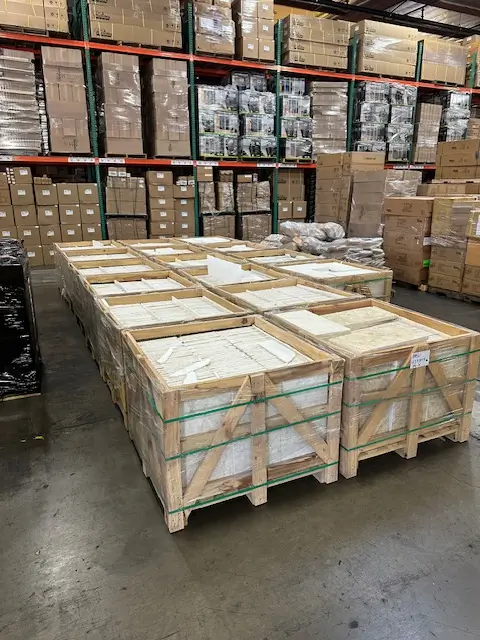
Lead time transparency is one of the clearest signals of a wholesaler’s operational competence. A supplier with genuine stock depth quotes lead times based on actual warehouse inventory — typically one to two weeks for standard formats. A supplier working primarily as an intermediary quotes lead times based on import cycles, which can run six to eight weeks and carry real schedule risk if a shipment is delayed at port.
Your project timeline can’t absorb an unannounced eight-week slip when you’re three weeks from installation. Before committing to a stone variety, ask the supplier to confirm whether the quoted quantity is warehouse-held or import-sourced. These are different supply chains with fundamentally different risk profiles, and a reliable natural stone wholesaler should be transparent about which one applies to your order.
- Warehouse-held stock: available within one to two weeks, confirmed quantities, lot traceable
- Import-sourced stock: typically six to eight weeks minimum, subject to port and customs delay, batch variation risk until arrival
- Mixed model: some wholesalers carry core items in warehouse and source specialty items on order — understand which category your selection falls into
The USGS dimension stone production data gives useful context on domestic supply volumes and material categories — it reinforces why domestic warehouse holding is a meaningful differentiator for time-sensitive projects. Stone that has to cross an ocean carries lead time, quality, and logistics variables that warehouse-held material simply doesn’t.
What Quality Verification Looks Like at the Wholesale Level
Quality assurance in natural stone supply isn’t just about whether the stone is beautiful — it’s about whether it meets the structural and surface performance requirements your specification demands. A reliable natural stone wholesaler performs dimensional verification, surface finish checks, and structural integrity assessment before stock enters their warehouse. By the time material ships to your site, these checks should already be documented.
Field experience shows that the most common installation problems — lippage on large-format material, edge chipping on dimensional stone, and unexpected absorption variation — trace back to incoming quality failures at the wholesale level, not installation error. Your installation crew can’t correct a warped paver or a surface with inconsistent finish; they can only work with what arrives.
- Ask for confirmation of incoming quality checks: dimensional tolerance, surface finish consistency, structural integrity spot checks
- Understand the wholesaler’s rejection protocol — what percentage of incoming stock typically fails inspection, and what happens to it
- Confirm whether dressed stone suppliers in the supply chain hold relevant material certifications for the stone types you’re specifying
- Request data on absorption rates and compressive strength for the specific stone variety — this should be available from quarry documentation
Account Coordination: How a Wholesaler’s Operational Structure Affects Your Project
The account coordination structure of a natural stone wholesaler directly shapes your project experience. Suppliers who assign dedicated account contacts — people who know your project, your timeline, and your specification — provide a fundamentally different experience than those routing every call through a general inquiry queue. The difference shows up most clearly when something changes: a revised quantity, a phased delivery schedule, or a specification adjustment mid-project.
A dedicated account contact knows your project without requiring you to re-explain it. They can confirm stock status, adjust delivery scheduling, and flag potential issues before they become your problem. That operational layer is part of what separates a genuine wholesale partner from a stone catalogue with a checkout button.
The Citadel Stone wholesale distribution model is built around this kind of account-level coordination — it’s how large-format orders stay on schedule even when project variables shift. Understanding how a wholesaler structures their account management before you place your first order is worth the conversation.
- Confirm whether you’ll have a named account contact or rotate through a general team
- Understand the escalation path when delivery or stock issues arise
- Ask how order amendments are handled — can quantities be adjusted after confirmation without penalty?
- Clarify the communication channel for urgent project needs: email queue or direct contact?
Seasonal Timing and How It Shapes Your Stone Procurement Schedule
Procurement windows and installation schedules interact more directly than many specifiers plan for. Natural stone installation has defined seasonal performance windows, and a reliable natural stone wholesaler helps you work within them by confirming material availability against your actual installation dates — not just your project kick-off date.
Setting stone with thin-set or polymer-modified mortars in early morning during cooler seasonal windows produces measurably better bond development than afternoon installation when slab temperatures are elevated. Adhesive cure times extend significantly below 45°F and accelerate unpredictably above 85°F at the surface. For projects in freeze-thaw regions, scheduling installations to allow full cure before the first hard freeze is non-negotiable — you need your stone in the ground and your joints fully cured before temperatures drop.
- Target morning installation windows during warmer seasonal periods — surface temperature differential between morning and afternoon can exceed 25°F on darker stone
- In cooler seasons, allow extended open time for adhesive — mortar that firms up too quickly in cold conditions produces hollow spots under large-format material
- Plan your warehouse pickup or truck delivery to align with your installation window, not just your project start date — stone sitting on a staging area in adverse weather needs protection
- Account for a 48–72 hour cure buffer before any grouting or joint sealing, adjusting that window for seasonal temperature conditions
A wholesaler who understands installation realities — not just logistics — will factor your installation timing into delivery scheduling. Getting a truck on your site two weeks before you’re ready to install creates staging and protection challenges that offset any procurement efficiency you gained. Coordinate delivery to land within five to seven days of your planned installation start whenever possible.

Format Range, Specification Flexibility, and Why It Matters for Complex Projects
The breadth of a wholesaler’s format range signals their operational depth. A supplier who stocks only standard field tile formats limits your design flexibility and forces specification compromises. Complex projects — particularly those involving dressed stone suppliers for facade work, large-format paving, and custom dimensional cuts — need a wholesale partner who can source and hold non-standard formats without routing every variation through a special-order process.
Stone countertop installer teams working on kitchen and bathroom projects have specific thickness and dimensional requirements that differ sharply from exterior paving specifications. A wholesaler who handles both categories — interior dimensional stone and exterior paving formats — gives you a single supply relationship for mixed-scope projects, which simplifies coordination and reduces the logistical overhead of managing multiple suppliers on one job.
- Confirm available thicknesses across the stone varieties you’re specifying — 3/4″, 1 1/4″, 1 1/2″, and 2″ are the most common, but not all wholesalers stock all thicknesses across all materials
- Ask about custom-cut capability: can the wholesaler accommodate non-standard dimensions for feature elements or stair treads?
- Understand minimum order quantities for non-standard formats — some wholesalers apply surcharges or extended lead times below certain thresholds
- Verify that the format range you need is warehouse-held, not special-order only
The Criteria Professionals Use to Evaluate Wholesaler Reliability
Experienced specifiers and project managers use a consistent set of criteria to assess whether a natural stone wholesaler is genuinely reliable — or simply well-presented. These criteria go beyond product photography and price lists to the operational details that determine project outcomes.
Documentation capability is a strong leading indicator. A wholesaler who can provide material test data, quarry certifications, and lot-specific documentation on request has built an operational infrastructure that supports quality specification. One who can’t produce this documentation reliably is operating without the systems that protect your specification. According to ASTM dimension stone quality and testing standards, material performance benchmarks across categories like compressive strength, absorption, and modulus of rupture should be documented and available — not estimated.
- Can they confirm live warehouse inventory levels for your required quantity and format?
- Do they track quarry lot numbers and can they match material across project phases?
- What is their documented incoming quality process?
- How do they handle damaged material discovered at delivery — replacement protocol, timeline, cost responsibility?
- Can they provide material test documentation on request for the specific variety you’re specifying?
- What is their minimum order threshold and how does it affect project-specific procurement?
These questions don’t take long to ask — and a supplier’s answers tell you more about their operational reliability than any catalogue or testimonial. A reliable natural stone wholesaler answers them confidently and specifically, not with generalities about their commitment to quality. Stone countertop installer teams and commercial specifiers alike benefit from applying this same evaluation framework regardless of project scale.
Parting Guidance
Working with a reliable natural stone wholesaler changes the texture of a project from the first specification call to final delivery. The variables that make stone sourcing genuinely complex — lot consistency, stock depth, format availability, documentation quality, and delivery coordination — are all manageable when your wholesaler has built the operational infrastructure to handle them. When they haven’t, those variables become project risks that land back in your lap.
Your evaluation process should go deeper than price comparison. Confirm warehouse inventory practices, ask about lot tracking protocols, understand their account management structure, and verify their documentation capability before your project depends on their answer. As you think about the broader scope of your natural stone specification work, understanding how different material categories perform structurally is equally valuable — how cladding and veneer stone differ structurally is a related dimension worth reviewing before specifying wall applications alongside your paving work. Contractors working with Citadel Stone as their natural stone wholesaler gain access to consistent lot availability and dedicated account coordination across large-format orders.
Related reading: types of stone for building · finding natural stone suppliers · types of stone for building houses.