A Grenadines pool earns its place twice: once against some of the sailing world’s most photographed water — why swim in a pool beside the Tobago Cays’ horizon? — and once against small-island logistics that make every cubic meter of construction a planned voyage. The pools that justify themselves here are composed, efficient and built to chain realities, and their stone packages are studies in doing more with exactly enough. Here is the archipelago’s pool craft.
The case a Grenadines pool must make
Surrounded by swimmable anchorages, the pool’s argument is specific: the dawn swim before the boat day, the toddler-safe shallow the sea never promises, the evening soak while the anchorage lights come on, the freshwater rinse that ends every salt day. The design follows the argument — modest volumes on the sanctuary logic, positioned for the anchorage view and the household’s rhythm rather than trophy scale — and the stone carries the composition: calm pale decks framing famous water, edges cut to the tolerances a horizon line audits, and the whole waterline reading as one drawn gesture against the bay.
Anchorage-view composition
The chain’s pools look at working water — masts swinging at anchor, ferries crossing, regatta fleets in season — and the view-first rules run with a nautical tune: infinity edges aligned to the anchorage’s axis, deck sightlines kept clear at seated height for the harbor’s perpetual theater, glare managed for west-facing bays where sunset is the nightly program, and the foreground-dark lighting that lets anchor lights own the night. The pool becomes the property’s harbor balcony; the stone is its rail and floor.
Water arithmetic on rain-fed islands
Out-island pools fill from the sky via household cisterns, and the arithmetic disciplines everything: volumes sized to what roofs harvest, covers on the warmth-and-debris logic doubling as evaporation control, backwash and drain-down routed to gardens rather than waste, and top-up planning that respects the dry months. The stone contributions are practical — collection surfaces graded to feed storage, cistern courts on the self-reliance rules, deck falls that shed rain toward harvest where design integrates it — and the mindset is the chain’s own: water is shipped by sky, and pools are its most luxurious line item.
- Pool volume sized against what the roofs actually harvest in a normal year.
- Covers used as evaporation control as much as for debris.
- Backwash and drain-down routed to planting rather than to waste.
- Top-up planning that respects the dry months rather than assuming a delivery.
- Deck drainage that returns rainwater to the cistern where the detail allows.
Building by boat: the construction voyage
Pool construction on the out-islands is logistics choreography: shells and equipment arriving by the island-leg system, stone packages crated for jetty handling, specials triple-checked because the missing weir stone is two sailings away, and works scheduled to the freight calendar rather than optimism. The stone disciplines compound here — one batch with generous spares, cutting lists closed early, crate weights matched to island equipment — and the successful pattern lands the entire finish package in one consignment: deck, coping family, weirs and spares, staged under cover, drawn down as the build proceeds.
- Shells and equipment scheduled onto the island freight run, not the calendar.
- Stone packages crated for jetty handling rather than for a container yard.
- Specials triple-checked, because a missing weir stone is two sailings away.
- Works booked to the freight schedule rather than to optimism.
- Spares landed with the main consignment for every cut piece on the edge.
Chain conditions: salt, breeze and season
Grenadines pools live in sailing weather — trade breeze most afternoons, salt on every wind, the wet season’s squalls — and the specification answers with the cluster’s marine stack: dense low-absorption stone, textured surfaces for wet feet in moving air, drainage at squall capacity, and wind-wise furnishing culture around the water. Storm season runs the honest split — refined work above the surge line, massive simplicity below where bays occasionally visit — and the repairable-surface philosophy keeps the decade’s worst day a repair rather than a rebuild.
The pool as chain citizenship
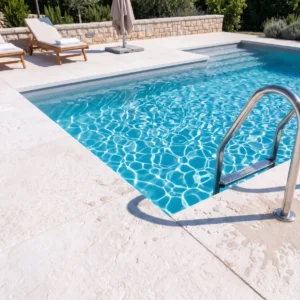
Done properly, the Grenadines pool joins the archipelago’s aesthetic: low, pale, composed against blue, visible from the water as one more well-made thing in a chain that notices craftsmanship. The package orders through the chain-wide supply guide with every leg priced, and returns the argument it opened with: the dawn swim, the safe shallow, the evening soak — freshwater luxuries, boat-delivered, justified daily. In the Grenadines, that is exactly enough.
The view from the water: composing for the anchorage’s eyes
Grenadines pools are unusual in one respect the drawings rarely admit: they are seen from the sea as much as from the house. The anchorage’s evening audience — charter guests at sundown, the harbor’s slow traffic — reads the shoreline’s properties as a composition, and the pool terrace is usually its brightest line. Designing for that second audience costs nothing and repays in the register the chain values most: discretion. Terrace lighting held low and warm so the house glows rather than glares; the pool’s underwater light on its own switch, because a lit pool with a dark terrace reads as theater while a floodlit deck reads as security; and the infinity edge’s weir line kept clean, since it is the one detail binoculars actually resolve.
The composition works in daylight too. Pale stone terraces are the shoreline’s highlights from the water, and their proportions — long horizontal lines, walls kept below the planting, no bright plastic clutter — decide whether a property reads as belonging to its hillside or imposed on it. The chain’s best houses are almost invisible until dusk and unmistakable after it: a warm line of stone, a lit edge of water, nothing shouting. That restraint is also neighborly practice in island terms — the anchorage is a shared room, and the property that floodlights it is the one the harbor remembers unkindly.
Practically, the from-the-water audit is one sail-past at design stage: photograph the site from the anchorage at noon and at dusk, and let those two frames join the drawing set. Builders who skip it design half the elevation blind. The pool that passes both audits — barefoot perfection from the terrace, quiet gold from the water — is the one the chain’s standard actually describes, and its stone choices, pale, low-sheen and warmly lit, are most of the achievement.
Grip on an edge that is wet all season
An anchorage-facing pool is used barefoot, wet, and often by people stepping off a boat. Finish selection deserves a test result rather than an adjective. This account of friction testing on stone walking surfaces explains what the standard covers.
- ANSI A326.3 measures dynamic coefficient of friction and supports in-place testing.
- The 0.42 benchmark applies to level interior surfaces walked on wet, so a pool edge sits outside it.
- No threshold is specified for exterior or ramped surfaces, leaving the judgment with the specifier.
- Polished finishes generally fail and have no place on coping.
- Coarser honed and lightly textured surfaces test better and stay kind to skin.
Absorption, salt and a small water volume
Out-island pools sit in salt air, run on harvested water and swing chemically faster than large ones. The Natural Stone Institute records that limestone absorption spans from below one percent to above ten, with dolomitic varieties generally denser and less absorbent.
- The lowest available absorption on coping and the first run of deck behind it.
- Textured rather than polished finishes, which hide the efflorescence salt brings.
- Acid cleaners excluded entirely, since carbonate stone etches permanently.
- Sunscreen and oil treated as the routine stain on a deck people lie on.
- Fresh-water rinsing built into the day, which the rinse point makes automatic.
Ordering an edge that has to arrive complete
The commonest out-island pool delay is not the shell; it is a coping piece that was never templated.
- Linear measure taken along the finished shell line rather than the excavation.
- Corners counted and identified as internal or external.
- Curves templated in ply, labeled and numbered to a setting-out drawing.
- Weir stones, steps and benches listed separately for their longer lead times.
- Overhang dimension fixed before cutting, since it changes every unit in the run.
Grenadines pool stone, trouble spots and solutions
Almost everything that goes wrong with a pool out here traces to one of three things: a finish that turns slick, an edge piece that never arrived, or a water plan that ignored the cistern. All three are decided before the shell is poured. Choose a dense, pale, textured stone with a real test result, template every curve, order the edge complete with spares, and size the pool against what the roof actually collects. Where the same palette runs across the villa, our Grenadines villa stone guide covers it. Template the edge and plan the water, and the pool builds itself.