Wet is the default condition, not the exception
On a Jamaican pool deck, dry is the unusual state. Between swimmers, afternoon rain, irrigation overspray, morning dew and the daily washdown, the surface spends a large share of its life carrying a film of water. Slip resistance is therefore not a safety extra bolted on at the end of a job; it is the primary performance requirement, and it is fixed by the finish you name at order stage. Texture cannot be added to a slab that was bought smooth, and no sealer will put it back. On the resort belt this is also a commercial question rather than only a safety one, because a deck that guests find slick gets roped off, gets rugs thrown across it, and eventually gets replaced years ahead of schedule.
The finishes that actually create grip
Texture works two ways at once: it gives the foot something to key into, and it gives water somewhere to go.
- Bush-hammered: a peened relief face, the workhorse for pool surrounds and ramps.
- Sandblasted: an even matte grain that holds grip without feeling harsh underfoot.
- Brushed: softer texture for barefoot comfort where the fall is generous and drainage is good.
- Tumbled: rounded arrises and a broken face, forgiving on informal villa terraces.
- Split or riven: the strongest grip available, best on steps and slopes rather than lounging areas.
Polished stone has no place at the water’s edge
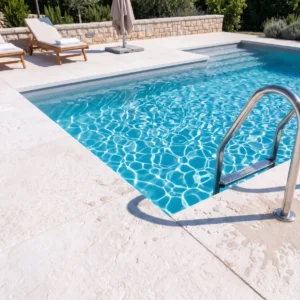
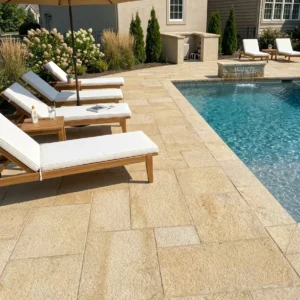
A polished face is a sealed, closed surface. Wet it and the water sits as an unbroken film with nothing to break through. Add sunscreen residue, a little algae in the shaded corner behind a planter, and friction collapses without warning. Polished stone earns its keep in a lobby. On a coping at Negril it is a liability. Honed is the smoothest face that belongs anywhere near a pool, and even then only well outside the splash zone. Most of the textured limestone pool paving we ship to the resort belt is bush-hammered or sandblasted for this reason.
Coping profiles and the edge detail
Most incidents happen at the transition rather than in the middle of an open deck.
- Bullnose copings give a rounded, hand-friendly edge for pulling out of the water.
- Drop-face copings conceal the pool shell and shed water clear of the deck.
- The overhang dimension decides where drips land and where the wet zone actually sits.
- Step nosings take the strongest texture on the project, without exception.
Salt pools, chlorine and cleaning products
Salt-chlorinated pools are common across the resort belt, and salt water splashed onto stone behaves much like the sea air the north coast already delivers every day. Textured faces hold more of it in the relief, which is an argument for rinsing more often rather than for smoothing the stone. Keep acidic cleaners away from limestone completely, use a pH-neutral product, and rinse with fresh water after any chemical treatment so nothing is left behind to concentrate as the deck dries. The other regular offender is sunscreen. It builds an invisible film in the surface relief, and it is the reason a deck that tested well in January feels different by August. Put a rinse point within reach of the pool and the housekeeping team will use it.
Storm rainfall changes the test entirely
Jamaica does not deliver water gently. Beryl came ashore on the south coast in July 2024, and the country now holds national mapping of rainfall, flood-plain and land-slippage hazards for exactly this reason. Grip in a light shower is a different question from drainage in a downpour, and a deck that sheds a shower well can still lift, silt up or undermine when a storm system parks overhead for an afternoon.
- Set a positive fall away from the pool and toward a drainage line, never toward the building.
- Size channel drains for storm volume rather than for splash-out alone.
- Keep joints open enough to shed water instead of trapping it against the units.
- Check that the bedding drains too, since a saturated base pushes water back up through joints.
Maintenance is what keeps grip alive
A textured face clogged with film performs like a smooth one. Grip is a maintenance outcome as much as a purchasing decision.
- Rinse salt and sunscreen film off regularly, especially in permanently shaded corners.
- Treat algae early, since a green patch behind a planter is the classic slip location.
- Avoid film-forming sealers on trafficked wet areas altogether.
- Inspect step nosings and ramps first at every scheduled check.
Putting grip on the order
Name the finish per area rather than for the whole project. Field, coping, steps, ramps and shaded returns can all take different faces cut from the same stone, and a sample walked on wet, barefoot, on the actual site, settles arguments no data sheet ever will. Ask the housekeeping supervisor to walk it too, because the person who cleans a deck every morning already knows more about how it behaves than any drawing does. Samples are small pieces sent ahead of the main shipment, and they clear through Kingston or Montego Bay long before a container is booked. Review the full finish range before you fix the schedule. Choose the texture for the wettest hour the deck will ever see, and the rest of the year takes care of itself.