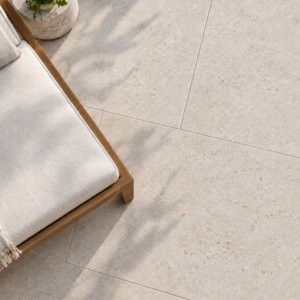
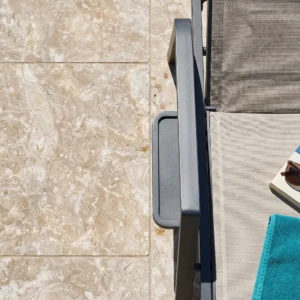
What Pool Coping Cost Really Reflects
Pool coping cost is a composite number built from stone species, profile complexity, edge finish, thickness, and the freight reality of getting heavy natural stone from a warehouse to your site on time — not simply a material price. Most budgets that fall apart do so because the specifier priced material alone and forgot that a standard bullnose travertine coping piece at the warehouse is one cost, while a custom drop-face bluestone shipped to a job with restricted truck access is an entirely different number. Understanding what’s inside the cost lets you build a number that actually holds through project completion.
Stone Species and Base Price Ranges
Your stone selection is the single largest lever on pool coping cost, and the range across species is wider than most project owners expect. Here’s a realistic breakdown of what you’ll encounter for natural stone pool coping, priced per linear foot at the material level before installation labor:
- Travertine coping: typically $8–$18 per linear foot for standard 12-inch-wide bullnose profiles in tumbled finishes — one of the most cost-accessible natural stone options
- Limestone coping: ranges from $12–$24 per linear foot depending on color density and profile complexity; blue limestone commands a premium over buff tones
- Bluestone coping: $18–$32 per linear foot — denser material with higher quarrying and cutting costs reflected in the price
- Granite pool coping: $22–$40 per linear foot for standard profiles; thermal-finished surfaces for slip resistance add to that range
- Natural stone pavers adapted as coping (sawn-edge format): $10–$22 per linear foot depending on species and slab thickness
These ranges assume standard 12-inch or 16-inch width and a single finished edge. Double-finished profiles for cantilevered or double-bullnose applications will push you toward the top of each range. Per Natural Stone Institute limestone specifications, material density and mineral composition directly influence both quarrying difficulty and finished pricing — which is why seemingly similar-looking limestones can land at very different price points.
Profile Complexity and Its Cost Impact
The coping profile you select — bullnose, drop-face, flat, or cantilevered — has a direct and measurable effect on pool coping cost that most specifications underestimate. A standard single-radius bullnose is the baseline. Every additional machined element adds fabrication time and waste factor.
Drop-face profiles require a second plane of stone removal, which increases the likelihood of material breakage during fabrication and raises the cost by 15–25% over a standard bullnose on comparable stone. Cantilevered coping — where the stone projects beyond the bond beam — requires greater thickness (typically 2 inches minimum rather than the common 1.25-inch tumbled piece) to avoid flexural failure at the overhang. That thickness increase alone raises material weight per linear foot, which affects truck delivery logistics and handling costs on site.
- Single bullnose: lowest fabrication cost, widely available in standard warehouse stock
- Double bullnose: moderate premium, typically 10–18% above single bullnose
- Drop-face bullnose: 15–25% above single bullnose due to additional machining passes
- Cantilevered flat coping: requires 2-inch minimum thickness — cost driven by material volume and slab selection
- Custom radius or curved coping: priced individually, often 40–80% above straight-run equivalents depending on radius tightness
Thickness and Structural Specification
Thickness is where pool coping cost specification intersects directly with structural performance, and getting this wrong costs far more than the initial savings. Standard tumbled travertine coping ships in 1.25-inch nominal thickness — adequate for a bonded application over a concrete bond beam where the stone has continuous substrate support. Push into cantilevered applications or specify the same piece over a waterline tile system with variable substrate, and 1.25 inches becomes a liability.
The PHTA pool deck and coping safety standards address load-bearing expectations at pool edges, which informs minimum thickness requirements for different installation configurations. Your installer’s bond beam geometry should drive the thickness specification — not the other way around. Ordering thinner pieces to reduce material cost and then discovering the bond beam geometry requires a thicker profile results in a complete material re-order, which is the most expensive mistake in pool coping procurement.
- 1.25-inch (nominal): standard for bonded applications over continuous concrete substrate
- 1.5-inch: intermediate option for slightly irregular bond beam surfaces or where some minor cantilevering is unavoidable
- 2-inch: required for true cantilevered profiles, high-traffic commercial applications, and granite or bluestone where edge chipping risk at thin sections is a concern
- Custom slab thickness: available for premium projects with specific structural requirements — lead times from the warehouse extend to 4–6 weeks for non-stock dimensions
Finish Selection and Slip-Resistance Costs
Your finish choice affects both the aesthetic and the safety performance of the coping — and it has a real effect on pool coping cost at the fabrication level. Tumbled finishes on travertine and limestone are the most widely stocked because the tumbling process happens at the quarry level and doesn’t require secondary finishing at a fabrication facility. That stock availability keeps prices at the lower end of each material range.
Honed or bush-hammered finishes on granite and bluestone are finished to order in most cases, which introduces fabrication lead time and cost. A bush-hammered granite coping piece — one of the best-performing surfaces for barefoot wet environments due to its naturally high coefficient of friction — typically runs 20–30% above a sawn-edge equivalent. According to ASTM slip-resistance standards for pool coping applications, a wet DCOF of 0.42 or above is the benchmark for pool deck and coping surfaces, and your finish selection is the primary variable that determines whether you meet it.
- Tumbled travertine or limestone: naturally aged surface with good tactile grip — DCOF typically 0.50–0.65 wet
- Honed limestone: smooth, refined surface — DCOF can drop below 0.42 wet without a grip additive; verify before specifying
- Bush-hammered granite or bluestone: textured surface with consistently high DCOF — preferred for commercial or high-traffic pools
- Thermal (flamed) granite: excellent slip resistance, slightly rougher texture — common on wide coping pieces where foot traffic is heavy
- Brushed travertine: moderate texture, better grip than honed but less than tumbled — mid-range cost premium of 8–12%
Seasonal Installation Timing and Budget Implications
Pool coping installation cost isn’t static across the year — and the seasonal timing of your project affects both the direct material cost and the labor component of your total spend. Scheduling your installation during moderate-temperature windows — typically late spring and early fall in most regions — gives the setting mortar and adhesive the ideal curing environment. Polymer-modified mortars used to bond natural stone coping perform best when ambient temperatures stay between 50°F and 90°F during the set period, with low humidity fluctuation overnight.
Most project managers overlook what timing does to adhesive chemistry: manufacturers specify performance data at 70°F. In high-heat installation periods, open time can drop by 30–40%, which means your installer is working faster and covering smaller areas before re-mixing — that’s directly reflected in labor hours and therefore your cost. Conversely, scheduling an installation when overnight temperatures risk dropping below 40°F requires heated enclosures or admixture adjustments, both of which add to the project budget. The most cost-effective installation window isn’t just about convenience — it’s about getting the chemistry right without expensive workarounds.
- Morning installation sessions (before 10 a.m.) are preferred in warmer months — adhesive open time is longer, and substrate temperatures are lower
- Avoid afternoon placement when stone surface temperatures exceed 100°F — thermal expansion of the coping piece occurs before setting begins, creating joint gaps on cooling
- Late spring and early fall scheduling typically reduces labor cost by eliminating cold-weather or high-heat surcharges
- Curing time before pool filling: allow a minimum of 7 days for polymer-modified mortar to reach full strength — schedule pool water fill accordingly
- Order your coping stock early — warehouse lead times extend during peak construction season, and delayed delivery can push your installation into a less favorable temperature window
Installation Labor Cost and What Drives It
Material cost is only part of the pool coping cost equation. Labor typically represents 35–55% of the total installed cost depending on project complexity, and understanding what drives labor rates helps you build a defensible budget. Straight-run coping on a rectangular pool is the baseline — experienced installers price this at $15–$25 per linear foot for labor in most markets. That number climbs fast when complexity is introduced.
Curved pool edges require the installer to cut relief joints into the back of each coping piece to allow the stone to follow the radius — a skilled process that adds time per linear foot. Corner returns on L-shaped or kidney pools require miter cuts or return pieces, both of which require precision fabrication on site or pre-ordered mitered units from the supplier. Natural stone fabrication tolerances mean that tight radius work or custom corner profiles carry labor premiums — the material’s natural variation requires more fit-and-adjust time than manufactured alternatives, and your budget should account for that from the start.
- Straight-run installation labor: $15–$25 per linear foot (baseline)
- Curved pool coping labor: $25–$45 per linear foot depending on radius and stone species
- Corner miters or return pieces: typically quoted per unit ($35–$75 per corner) depending on profile and fabrication source
- Substrate preparation (bond beam leveling, waterline tile integration): additional cost — typically $8–$15 per linear foot and often underestimated
- Truck access restrictions: if delivery requires hand-carrying pallets from street to pool area, material handling surcharges apply — plan site access early
Freight, Logistics, and Delivery Variables
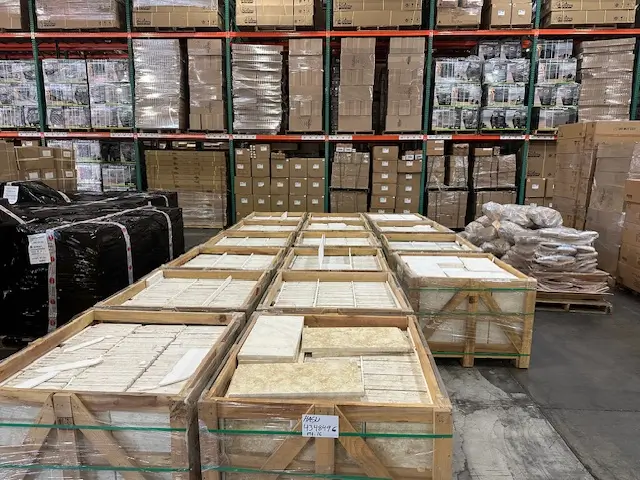
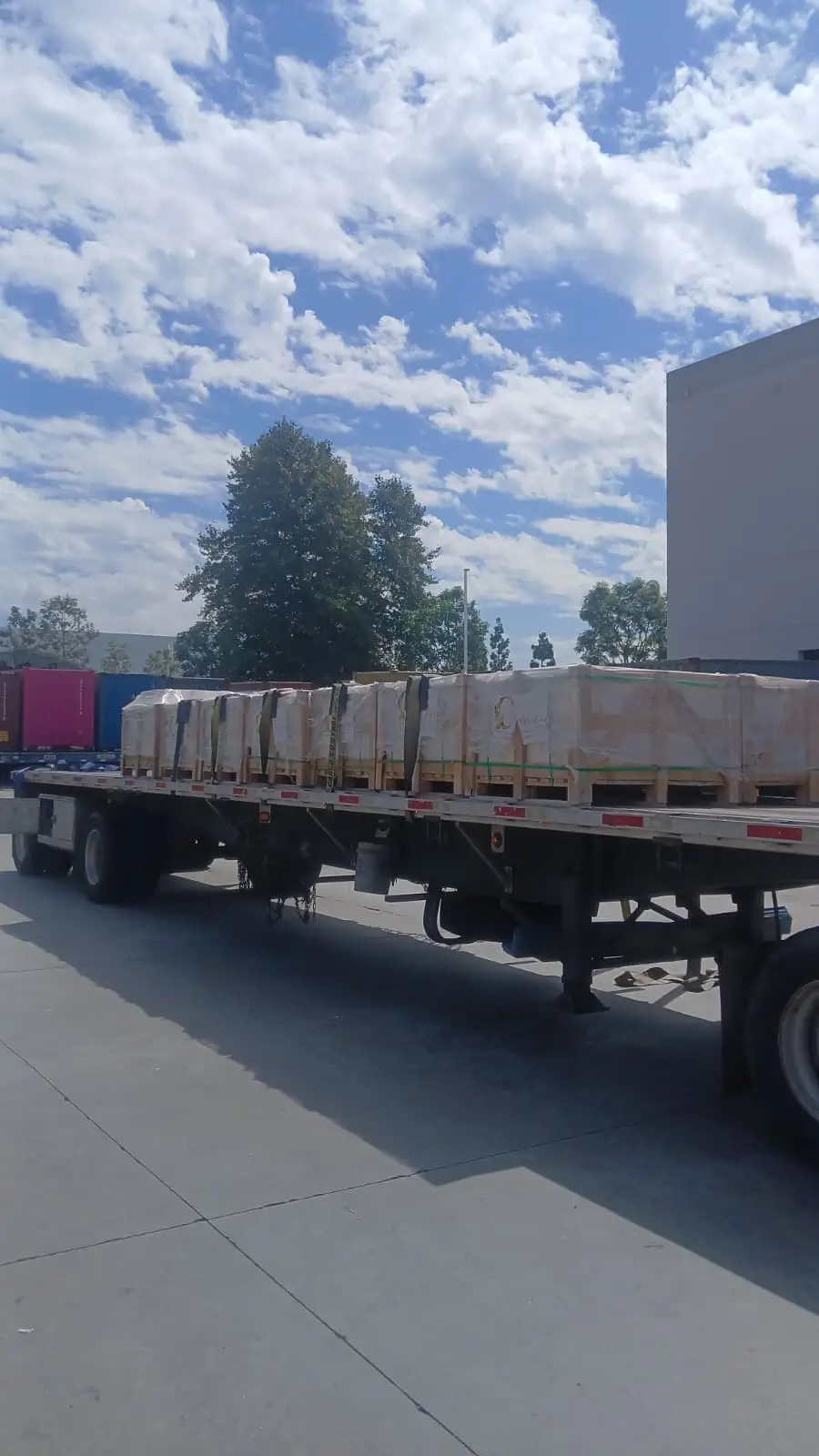
Pool coping is a heavy material — a full pallet of travertine coping can exceed 2,000 lbs — and the freight component of your pool coping cost deserves a line item of its own in your budget. Most specifiers focus on per-linear-foot material pricing and treat freight as an afterthought until the invoice arrives. Freight for natural stone coping typically runs $150–$400 per pallet for standard truck delivery within the continental US, but site conditions can change that quickly.
Confirm truck access to your site before placing an order. Standard flatbed or liftgate delivery requires an open staging area close to the pool — if your project involves a backyard with restricted access, a narrow gate, or no hardstand area for a truck to park, you may be looking at boom truck delivery or multiple smaller loads, both of which cost more. At Citadel Stone, we confirm truck access requirements with every order — it’s a step that prevents the single most common delivery problem on residential pool projects. Coordinating warehouse dispatch timing to align with your installation window is equally important: order with enough lead time that you’re not paying rush freight to hit a seasonal installation target.
Total Installed Cost Benchmarks
Pulling all variables together into a realistic total installed pool coping cost gives you a working budget framework. These figures represent material plus standard installation labor, excluding bond beam remediation or waterline tile work:
- Entry-level travertine tumbled coping, standard profile, straight pool: $28–$42 per linear foot installed
- Mid-range limestone coping, drop-face profile, mixed straight and curved runs: $40–$60 per linear foot installed
- Bluestone coping, honed finish, rectangular pool: $52–$75 per linear foot installed
- Granite coping, thermal finish, commercial or complex pool geometry: $65–$95 per linear foot installed
- Custom curved coping in premium stone species: $90–$140+ per linear foot installed for tight-radius applications
For a standard residential pool with 80–100 linear feet of coping, you’re looking at a total installed cost range of roughly $3,200–$9,500 depending on material and complexity. Commercial pools with more linear footage benefit from better unit economics but face higher compliance requirements. Browsing our stone coping selection alongside these benchmarks will help you align your material choice with your project budget before you go to bid.
Budgeting for Waste and Overage
Your take-off measurement is never your order quantity. Natural stone coping requires a waste allowance that accounts for cuts, breakage during installation, and the reality that some pieces from any batch won’t meet the visual consistency your project demands. The standard industry allowance is 10% for straight-run rectangular pools — bump that to 15% for curved pools and 20% for complex pool shapes with multiple radii, corners, and step returns.
Order your overage in the same batch as your primary quantity. Color variation between production runs is a real issue with natural stone — limestone and travertine in particular show batch-to-batch variation in veining density and background tone. Matching a supplemental order placed six months after the original is difficult and sometimes impossible if the warehouse has moved to a different production lot. Your 10–20% overage order placed upfront is cheap insurance against a very expensive color-match problem later.
- Straight rectangular pools: 10% overage allowance
- Curved or kidney-shaped pools: 15% overage allowance
- Complex L-shaped, freeform, or multi-level pools: 20% overage allowance
- Step coping and raised spa integration: calculate separately with 15% allowance — different profile dimensions may apply
- Store leftover pieces on-site for future repairs — natural stone color-matching years later is unreliable even from the same supplier
Before You Specify
The variables that define your final pool coping cost are all knowable before you place an order — stone species, profile, thickness, finish, pool geometry, site access, and seasonal installation timing. Working through each one systematically produces a budget that holds rather than a number that erodes through change orders. Your specification decisions at this stage also determine whether you get a 15-year installation or a 25-year one: the right thickness for your bond beam geometry, the right finish for your safety requirements, and the right installation window for your adhesive chemistry all compound into long-term performance. Once you’ve established the pool coping cost framework that fits your project scope, the next priority is protecting that investment through proper ongoing care — stone coping care and protection covers what your maintenance schedule should include to keep natural stone performing at pool edges year after year. Sourced from quarries across the Mediterranean and Middle East, Citadel Stone coping ships in uniform sizes that simplify project budgeting.
Related reading: What Is Pool Coping and Why Does It Matter? · pool coping material comparison · pool coping material guide.