Why Pattern Choice Drives Long-Term Performance
Paving stones design ideas fail most often not at the material selection stage, but at the layout planning stage — specifically when pattern orientation conflicts with the structural load path. A herringbone set at 45 degrees to the primary traffic direction locks individual units under compression, which is exactly why it performs so well on driveways. A running bond running parallel to traffic, by contrast, allows racking forces to travel along the longest joint line — a problem that shows up as wave deflection two or three winters in. Understanding this distinction before you commit to a layout saves you from a costly reset.
Choosing Between Irregular and Flat Paving Stones
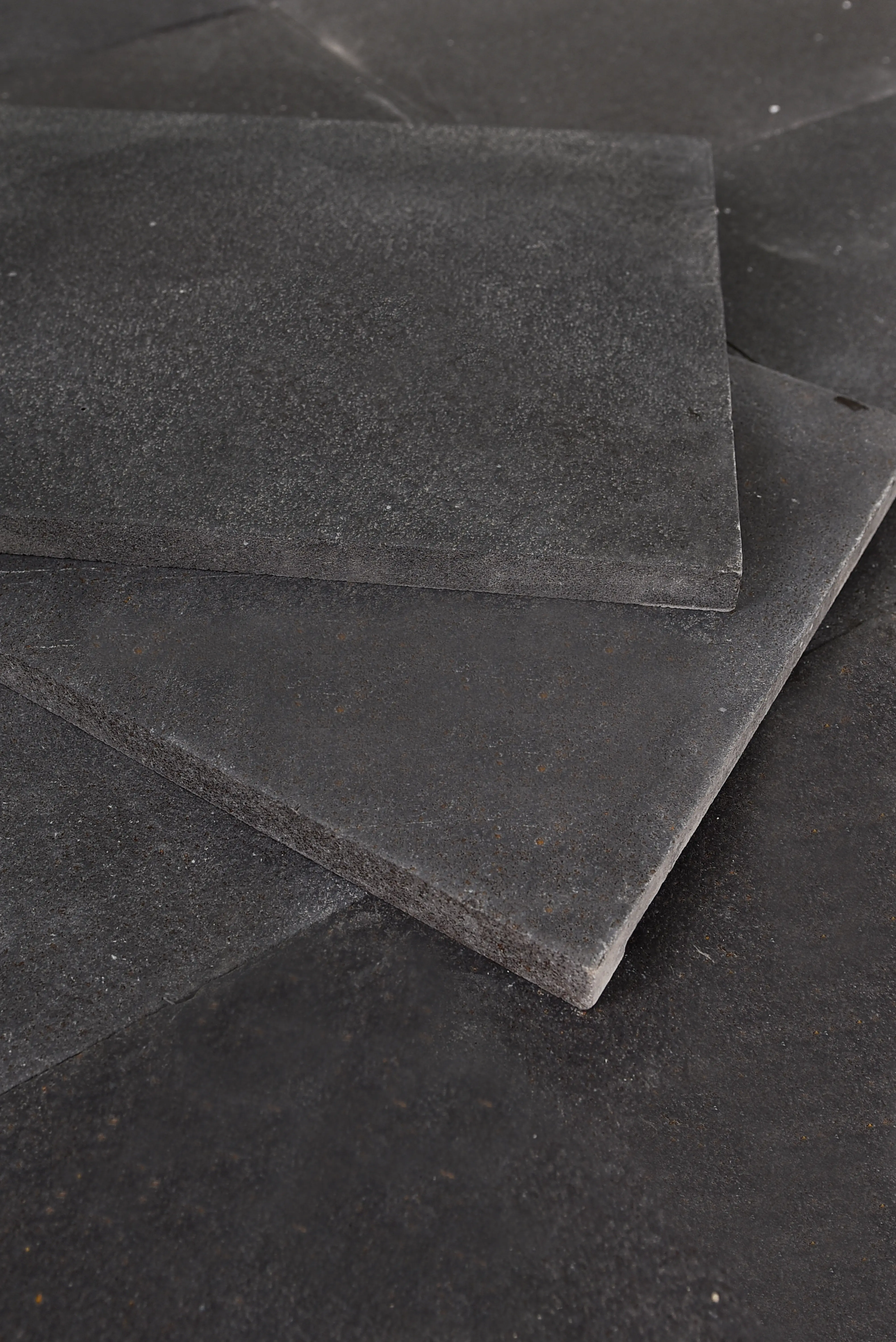
Your material shape determines far more than aesthetics — it controls joint width, base tolerance requirements, and long-term maintenance intervals. Irregular paving stones, meaning natural-edge flagging with random broken faces, require a more forgiving setting bed because no two pieces share the same contact footprint. You’ll typically work with a 1- to 1.5-inch screeded sand or mortar bed and accept visible joint variation of 0.5 to 2.5 inches across a single field. That variation is part of the design language, and it reads beautifully in naturalistic garden paths and informal courtyard settings.
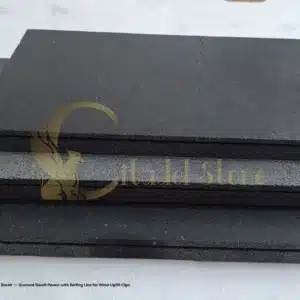
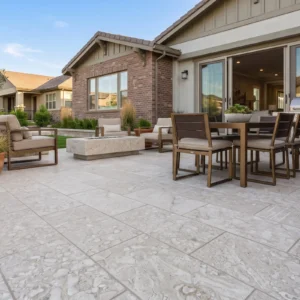
Flat paving stones — machine-cut or saw-cut slabs with consistent dimensional tolerances — demand a tighter base because the eye immediately catches any lippage above 1/8 inch. The ASLA outdoor patio stone selection guidance consistently emphasises that dimensional consistency between adjacent units is the single biggest predictor of long-term surface stability. For formal terraces, entertaining decks, or any surface where furniture legs or wheeled traffic is expected, flat-cut is the right call — not because it looks better, but because it performs better under point loads.
Layout Geometry: Matching Pattern to Space
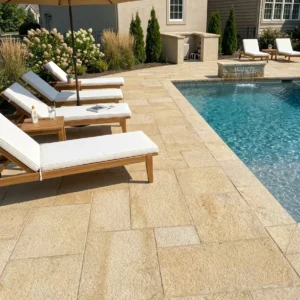
Consider how your eye moves across an outdoor space before you finalise any paving stones design ideas. Elongated running-bond layouts with rectangular slabs visually stretch a narrow courtyard — a useful trick when you’re working with a 10-foot-wide passage that feels compressed. Square-cut units in an ashlar pattern, where three or four different module sizes are combined in an irregular but balanced arrangement, break up large featureless terraces without the complexity of a full geometric design. Circular fan patterns anchor a feature point beautifully — a fire pit surround, a fountain base, an entry forecourt — but they generate substantial offcut waste on the radiating outer ring, so factor 12 to 18 percent additional material into your order when specifying radial layouts.
For projects drawing from Citadel Stone design inspiration, the combination of irregular flagging and flat paving stones in a single project allows you to differentiate zones — casual garden paths in natural edge stone, formal dining areas in precision-cut slabs — creating a visual hierarchy that reinforces how each space is actually used.
Structural Requirements and Base Depth Standards
Most design conversations skip straight to surface finish and miss the specification decisions that determine whether the installation meets local building code. Base depth requirements for paved surfaces vary significantly depending on frost line depth, soil bearing capacity, and the intended load classification. In freeze-thaw regions, the International Building Code and local amendments commonly require a minimum 6-inch compacted aggregate sub-base for pedestrian paving, extending to 8 to 12 inches for vehicular surfaces. Frost line depth in colder zones can reach 48 inches or more, which means the sub-base must extend below the frost-susceptible soil layer or be designed with drainage to prevent frost heave from lifting the surface.
- Pedestrian-only applications: minimum 4-inch compacted aggregate base in temperate zones, 6 inches in freeze-thaw exposure zones
- Vehicular driveways: 8 to 10 inches of compacted Class II aggregate, with geotextile separation fabric at the sub-grade interface
- Edge restraint: required under most municipal codes for any unbound paving installation — plastic, steel, or stone kerb restraint prevents lateral creep that unravels even well-installed patterns
- Stone thickness: 1.25-inch nominal for pedestrian paving, 2-inch nominal minimum for vehicular traffic, per standard industry practice
- Seismic zones: additional base reinforcement and flexible joint detailing may be required — check local amendment to IBC Chapter 18 before specifying rigid mortar joints in high-seismic areas
According to Natural Stone Institute paving specifications, natural stone units for exterior paving should be specified at a minimum flexural strength appropriate for the load class — a detail that matters most when your layout includes cantilevered edge pieces or irregular units bridging wide joint gaps. Always verify your base specification against local amendments before the project breaks ground.
Natural Stone Pattern Options Worth Specifying
The most effective paving stones ideas are the ones that work with the material’s natural variation rather than against it. Here are the patterns that consistently deliver strong performance across residential and commercial applications:
- Herringbone at 45 degrees: highest interlock efficiency under directional load — the preferred pattern for driveways and high-traffic pathways using rectangular units
- Ashlar coursed: three or four module sizes combined in staggered horizontal rows — visually rich, structurally sound, and forgiving on slightly uneven ground planes
- Random irregular: natural-edge flagging in a puzzle-fit arrangement — suits garden paths, woodland settings, and any design where an organic character is the goal
- Stack bond grid: square units in a perfect grid — clean and modern but structurally the weakest option because all joints align; restrict this to low-traffic decorative use
- Radial fan: ideal for circular features, entry courts, and medallion insets — requires precision cutting and careful material estimation for the radiating outer rings
- Offset running bond: the workhorse of landscape paving — versatile, approachable, and structurally reliable for most residential applications
Material Sourcing and Project Logistics
Your paving stones design ideas only work if the material is actually available in the volume and finish you’ve specified. Stone sourced from Middle East quarries — particularly the dense limestone and sandstone varieties popular in formal landscape applications — typically carries a 6 to 10 week import lead time when ordered through standard channels. Citadel Stone maintains warehouse inventory of key paving formats nationally, which compresses that window considerably for projects working against tight installation schedules. Confirming warehouse stock before finalising your pattern layout is worth the extra step, because switching from a 24×24 module to a 20×20 mid-project to accommodate available inventory forces a complete pattern re-calculation.
Truck access is a practical constraint that gets underestimated at the planning stage. A full-size delivery truck carries a standard 22-foot trailer — verify that your project site can accommodate this before scheduling. Properties with restricted access, low overhead clearance, or weight-limited driveways may require a smaller truck delivery at additional cost, or a crane-assisted off-load at the property line. Build this into your logistics planning early rather than discovering it on delivery day.
Surface Finish and Slip Resistance Considerations
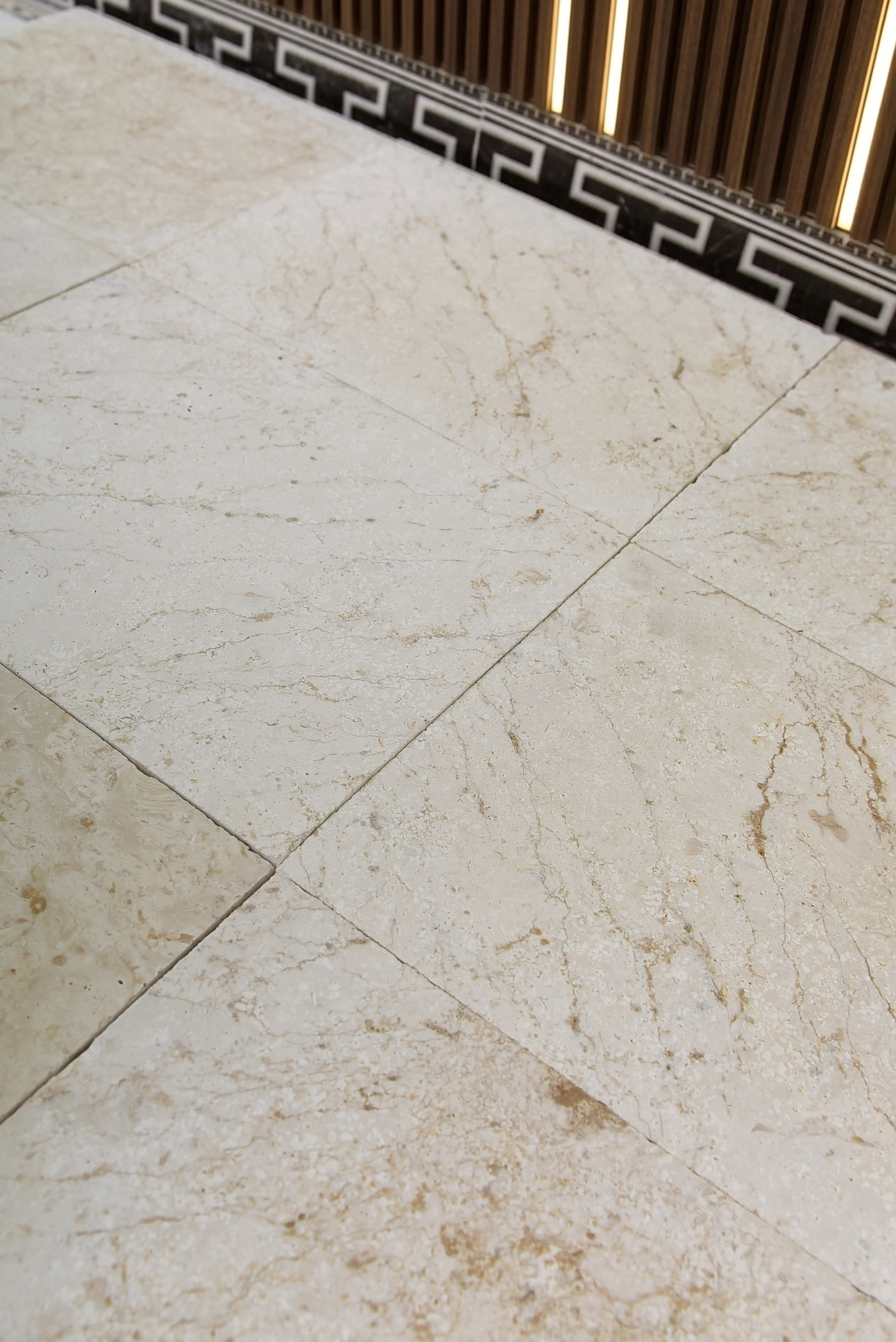
The finish you specify for paving stone design patterns and layouts affects traction, maintenance frequency, and how quickly the surface ages visually. A honed finish reads clean and contemporary but requires resealing every 18 to 24 months in outdoor applications to maintain stain resistance. A bush-hammered or sandblasted finish provides a higher coefficient of friction — typically 0.6 or above on the wet DCOF scale — which matters for sloped surfaces or any paved area adjacent to water. A sawn face finish sits in between: moderate traction, modest maintenance, and a texture that reads well in both modern and transitional designs.
The USGS dimension stone production data documents the full range of natural stone paving types in active use across the USA, which is a useful reference when specifying less common formats like tumbled irregular pavers or sawn-edge flagging. Thermal-finish stone — flame-textured — is worth considering for any sloped run where wet traction is a priority; the surface texture is aggressive enough to significantly reduce slip risk without the rough appearance of a heavily bush-hammered face.
Designing Multi-Zone Outdoor Layouts
The most sophisticated paving stones design ideas involve multiple materials working together across a single outdoor area — not competing, but clearly delineated. A practical approach: use flat paving stones for the primary living and dining zones where dimensional consistency supports furniture and traffic, then transition to irregular paving stones for the connecting paths and planting bed edges where a softer character reads better. The transition joint between the two zones deserves as much design attention as the zones themselves — a single course of contrasting material, a slight grade change, or a narrow gravel channel all work as deliberate thresholds.
At Citadel Stone, we recommend resolving the material selection for all zones before installation begins rather than specifying sequentially. Base preparation requirements differ between a 2-inch flat-cut slab and a 1.5-inch irregular flagstone — if both zones share a single sub-base, it needs to be built to the more demanding specification. Getting that detail wrong at the base stage is a considerably more expensive fix than getting it right on paper first.
Final Recommendations for Paving Stones Design
The paving stones design ideas that hold up over a decade share a few consistent traits: the pattern was selected based on structural logic first and visual preference second, the base was built to code depth for the local frost and load conditions, and the material finish was matched to the site’s actual slip and maintenance requirements — not just its aesthetic brief. You’ll avoid the most common field failures by resolving base depth, edge restraint, and joint width before the stone arrives on site, not after. For related specification detail on how edge restraint integrates with paving layouts, edge restraint for paving stones covers the technical requirements worth reviewing alongside your design plan. Citadel Stone carries both irregular flagging and flat-cut slabs, giving designers the material range needed to execute multi-zone outdoor layouts from a single supplier.
Related reading: how to lay paving stones · preparing ground for paving stones · natural stone paving guide.