An island with four real seasons
Bermuda sits by itself in the North Atlantic and does not behave like the island markets it gets grouped with. There are four genuine seasons here, and winter is cool and damp rather than mild and dry. Paving spends months wetting and drying at low temperature, then meets a warm season of strong sun, salt haze and heavy use. A specification written for constant heat misses half the year. Choose material for the whole cycle rather than for the summer photograph, and the terrace will not fight you through the cool months.
The winter cycle nobody budgets for
Repeated saturation followed by slow drying is the quiet stress test. Water finds open joints, sits in bedding that cannot drain, and works patiently at anything laid without a fall. Nothing dramatic happens in any single wet week, which is exactly why the damage accumulates unnoticed until a unit rocks underfoot. Dense units with low absorption, joints that are genuinely filled, and a surface graded to shed water are worth more here than any product claim printed on a brochure page. It is also the reason absorption figures deserve a look before appearance does. A stone that takes on water slowly, releases it steadily and holds its face through repeated cycles will read better a few winters on than a prettier unit chosen from a sample in dry summer light.
Reading exposure across one plot
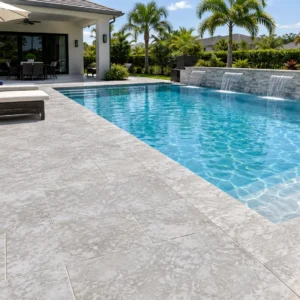
Exposure changes across a single Bermuda property. An open ocean-facing frontage takes the Atlantic directly; a courtyard behind the same house may barely see salt at all. Writing one build-up for the whole site either over-engineers the sheltered areas or under-engineers the exposed ones. Walk the plot, band it, then match stone we hold for exposed frontage to the bands that actually need it.
- Open sea frontage: direct spray, wind-driven rain and a constant salt film.
- Sound and harbor edges: salt carried on wind, without the full swell.
- Mid-plot terraces: sun and rain, limited spray, heavy furniture use.
- Courtyards and covered loggias: the sheltered end of the range.
Storm exposure and what it asks of the detail
Bermuda has taken serious storms within living memory, among them Fabian in 2003, Gonzalo in 2014, Nicole in 2016 and Humberto in 2019, and those names sit in the island’s recent record. For paving, the storm question is rarely whether a single slab survives the wind. It is whether the assembly stays where it was put when water arrives faster than the ground can absorb it, and whether loose objects on the terrace stay loose. Restraint, bedding and drainage carry that load, not the surface material.
Stone that drains toward a tank
This is the constraint no other market shares. Bermuda has no rivers, streams or freshwater lakes; domestic water is rain caught from roofs and held in tanks, and storage is regulated with tank capacity set against roof area. The rule is written around roofs, but the discipline reaches the ground. Whatever you put on stone that drains toward a catchment deserves thought before it is applied rather than after.
- Establish where each terrace surface drains before you choose a sealer.
- Keep cleaning chemicals off any run that reaches a collection surface.
- Ask any treatment supplier what the product does once diluted by rain.
- Grade terraces deliberately, either into collection or clearly out of it.
- Tell the maintenance crew which areas are excluded and which are not.
Joints, falls and where the water goes
On an exposed island it is worth checking the water before blaming the stone. A fall that looks generous on a drawing can flatten out during laying, and a joint left short becomes the route water takes into the bed. Agree the fall, the joint detail and the discharge point before the first course goes down, then check them again when the terrace is half laid rather than when it is finished and covered in furniture. Where a terrace meets a threshold, a wall or a step, decide early which way water is meant to travel and make sure the levels agree with that intention. Those junctions are where standing water usually starts, and they are the cheapest places on the whole job to get right first time.
Texture through the cool damp months
Surface texture earns its keep in a wet winter. A face that grips underfoot when wet, sheds water instead of holding a film, and does not turn slick under organic growth is doing genuine work through the cool months.
- Prefer a worked face over gloss anywhere the paving stays damp.
- Test grip on a wet sample underfoot rather than from a photograph.
- Keep shaded paving textured, because it dries slowest of all.
- Match texture to the cleaning method so upkeep stays simple.
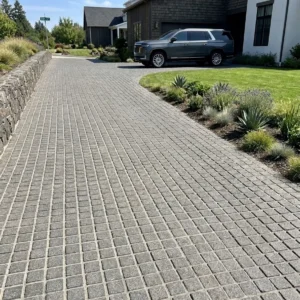
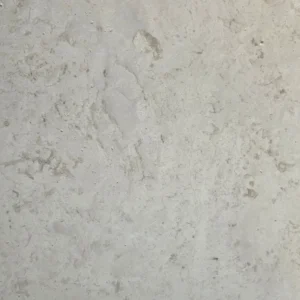
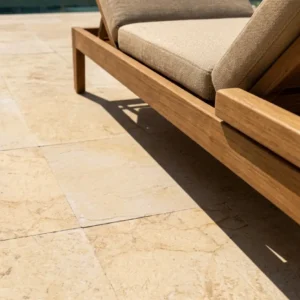
Compare surface textures for winter damp before the schedule hardens, because a finish is far harder to change later than a layout.
After a storm, and through the year
Exposed paving rewards a short routine far more than an expensive one. Salt film, wind-blown debris and standing water are all cheap to deal with early and costly to ignore for a season.
- Rinse salt-facing paving with fresh water after heavy blows.
- Clear joints and drainage runs before the wettest part of the year.
- Check edge restraint after any storm that moved water across the terrace.
- Lift and re-bed a rocking unit early, before its neighbors follow.
Band the site by exposure, detail the water first, and Bermuda paving will hold its line through whatever the Atlantic sends.