Duty Classes on a Villa Site
A residential site in the Virgin Islands can easily carry three or four distinct duty classes inside a single boundary, and the drawing rarely says so. There is the terrace and pool surround where nothing heavier than furniture ever lands. There is the arrival court, where cars turn and stop. There is the service run where a delivery truck or a water tanker reaches the house. And there is the path network, which looks easy until a wheelbarrow full of wet concrete crosses it forty times. Naming those classes on the drawing before anything is priced is cheaper than lifting stone later, and it usually reduces the order rather than inflating it, because you stop paying driveway depth for a shaded courtyard nobody drives on.
Foot Traffic: Terraces and Pool Surrounds
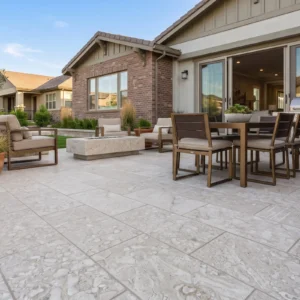
Pedestrian areas give you the most freedom, and that freedom is worth spending on appearance rather than on unnecessary depth. What actually governs the choice here is comfort and safety underfoot.
- Surface temperature, which pushes pale stone ahead of dark on a sun trap
- Texture that stays grippy when wet, especially around a pool edge
- Unit size that suits the room proportion rather than the price list
- Joint width narrow enough to feel calm underfoot on bare feet
Cars and Light Vehicles
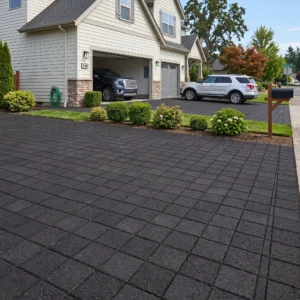
The moment a wheel crosses paving, the calculation changes. Depth increases, bedding changes and the tolerance for a weak sub-base disappears. Vehicles also apply turning loads, which grind and twist rather than simply press, and turning is exactly what happens in a compact arrival court cut into a hillside. Choosing format and depth by use is the whole discipline here, because a unit that is perfectly sound underfoot can be marginal under a wheel.
- Step up a depth class from the pedestrian units used on the terrace
- Bed on a properly designed base rather than sand over hardcore
- Reduce unit face size where turning loads concentrate
- Detail the wheel path and the parking bay as one construction
- Confirm the exact gauge available in your chosen stone before ordering
Service Access and Turning Areas
Service vehicles are the load nobody draws. A concrete truck, the crane that lifts a roof frame, a water delivery truck and the flatbed carrying your own stone all apply axle loads far beyond anything a driveway designed for a family car will ever see. Ask the owner honestly what will reach the house across its life, then design the service run for the heaviest of them. Paving that fails under a tanker fails in the worst possible place, at the pinch point where nobody can drive around the damage. It is worth walking the route with the owner and marking the turning circle, the reversing point and the spot where a heavy vehicle stops with its weight on one axle. Those three positions almost always want the deepest units on the property, even if they sit outside the area the designer was thinking about.
Format and the Hillside Handling Problem
Large format looks generous in a rendering and behaves very differently on a steep site with a narrow approach. Every unit has to be carried to where it lands, sometimes by hand, sometimes down steps cut into a slope.
- Large slabs need two people and clear access, which hillside sites rarely offer
- Smaller units follow falls and level changes without wasteful cutting
- Mixed sizes in a modular layout absorb an irregular boundary neatly
- Cobbles and setts turn tight radii where slabs would need cutting
Where Basalt Earns Its Place
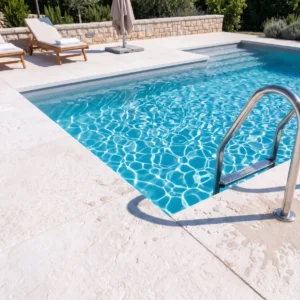
Pale limestone is usually right for terraces and poolside, where reflected heat and glare are part of the brief. Where the load is heaviest, a dense dark stone often makes better sense, and specifying basalt in heavier paving depths for the driveway while keeping limestone on the terrace gives you both. It also reads well against the granite boulder landscape of the eastern islands, which no imported stone should try to copy but which sets the tonal range a designer works within.
Edge Restraint Decides Whether Depth Matters
A thick paver in an unrestrained field still moves. Restraint is what converts individual units into a working surface, and on sloping ground it is doing structural work every day.
- Positive restraint on every free edge, not only the visible ones
- Bedded construction rather than loose laid in exposed positions
- Curbstones or a haunched edge where paving meets planting
- Joints filled and maintained so units cannot rock and migrate
- Falls checked at the edge, where water and grit collect first
Mixing Depths in One Container
None of this means separate orders. A single container can carry terrace units, driveway units, steps and edging, crated and marked by area so the right pallets open in the right order. That is the efficient way to buy for an island site, because a second shipment costs freight, clearance time and another road leg up the hill. Send us the layout with the duty classes marked and we will split the order by area, confirm the depth available in each stone and format, and crate the load so that the terrace pallets are not buried behind the driveway ones. Decide the duty class of every square foot before you decide anything else, and the rest of the specification falls into place.