Duty first, looks second
Every paving failure worth discussing starts in the same place: a unit specified for one duty and then asked to carry another. A terrace slab is not a driveway unit with a nicer face. It is a thinner section resting on a different build-up, and it behaves accordingly when a delivery van reverses across it. So the first question on any Aruban schedule is not which stone, or even which finish, but what will run over this ground on a bad day. A resort service yard has a bad day involving a loaded truck. A villa terrace has a bad day involving a heavy planter and a party. Those are different products even when the client wants them to look identical, and they can be made to look identical while being built entirely differently.
Foot traffic: terraces, walkways and pool surrounds
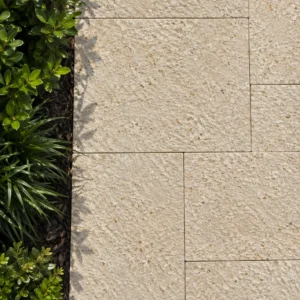
Pedestrian areas are easy to over-engineer and just as easy to under-build. For these zones we cut at the lighter end of the outdoor range and let the bedding do its share of the work:
- Terraces and walkways in a nominal three-centimeter outdoor depth
- Pool surrounds with a textured face and eased edges where feet meet the water
- Larger formats where the ground is flat and the layout is simple
- Smaller units where levels change or the shape gets awkward
- Consistent calibration so the installer is not packing every second unit
Where wheels turn
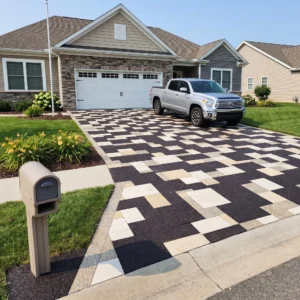
Vehicle areas are a different product, not a different pattern. Villa driveways, resort service yards, delivery aprons and turning grounds concentrate load into small contact patches and then twist that load sideways every time a wheel steers while stationary. Those areas move up in depth, move down in unit size, and sit on a bound base rather than on loose material. The klinkers and slabs we supply for that duty are cut deeper for a reason, and the extra section is far cheaper than lifting a failed apron in its second year.
Interior tegels and the thin end of the range
Inside, the constraints invert. Floors are supported continuously, so thickness stops carrying structural meaning and starts governing build-up height against thresholds, door swings and existing levels. Thinner gauged tiles keep the finished floor where the architect drew it. That is why an interior schedule and an exterior schedule for the same villa often use the same stone in two different depths. Agree that build-up early, because these are all fixed by the time the screeds go down:
- Finished floor level against thresholds and adjoining rooms
- Door swings and whatever clearance the ironmongery needs
- Tile depth plus the adhesive bed within that overall height
- Transitions where an interior tegel meets exterior paving
Format size and what the wind does to a joint
Format is not purely aesthetic on an island where the wind never really stops. Bigger units mean fewer joints, and joints are where blown sand and grit collect. Smaller units mean more joints but far better tolerance of falls, curves and awkward transitions. The choice is a trade, and it is worth making deliberately:
- Large formats on open, flat terraces with a simple perimeter
- Modular mixes where a long run needs to feel less mechanical
- Small units where the ground falls or the layout curves
- Setts and small blocks at aprons, thresholds and turning points
- Cut units at the perimeter, not shaved slivers pushed into a corner
Setts, klinkers and small units
Small units earn their place where big ones struggle. A sett follows a radius without cutting, tolerates a change in fall, and spreads a wheel load across many bedded pieces instead of one long span. They also read differently against the low, plain masonry of older Aruban buildings, which is a design point rather than a technical one. Where the duty is heaviest and darker tone suits the scheme, darker basalt for wheel paths is a straightforward specification that keeps the pale limestone for the areas people sit on.
Bedding decides more than thickness
A generous unit on a poor base still fails. Thickness buys you tolerance, not immunity, and the build-up under the stone carries the actual argument:
- Bound base under anything that carries a vehicle
- Compacted, well-graded material under pedestrian areas, laid to a fall
- Edge restraint on every free edge, because unrestrained paving creeps
- Joint material chosen for wind-blown sand rather than for appearance alone
- Drainage detailed for the downpours that do arrive on an arid island
Writing a schedule that survives the site
Set the schedule out zone by zone with the duty named against each: pedestrian terrace, pool surround, private driveway, service yard, threshold. Give every zone a depth, a format and a finish, then check the total weight, because weight decides freight and freight decides landed cost. Order the awkward pieces, the steps, the copings and the cut specials with the main lot rather than as an afterthought that ships alone at its own cost. Then read the schedule back against the site as it will be used rather than as it appears on a plan, and ask whether any zone has quietly been given a lighter unit than the traffic it will really see. A schedule written around duty rather than around square footage is worth more than any decision made later on site.