Start With Duty, Not With Looks
Ask what will roll across the surface before you ask what it should look like. On a Providenciales villa the same terrace often runs from a pool coping into a covered loggia and out onto a driveway apron, and those three zones are three different structural problems wearing one appearance. Choose the depth for the hardest duty in each zone, then choose the face, the tone and the finish inside whatever depth range is available. Doing it the other way around is how a beautiful specification gets value-engineered into failure halfway through the job.
Foot Traffic: Terraces, Pool Surrounds and Villa Floors
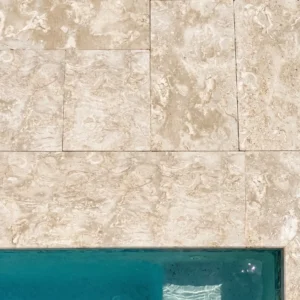
Pedestrian areas are the most forgiving duty class and the easiest place to use larger formats and thinner units, provided the bed underneath is right. This is where a bonded installation over a properly formed slab pays for itself, because the stone is no longer working alone.
- Thinner calibrated units suit interior floors and covered terraces set on a bonded bed.
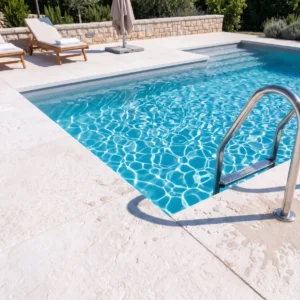
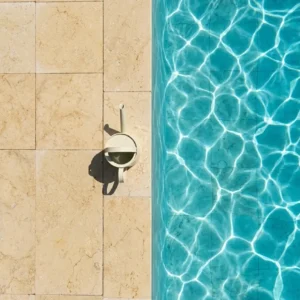
- Open pool decks want a slightly heavier unit and a textured face for wet grip.
- Larger formats read well on open terraces but need a flatter, better-prepared substrate.
- Keep joint widths consistent so movement and thermal expansion have somewhere to go.
- Confirm the actual supplied thickness for your chosen format rather than assuming a standard.
Light Vehicle Duty: Villa Driveways and Turning Aprons
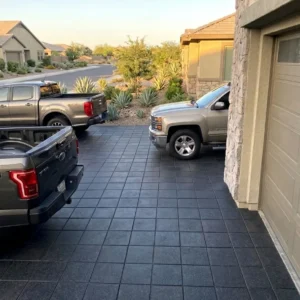
The moment a car crosses a paved surface, the specification changes. Point loads at the wheels, turning scrub from power steering and the occasional delivery van are what break units chosen for a terrace. Step the depth up, reduce the format, and increase the proportion of joints so load spreads across more units.
- Move to a noticeably thicker unit than the adjacent terrace, not the same one.
- Reduce plan size so each unit carries less bending stress.
- Use a restrained edge on every free side of the driveway.
- Detail turning circles and gate thresholds as the heaviest duty on the plot.
- Keep the falls generous so burst rainfall clears rather than ponding at the wheel tracks.
Service Routes Are Heavier Than Anyone Admits
The overlooked zone on almost every villa is the service route: the strip a septic truck, a water delivery or a construction vehicle uses long after the landscaping crew has gone. It rarely appears on the drawing as a trafficked area, and it rarely gets the depth it needs. Walk the site with the owner and trace where a heavy vehicle will actually go, including the reversing path. Specify that route at the heaviest duty on the project, even if it is only a few yards of paving, because retrofitting it later means lifting finished work. If you are still weighing options, the range of the paving depths we stock will tell you quickly what is realistic for each zone.
Format, Pallet Weight and an Eleven-Foot Draft
Format is a logistics decision here as much as a design one. Draft at South Dock is only about 11 feet and only vessels of roughly 110 TEU can berth, so everything arrives on shallow-draft feeders and barges and gets handled more times than it would in a deepwater port.
- Very large, thin formats are the most vulnerable to handling damage in transit.
- Thick units in big plan sizes build pallet weight fast, which limits lifting options on site.
- A mixed order of two or three formats often ships better than one extreme size.
- Order a modest overage so a single broken unit does not stall a whole elevation.
Bedded and Bonded, Not Dry-Laid
On exposed island terraces, a fully bedded and bonded installation outperforms a dry-laid sand-set one by a wide margin. Storm-driven water lifts and washes out loose bedding, and the good aggregates are imported anyway, so there is little saving in the sand-set route. Reinforced poured concrete is the recommended structural approach across the islands, which gives paving a sound base to bond to.
- Form and cure the slab before any stone arrives on site.
- Detail movement joints deliberately rather than leaving them to chance.
- Use non-ferrous fixings for every piece of edge restraint.
- Let the slab and the stone act as one surface under load.
Where a Denser Stone Earns Its Place
Not every zone needs the same material. Pale limestone stays cooler underfoot around pools and reads correctly against the water, while a denser, darker stone absorbs punishment better where vehicles turn and stop. Many villas end up using both, with the paler stone on the terrace and something tougher on the drive. If wheel loads dominate your project, look at denser units for wheel loads for the driveway and keep the limestone where people walk barefoot. Splitting the specification across two materials is normal here, and it reads as a deliberate design move rather than a compromise.
Specify the Depth First, Then the Face
A specification that holds up on the islands reads in a fixed order: duty, depth, format, bedding, then finish and tone. Write it that way and every later decision has a boundary to sit inside. Send the depths to your engineer, send the formats to your logistics contact, and order small samples of the shortlisted faces so the visual call is made on real material. Put the depths on the drawing rather than in an email, so nothing quietly gets substituted on site. Get the depth right and the surface keeps doing its job long after the job is handed over.