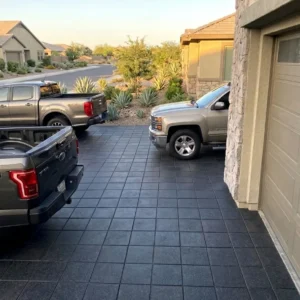
On a concrete island, stone is the finish layer
Puerto Rico builds in reinforced concrete more thoroughly than almost anywhere in the hemisphere. Houses, terrazas, marquesinas and pool decks are poured structure first, and the stone that arrives afterward is a wearing surface bonded to something already strong. That reorders the thickness conversation completely. On a mainland patio the paver often carries the load itself; here it more often protects and finishes a slab that is already carrying it. The mistake this invites is the opposite of the usual one: instead of under-specifying, buyers over-specify a heavy section for a bonded terrace and pay for the extra weight twice, once in freight and once in handling. Specify for the duty cycle at the surface and the setting method beneath, and the right number falls out without guesswork.
Foot traffic: terrazas, galleries and pool surrounds
Pedestrian areas are the island’s largest paving category by area, and they are where thinner material genuinely earns its place. Bonded to a sound slab, a thinner unit performs indefinitely and costs less to ship on a lane where weight is money. Typical pedestrian work covers:
- Roof and upper terrazas over occupied space, where dead load is genuinely constrained.
- Pool surrounds and coping runs, wet underfoot and walked barefoot every day.
- Interior-to-exterior gallery floors where one material carries through a threshold.
- Courtyards and patios inside urbanizacion lots with no vehicle access at all.
Light vehicles: marquesinas and driveways
The moment a car parks on stone, the specification changes character. Point loads from tires, turning scrub at the wheel and the occasional delivery van concentrate stress at joints and edges rather than spreading across the field. For residential vehicle areas the sensible rules are short:
- Step up in thickness rather than relying on a stronger adhesive to compensate.
- Prefer smaller units, which distribute movement across a greater number of joints.
- Treat the street apron and the transition at the conten as their own condition.
- Keep joint widths consistent so no single unit takes a wheel edge alone.
The full breakdown by unit sits on the paver thickness and format guide.
Commercial and public duty cycles
Hotel entrances, plaza work, hospital forecourts and retail thresholds run duty cycles a residential terrace never sees: service trolleys, luggage carts, night cleaning machines and the constant grind of sand tracked in from the coast. Here thickness is only half the answer. Abrasion resistance, joint durability and the ability to lift and reset a single unit without rebuilding the bay all matter as much as section depth. Access panels over services deserve the same thought, because a plaza that cannot be opened is a plaza that gets broken open. Public work also invites inspection, so material documentation should exist in the file before anyone asks for it.
Format size changes the failure mode
A large-format slab and a small sett fail in completely different ways, and that is the real reason format is a structural decision rather than a styling one:
- Large slabs bridge minor base irregularities but crack across the middle when unsupported.
- Small units follow the base closely and rarely crack, but reveal settlement as a ripple.
- Long, narrow planks are the most sensitive of all to a hollow spot beneath them.
- Mixed-size patterns absorb minor tolerance differences a single format would expose.
The practical reading is that format should answer to the quality of the base you actually have, not to the drawing you would like to publish.
Setting method decides more than thickness
On a poured island most exterior stone is mortar-set or bonded over a structural slab, and a full, void-free bed does more for longevity than an extra increment of section depth ever will. Hollow spots are the origin of most cracked units, especially under vehicles, and no thickness saves a unit sitting over air. Where a sand-set assembly is chosen instead, the edge restraint becomes the entire design, because unrestrained units migrate under turning loads. Dense, low-absorption material tolerates both methods well, and basalt paving in dense formats are a common choice where traffic is heavy and glare is unwelcome.
Edges, contenes and transitions
Failures start at edges. The pavement that survives twenty rainy seasons is almost always the one whose perimeter was detailed before the field pattern was drawn:
- Vehicle aprons want a thickened edge or a curb unit, not a field paver on its own.
- Pool coping takes a different profile and a different fixing from the deck behind it.
- Drainage channels and grates should land on a joint line, never mid-unit.
- Interior thresholds need a planned level change and a properly sealed joint.
Specify it once, correctly
The cheapest specification is the one that never needs a second container. Decide the duty cycle for each area, set thickness to that duty rather than to a single site-wide default, choose format for the base you actually have rather than the base you wish you had, and detail the edges before the field. Write the schedule down by area so the crew is not making thickness decisions with a saw in hand. Order small samples first so the client approves the surface in island light rather than from a screen. Thickness follows traffic, format follows the base, and everything else follows the edges.