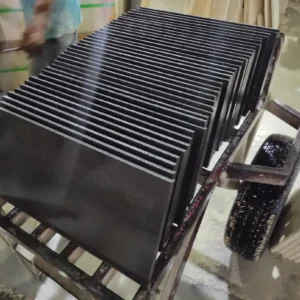
Duty Class Before Dimension
A common specification error on a mixed island project is picking one paving unit and using it everywhere. A terrace, a turning apron and a public walkway do not share a load case, and a single depth chosen for the prettiest of the three will fail in the hardest. Start by writing down what each surface actually carries: bare feet, furniture, service trolleys, a delivery van, a skip truck. Only then does the conversation about depth, format and bedding make sense, and only then can a supplier tell you which lots are worth holding for you. Written the other way round, the schedule ends up carrying one compromise everywhere instead of the right answer anywhere.
Four Duty Classes on a Dutch-Side Job
It helps to sort a mixed schedule into four duty bands:
- Pool surrounds and private terraces, where comfort underfoot and wet grip dominate.
- Villa driveways and turning aprons, where wheel loads concentrate in small areas.
- Hotel service routes and back-of-house yards, carrying trolleys, bins and delivery vehicles daily.
- Public realm around Philipsburg, where cruise arrivals passed a million passengers by 2018 and footfall is a commercial wear case rather than a residential one.
The fourth band is the easiest to underestimate. Cruise arrivals crossing Front Street and the Boardwalk along Great Bay Beach put footfall on those surfaces at a scale no private terrace has to absorb.
Format Matters as Much as Depth
Depth alone does not decide whether a unit survives. Aspect ratio matters just as much: a large, thin slab spans a soft spot in the bedding and cracks, while a smaller unit of the same thickness simply settles with the surface around it. Where vehicles turn, small units win because the torque of a turning wheel is spread across many joints rather than levering one big plate. That is why an instruction to use thicker units where vehicles turn is incomplete on its own, and a change of format alongside the change of depth is the better answer. A few working rules are worth holding on to:
- Small units spread a turning wheel load across many joints.
- Large thin slabs bridge soft spots in the bedding and then crack.
- Narrow formats follow a fall on sloping ground more forgivingly.
- Square modules keep setting out simple on open terraces.
The Bedding Decides the Depth
A paving unit is only as good as what sits beneath it, and this is where the island’s own materials do the heavy lifting. Locally produced aggregate and the concrete made from it form the sub-base and base course under an imported wearing surface. Rigid construction, with the stone bedded on a concrete slab, allows shallower units for a given load. Flexible construction over compacted aggregate asks more of the stone itself. Decide which you are building before you fix a thickness, because the two routes point to different unit depths for the same traffic:
- Rigid build-up: stone bedded on a concrete slab, shallower units acceptable.
- Flexible build-up: stone over compacted aggregate, more asked of the unit.
- Sub-base depth set by the vehicle load, not by the paving thickness.
- Edge restraint built before the field paving, never bolted on afterwards.
Where Basalt Earns Its Place
Sint Maarten’s bedrock is volcanic. Volcanic rock dominates: andesite tuff and breccia, intruded by hypabyssal basalt, with limestone and marl laid down later over the eroded volcanics. There is a documented history of aggregate quarrying here, and the rock is real. The distinction worth drawing is one of product category rather than quality: what a small island does not produce is calibrated, dimension-sawn paving in repeatable lots, gauged thicknesses and matched finishes. That is a processing and supply argument, not a claim about which rock is harder, and it is worth holding in mind when you specify setts that carry point loads over a base built from island aggregate.
Matching Into Older Buildings
If you are paving beside an older Dutch-side property, be clear about what you are matching. The surrounding fabric may be concrete, block, render or timber rather than laid stone, so establish what is actually there before the tone and texture are fixed. That is freeing rather than limiting. You are introducing a new surface, so the job is to choose a tone and a texture that sits quietly against render and painted timber, not to copy a pattern borrowed from somewhere else.
Cut, Waste and Edge Details
- Radii, steps and thresholds generate cuts, so allow for them in the order rather than the argument later.
- Edge restraint carries more load than the field paving and deserves its own specification.
- Keep a small reserve from the same lot for reinstatement after service work.
- Where two duty classes meet, change the unit at a joint line, not mid-run.
- Confirm the depths available in each format before the layout is drawn.
Write the Schedule by Surface
The cleanest way to buy paving for a mixed site is a schedule listing every surface, its duty class, its bedding type and its unit format on one line. It makes quoting faster, it makes crating tidier, and it stops the moment on site where a crew reaches for the terrace stone because the driveway crate is empty. It also gives your supplier a chance to hold matching lots across formats so tones agree across the whole property. Specify by duty first and every other decision on the job gets easier.